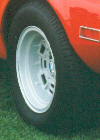
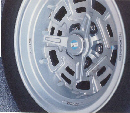
| Although most productions cars were initially delivered with 7� front wheels and 8� rear wheels, a 10� wheel was also available. In Europe the car could be factory ordered with any combination the buyer desired, in the United States, during the Ford-marketed era, (from 1971-1974) wheel width options were not available. Many 10� wheels were sold �over-the-counter� to U.S. customers during this period and later years. Note the rib is extended from the vent onto the rim portion. The additional 2� is spaced with 1� inside of the face, and 1� outside the face. In the last image, ignore the custom �knock-off�, it was installed by the owner. |
 |
 |
| There was a car model available called the �GTS�. In Europe this was a performance option package, whereas in the U.S. it was strictly an appearance package. In Europe, GTS cars often came with 8� front wheels and 10� rear wheels. This 8� and 10� sized set is a desired format, where the owner often bought a pair of 10� wheels for the rear, and move the old 8� rear wheel to the front. The current price for 10� wheels are from $1,500 to $2,000 or more, for a pair in good condition, compared to a pair of 7� and a pair of 8� wheels which can be bought for between $450 and $650 commonly for the set of 4 wheels. It has been suggested by Jack �BossWrench� DeRyke that one can run the 8� wheels on all 4 corners if one chooses not to invest in 10� Campys for the rear. |
| What drove the choice of wheels used to be appearance, or performance. Size, bigger, (meaning wider), was better, but now tire availability is crucial. The options for a 15� tire are very limited, or non-existent, when considering the factors necessary for a car as performance oriented as the Pantera. Trying to find a tire that fills the need from what is available can be almost impossible. The factors to consider are type, width, speed rating, series (sidewall height ratio), and overall height, not to mention the cost ! Naturally, tire type needs to be suitable for a performance car, not a sport utility vehicle. An important fact to consider is that tire sizes, specifically width, vary between manufactures, and even within a single company�s product line. For example, not all 245/50X15 tires are the same size. I have measured several tires that were marked the same, and was surprised to learn how much the tires differed in actual size. One company�s 265/50X15 was SMALLER than another company�s 245/50X15. So much for standards ! |
| The speed rating for the original tire was VR. With the upgrades in performance many cars have received, a speed rating of Z or ZR is appropriate. The series ratio is the height of the sidewall, as measured as a percentage of tread width. The original series was 70, giving a total rear tire height of approximately 27.1� tall. As tire widths increased, the height ratio decreased, maintaining overall tire height. Not long ago performance tires were almost exclusively 50 series, but now 45, 40 or even 35 series are common. |
| The height of the rear tire is a significant component affecting acceleration and top speed. Overall rear tire height is an integral part of the performance envelop, in conjunction with gear ratio, final drive ratio, torque, horsepower, and maximum engine RPM. If the overall tire height is reduced, top speed is reduced, and RPM is increased for a given speed. As a benefit, acceleration is increased. Conversely, if tire height is increased, top speed is increased, RPM is reduced for a given speed, and acceleration is reduced. |
| Something else to consider is that the speedometer is calibrated to the original tire height. It is not easily re-calibrated by just changing the speedometer gear drive in the transmission with one with a different number of teeth bought from your vendor of choice. Re-calibration requires installing a converter box behind the speedometer to correct for a given tire height change. You must calculate the gearing yourself, and if you change the tire height in the future, you must again make another adjustment. |
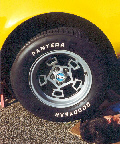
| Let�s view some tire solutions. In this first image, captured at a PCNC tech session 4/1/2000, is the Goodyear Pantera tire in 295/60ZR15. This tire is made exclusively for the Pantera and is a great choice for either the 8� (Shown) or 10� rear wheel. It is available in numerous sizes for both front and rear wheel. |
 |
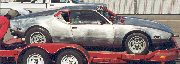
| Next we see the Euro T/As mounted on 7� front, and 8� rear wheels. These tires are �H� rated, which is a lower speed rating than I suggest. Note that the front tire, 195/50H15, looks �tiny� and the rear, in the 305/50H15 size, balloons over the wheel, a tire too large for |
 |
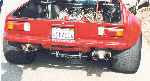
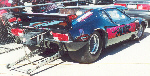
| Finally I�ll end with what I call �Monster Meats�. The first set is for �racing�, and the second set is manufactured with a street tread. Both were created for special applications. |
 |
| To learn what is CURRENTLY available in new production tires to fit our stock wheels, I suggest you visit websites like www.tirerack.com. The source of high performance tires is, or will dry up. However, many good tires are still around, either unused or used and can postpone the decision. For example, at a recent PCNC swap meet, I found 3 sets (2 front, 2 rear) of acceptable tires that changed hands very cheaply. |
| Because new performance tire availability is very limited, many owners have now changed to aftermarket wheels and tires. There are wheels available from numerous suppliers that will fulfill this need. When buying wheels, backspace or/and offset are important to avoid having the wheel or tire rub the body or suspension. At least two Pantera vendors now market wheels in 16�, 17� and soon 18� diameter that are copies of the original Campagnolo wheel design for owners that want to maintain the stock look. The design of two of these wheels are compared in another article of mine found here. |
 |
| In the next part of this story I�ll cover the advantages and disadvantages of the 16� and 17� Campy Copy wheels. Separately, I�ll cover the later (GT4, GT5, GT5-S) factory wheels and their replacements also. |
 |
 |
 |
| an 8� wheel. I can tell you from driving this car that the front was not forgiving of sharp bumps, and the rear was spongy in hard cornering. Before upgrading to 17� wheels, I planned to mount the rear tires on 10� Campys, which would help limit the sidewall flex I felt. |