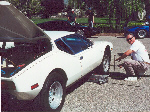
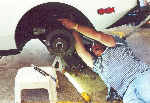
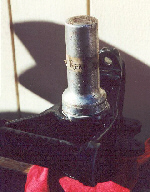
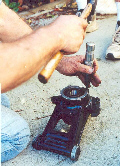
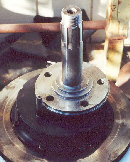
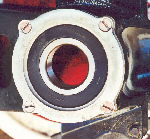
| Rod Kuneshige got his car tech inspected. We found the front bearings slightly loose, but that was not the only issue. The radiator overflow line was routed to dump excess coolant right in front of the rear tire, but this was an easy fix. The larger �save� was that his left rear bearing had failed. One advantage of the club event is getting an examination by several experienced mechanics. The car was moved into the next available bay, and Jack Bartole jumped into the task, pulling the effected parts, and leading the repair. I joked with Rod, saying that if wants to work on his own car, he had better elbow his way into the action and fast. I could not stand back far enough to get a good picture of the 12 people standing around ! |
 |
 |
 |
 |
 |
 |
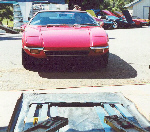
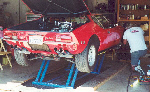
| While Rod was making rapid progress in the other bay, another car takes the rack. |
 |
 |
 |
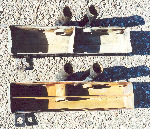
| Guy Dellavecchia displayed two types of the radiator baffle. The end tank with the horizontal baffle became known for breaking loose. This failure caused the coolant to return to the engine without going thru the radiator, which caused the car to overheat. This design, when it worked, ran the coolant thru � the radiator then back through the other half (separated top and bottom), while the vertical baffle design has the coolant pass through the full front half of the radiator fin area, then back via the back half. This design has the radiator be less efficient, as the second half (behind the front half) gets less cool because the air has already had some heat exchanged as it went through the front half. |
 |
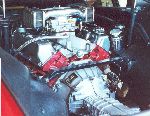
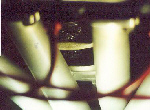
| In this close-up image, look thru the header tubes, at the non-rubber motor mount insulator, you can see that the insulator has not withstood the heat from the header. Some polyurethane insulators are advertised as being heat resistant. It is suggested that rubber mounts be used to better dampen engine vibration and resist heat damage. |
 |