
Major Sabbats occur at the peak or midpoint of the four seasons. These Sabbats originated from the Celtic harvest festivals which were religious, agricultural holidays.
The Minor Sabbats occur at the beginning of each season. These are marked by astronomical events (when the sun enters a certain astrological sign). The Minor Sabbats came from Roman holidays which were integrated into the Celtic calendar after the Roman occupation of Northern Europe and the British Isles.
In common with many ancient people, many Pagans feel that the holiday begins at sundown the day before the actual date of the event and ends at sundown the following day. So, for example, Samhain starts at dusk on the 30th of Oct, ending the evening of the 1st of Nov.
The Sabbats are generally felt to be a time for the entire community or families to gather together, give thanks, celebrate and be merry. A symbolic ceremony is held to mark how the changing seasons reflect our changing lives.
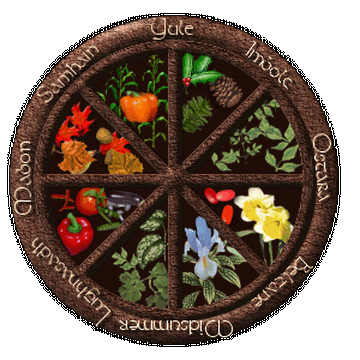
The celebration of the winter solstice, the shortest day of the year. It is the celebration rebirth of the Sun, which is the promise of spring and life even on this the darkest day.
The burning of the log is to give the Sun strength. Mumming (plays) such as "St. George" is a Pagan survival.
The Roman festival of the Solstice was Saturnalia, which lasted from December 17th to the 24th.
More on Yule
IMBOLC February 2nd:
February is a purifactory month, bonfires are held now. In the Christian calendar this festival was converted to the Feast of the Purification of the Virgin (Mary). Candles for the following year were purified in the western church - therefore we get the name Candlemas.
More on Imbolc
OSTARA March 21st:
The celebration of the Vernal (Spring) Equinox. Day & Night are equal length. It is a time for planting and celebrating the first signs of fertility and rebirth. Symbols of Ostara like eggs, chicks, and rabbits have been adopted by Christians in their Easter holiday. The word, Easter is from the goddess Eostra, Ishtar or Astarte.
More on Ostara
BELTAINE May 1st:
May Day. Beltane celebrates the Marriage of the Goddess and the God, the Goddess is thought to conceive the Divine Child at this time, to which she will give birth to at Yule. The maypole dance is symbolic of the union of the Goddess and the God . Pagan Handfastings occur at this time. Also this is an excellent holiday to perform sex magick .
More on Beltaine
MIDSUMMER June 21st:
The Summer Solstice a celebration in honor of the Sun-God . The traditional Pagan activity of Midsummer is to leap across bonfires to promote fertility of animals and crops.
More on Midsummer
LUGHNASADH August 1st:
Also known as Lammas, this is the first of the three Harvest festivals. The first fruits of the annual harvest are reaped, and the days grow shorter.
More on Lammas
MABON September 21st:
The Autumnal Equinox, is the second of the Harvest holidays. Mabon is a time to recognize what we have and to begin preparing for the coming winter.
More on Mabon
SAMHAIN October 31st:
The third of the Harvest holidays, the ending of the cycle, death, but with the hope of rebirth and the New Year.The traditional time for the annual slaughter to ensure food throughout the winter months.
Take this time to remember departed ones.
The separation between this physical world and the spiritworld is thin. Halloween customs are a part of this element of death, the thin line at this cycle and remembering the dead and the hopes of rebirth. On this night Magick is more powerful .
More on Samhain