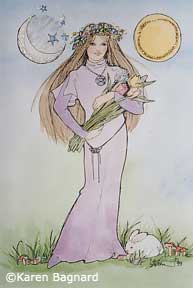
Also called: Lady Day, Alban Eiler (Druidic), Spring Equinox, Vernal Equinox, Summer Finding (Asatru), Festival of Trees, Rites of Spring
Date: On or around March 21
Ostara is a fertility festival celebrating the birth of Spring and the reawakening of life from the Earth. At the moment of the Vernal Equinox night and day stand in perfect balance, with light on the increase The energies of Nature subtly shift from the sluggishness of Winter to the exuberant expansion of Spring. It is a time of great fertility, new growth, and newborn animals.
Traditionally, Ostara is a time for collecting wildflowers, walking in nature's beauty and cultivating herb gardens. This is the time to free yourself from anything in the past that is holding you back. At this time we think of renewing ourselves. We renew our thoughts, our dreams, and our aspirations. We think of renewing our relationships. This is an excellent time of year to begin anything new or to completely revitalize something. This is also an excellent month for prosperity rituals or rituals that have anything to do with growth.
New Year
In many traditions, this is the start of the New Year.
The Roman year began on the ides of March (15th).
The astrological year begins on the equinox when the moon moves into the first sign of the Zodiac, Aries, the Ram.
The Greek God Ares is equivalent to the Roman Mars for whom the month of March is named.
Between the 12th century and 1752, March 25th was the day the year changed in England and Ireland. (March 25, 1212 was the day after March 24, 1211.)
Resurrection
We celebrate the renewal of life as seen by the newly emerging life in many forms all around us. A resurrection from all that looks dead is seen as the Earth regenerates and renews herself. This is symbolized in resurrection myths in many cultures and traditions.
Eggs
Many of the myths hold that the egg is sacred to life on earth. It represents life just as a circle can represent eternal life. The golden orb of its yolk represents the Sun God, its white shell is seen as the White Goddess, and the whole is a symbol of rebirth.
Germanic lore states that the rabbit so loved and revered the Goddess that he laid eggs, decorated them beautifully, and presented the eggs to the Goddess as a gift. Eostre was so delighted with the gift that she wished all people could experience her joy. In order to further please his beloved Lady, the rabbit roamed the world delivering the sacred eggs to humanity.
One of the Goddess Eostre's chief symbols was the egg (representing the cosmic egg of creation).
During the Middle Ages people not only gave up meat for Lent but also eggs. It was a very precious gift to be given an egg for Easter because of harsh winters making food scarce. Children would often go from house to house to beg for Easter Eggs.
In ancient days, eggs were gathered and used for the creation of talismans and also ritually eaten. The gathering of different colored eggs from the nests of a variety of birds is thought to have given rise to two traditions still observed today - the Easter egg hunt, and coloring eggs in imitation of the various pastel colors of wild birds.
Gardens/Seeds/ Planting
The Spring Equinox is a time of new beginnings, of action, of planting seeds for future grains, and of tending gardens. Spring is a time of the Earth's renewal, a rousing of nature after the cold sleep of winter.Seeds are like eggs. While eggs contain the promise of new animal life, seeds hold the potential of a new plant.
In ancient Italy in the spring, women planted gardens of Adonis. They filled urns with grain seeds, kept the in the dark and watered them every two days.
Fires
Easter Fires were one of the ways pagans celebrated the coming of spring. They called these fires Spring fires. Until 752 A.D these fires were forbidden by the Christian laws. It was St. Patrick who gave rebirth to these fires as Easter Fires. The people would gather outside the church on Easter Eve and light a fire.
Before they returned home each person would light a stick from the fire and take it home with them. All the flames in the house would come from that fire.
The meaning behind these fires is "Life and light triumph over death and darkness.
Cakes or Hot cross buns
A wheaten cake marked with a cross was found in Herculaneum, preserved since 79, and may have been used in the spring rites.
It is believed that Hot Cross Buns came from the Anglo-Saxons to honor the goddess of springtime, Eostre. After the Anglo-Saxons were converted to Christians the continued to make these pastries.
Baskets and goodies
It is believed that humankind first got the idea of weaving baskets from watching birds weave nests. This is perhaps the origin of the association between colored Easter eggs and Easter baskets.
The Easter basket filled with its myriad of goodies originates from the ancient Catholic custom of taking the food for Easter dinner to mass to be blessed. This, too, mirrored the even more ancient ritual of bringing the first crops and seedlings to the temple to insure a good growing season.
It is customary to leave food and drink out for the fairies on the nights of festivals, and it is believed that if the fairies are not honored with gifts at these times, they will work mischief in our lives. At Ostara, it is customary to leave something sweet (honey, or mead, or candy)and this could be connected to the Easter basket tradition. Perhaps a gift of sweets corresponds to the sweet nectar gathering in new spring flowers.
Lambs
The astrological sign of Aries (denoted by a lamb or sheep symbol) begins at this time
Sheep who have given birth around Imbolc have lambs that are large enough for slaughter. This was important to ancient herders since it was a time of year when the larders were basically empty.
Chicks and Ducklings
Left under natural light and allowed sunshine, the laying pattern of hens and ducks will follow the yearly day length. This means it will slack off in the fall, stopping entirely at Yule when the days are darkest. The laying will again starting in late February or early March. This means by the equinox the egg production is in full swing and many tiny new lives have hatched out.
Rabbits
One of the Goddess Eostre's symbols was the bunny which symbolized for fertility and because the Ancient Ones who worshipped her often saw the image of a rabbit in the full moon.
The rabbit is an enduring symbol of fertility and desire, or "spring fever" and worldwide, rabbits or hares co-exist with the moon as sacred symbols of vitality, fertility and the life-force. A rabbit's gestation period is approximately one month, and it tends to be the first animal to give birth in the springtime
Some of rabbit lore springs from incorrect superstition. But underneath the superstition lies a deeper core of pagan sacral belief in which symbols of sex, fertility, the moon, re-birth and renewal are intertwined.
The saying, "mad as a March (or marsh) hare" is attributed to 15th Century Erasmus, who was referring to either the animals' vigorous mating displays, or their bouts of wild bounding over wetlands in the springtime.
During the Renaissance, rabbits were even considered to be able to conceive without the male, and so they became a symbol of the Madonna's virgin birth. A 16th Century painting by Titian shows Mary clutching a white rabbit, illustrating purity and a control of sexuality. The rabbit had become an important symbol of docility, gentleness and submission: qualities the church particularly wished to encourage in its followers.
Less evident today is the ancient symbolism connecting rabbits to women, blood cycles and the moon, although contemporary Asian images often depict rabbits with a traditional sense of womanly grace and stillness. Nevertheless, rabbits have become an enduring symbol for the beginning of springtime at Easter, and are worth considering for their deeper symbolism when we celebrate Ostara.