The Golden Ratio
The Golden
Ratio is an ancient proportion of a shorter length to a longer one.
While it was employed by the Egyptians as early as second millennium B.C.E.
(Before the Current Era), It was with the classical Greeks that it found
its highest expression. Jay Hambridge's stunning analysis of the
Parthenon, a fifth century temple designed by Calicrates, Ictinus and Phidias
and dedicated to Pallas Athena that dominates the acropolis (define)
in Athens, leaves no doubt that this proportion is the motif underlying
the beauty of this most beautiful edifice of human expression.
The beauty of the Golden Ratio lies in the dynamic relationship between
its two parts. The longer part dominates the pair but the shorter
asserts itself against it in a delicate shifting balance. The eye
measures and compares the two distances which seem to shift in the process.
Also there is deep intellectual satisfaction in seeing an unequal, yet
complementary, pair where the lesser is to the greater as the greater is
to the whole.
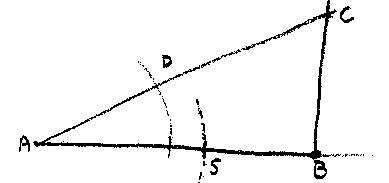
To divide a given line into the Golden Ratio, one needs only a string
and straight edge.
Let AB be any length line. Construct a perpendicular at B. Mark C at
half of AB. Draw AC. Mark D at half of AB. Measuring from A, mark
S at CD. S is the division of AB into the Golden Ratio.
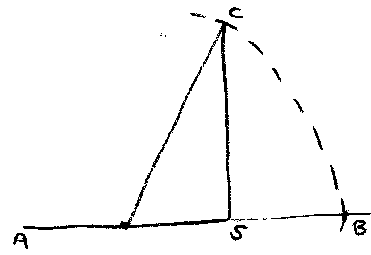 To extend a line AS so that it becomes the larger of the Golden Ratio pair,
construct a perpendicular at S whose height C is equal to AS. Strike
an arc from the midpoint of AS thru C to B. S is the division of
AB into the Golden Ratio.
To extend a line AS so that it becomes the larger of the Golden Ratio pair,
construct a perpendicular at S whose height C is equal to AS. Strike
an arc from the midpoint of AS thru C to B. S is the division of
AB into the Golden Ratio.
Test
your sensitivity to the Golden Mean.
Dr. Knott's exhaustive
page on the Fibonaci numbers and the Golden Mean.