
Dream up a fantasy.. It need not be sincere or limited by reality. Be
creative. Be inventive.
Using images cut from magazines or other sources, assemble a collage
that relates to your fantasy. It's not necessary to illustrate it. Your
creation only has to relate to it. It may do this in any way you wish.
Try to make it visually interesting. It may be any size.
Rubber cement used in the frisket technique is recommended for its
"undo" property and unique clean-up behavior. But it is a nasty, temporary
adhesive that eventually stains paper as it fails to adhere with the passage
of time. Polymer acrylic medium is a stable material that can be used as
a glue in permanent artworks.
Do only three of the four following assignments!
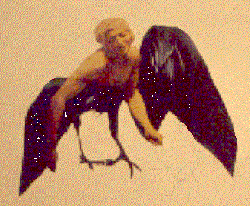
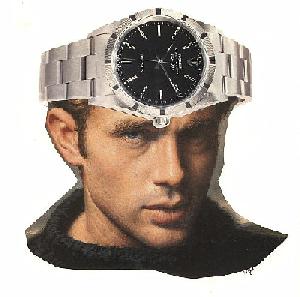
Marat Bird (1998) anon. Watch
Head (1999) Anon.
1. Juxtaposition:
Putting two things together that don't normally go together, for expressive purposes is a technique employed by creative artists in all disciplines, not just the visual arts. Collage is an medium ideally suited to explore the possibilities of juxtaposition.
Do This (1 hour):
Create at least five examples of juxtaposition on separate, suitably
sized (use your scissors or knife to crop, or the paper-cutter in the classroom.).
Titles are a creative opportunity but are not required.
(click here for more examples)
2. Concrete Poetry:
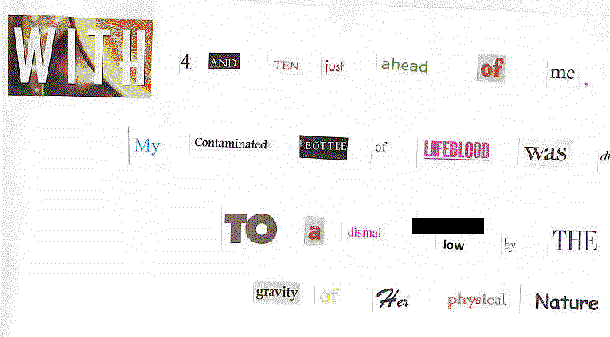
"With 4 and 10 years ahead of me, My contaminated bottle of lifeblood
was down to a dismal new low by the gravity of her physical nature."
by student Steve Dunham
Words may be treated as real physical objects capable of expressions of "thingness" in addition to their usual role as symbols of sounds and meanings . The following exercise asks you to use them as you might use found objects as if you were beach combing materials for a sculpture. Collect enough interesting parts, then find a way to put them together.
Do This (1.5 hour)
Cut out of magazines, newspapers or other printed matter at least 150
words and short phrases. Try to collect an assortment including a variety
of parts of speech i.e. verbs, nouns and modifiers.
Assemble them into more or less grammatically correct sentences. Strive
for poetry. It's not necessary that it rhyme, but it's nice if it's funny,
shocking, profound, sad, angry or otherwise beautiful.
(click here for Nanette Wylde's
"Postmodern Conditions,
Contemporary Tales".
Do This (1.5 hour)
Make a collage of flat material from any source that is about color,
shape, pattern and/or texture and is about NOTHING ELSE.. No easily recognized
objects, no subjects, no symbols, no words.
Let the collage be about formal issues.
Do This (1.5 hour)
Make a collage that illustrates (relates to, in some way) a work of
literature, music or other , intellectual opus or political, social idea.
Next assignment (Point)
Design Class Home Page.
Macomb Community College.
Jim Pallas Homepage.