 |
|
|
|
|
|
|
|
|
|
|
|
|
|
|
|
|
|
|
|
|
|
|
|
|
|
|
|
|
|
|
|
|
|
|
|
|
|
Professor Hicks' Foundation Studies Page |
|
|
|
Below are a couple of links that I hope you will find beneficial and the handouts that I have mentioned previously. Please note that the last "handout" discusses the use of a view-finder. If we do not dicuss this during the second class it will be discussed in the third. |
|
|
|
Drawing Basics #1 |
|
Drawing Basics #2 |
|
|
|
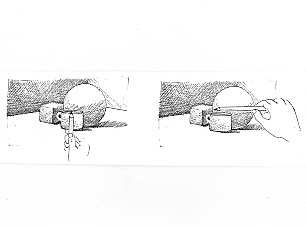
A pencil can be used as a sighting device to measure the height and width of objects, as well as the distance between those objects. Holding your pencil verically, extend your arm straight out. Close one eye and align the tip of your pencil with the top of the object to be drawn. Place your thumb on the pencil where the base of the object ends. Without moving your thumb, turn the pencil to a horizontal position. Now align the tip of your pencil with the outside edge of the object. By doing this you can compare the relative height and width relationship of an object. |
|
|
 |
|
|
|
|
|
 |
|
|
|
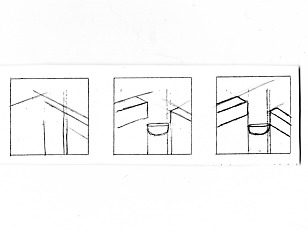
"Blocking Out" or "Mapping Out" a drawing is a technique that can help artist more accurately deal with the spatial and proportional relationships between the objects and the format of the work. This process requires careful analysis of the dominant linear elements. |
|
|
|
|
|
 |
|
|
|
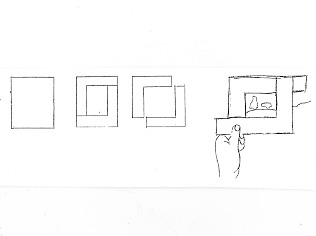
A viewfinder is used to help artists visualize the format within which they wish to work and the overall composition as it relates to positive and negative area. |
|
|
|
|
|
 |
|
|
|
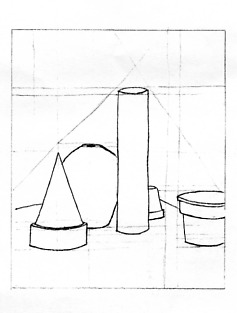
These techniques can be comnbined to establish the basic structure of a drawing. Notice how all lines are recorded in this example. |
|
|
|
|
|
Note: The lines in this image are exaggerated. Your under drawing should be very light. You should use a 2H pencil |
|
|
|
|
|
 |
|
|
<<<Turn Page |
|
|
Turn Page>>> |
|
|
|
|
|
 |
|
|
|

|
|
|
|