 |
|
|
|
|
|
|
|
|
|
|
|
|
|
|
|
|
|
|
|
|
|
|
|
|
 |
|
|
|
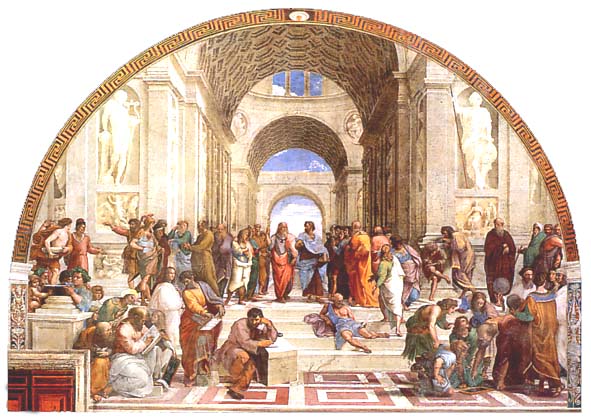
The School of Athens - Rapheal |
|
|
|
Linear Perspective is a system that is used to create the illusion of three-dimensional depth on a two-dimensional surface. It was developed during the Renaissance by the Italian architect Fillippo Brunelleschi (1377 - 1446) around 1420 BCE. The directions for employing this system were first documented i 1436 BCE by the Italian painter and architect Leon Battista Alberti in his treatise On Painting. |
|
|
|
The mechanics of linear perspective require that certian rules be applied to achieve a believable illusion...
ONE POINT LINEAR PERSPECTIVE adheres to these three rules:
1) All lines which are parallel vertically or horizontally to the picture plan are constant.
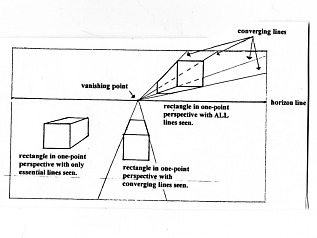
2) Those lines which are not parallel, horizontally or vertically to the picture plane, recede to the degree that they converge at a point on the horizon/eye-level line called the vanashing point.
3) All vanishing points must be located on the horizon line.
|
|
|
|
 |
|
|
|
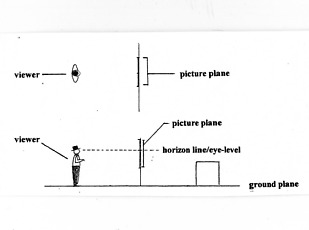
In the diagram to the left the viewer is depicted looking through the picture plane at a box placed on the ground plane. |
|
|
|
|
|
 |
|
|
|
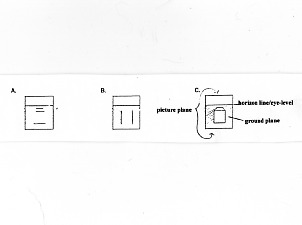
Examples A and B, in the diagram on the left, illustrates the first rule of one-point perspective. Example C completes the drawing and illustrate the second rule of one point-perspective. |
|
|
|
|
|
 |
|
|
|
<<< Turn Page |
|
Turn Page >>> |
|
|
|

|
|
|
|
|