
Discussion of the syllabus and materials/Pretest
Class Two - 8 Jan
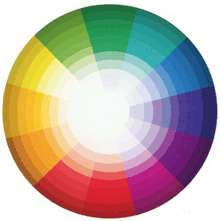
Introduction of the Traditional Color Wheel and the Munsell Color Wheel/ In-class work - We will establish both color wheels. These color wheels are intended to be the "standard" on which other color schemes will be based.
Class Three - 13 Jan
Todays class will center around establishing a value scale and tint and shade scales for the primary and secondary colors.
Class Four - 15 Jan
We will continue the establishment of the tint and shade scales. This will be followed by the creation of chromatic grays and three saturation scales.
fashion design, and illustration.
The Traditional Color Wheel is employed by artist and designers. It consists of 12 colors. 3 primaries, 3 secondaries and 6 tertiary colors.
There are Three Aspects of Color. These are: Color Physics and Perception which deals the science of light and the physiology of how the human eyes percieve light and thus color; The Psychological which involves the reaction to, and uses of, color by humans; and The Chemical which deals with pigments, dyes, inks and electronic media.
Pigment - a colored powder.
Binder - That which stablizes the the pigment and holds it together in a liquid form. For Example the binder in oil paint is linseed oil, in acrylics the binder is acrylic polymer, in watercolor it is water and in guoache the binder is gum arabic.
Vehicle - That which disperses the pigment. The vehicle is used to thin paint or ink and is also used in the cleanup of those materials also. For example the vehicle in oil paint is paint thinner or mineral spirits (solvents), in watercolor, acrylics and guoache the vehicle is water.
Hue - refers to the colors base root and to specific, pure spectral hues from the color wheel and also refers to any wavelength from the Electromagnetic Spectrum.
Color - any variation of a hue or neutral.
Local Color - the general color of an object under normal lighting conditions.
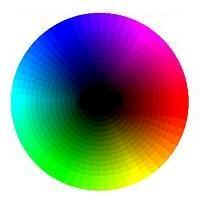
Primary Colors - hues that can not be obtained by any other color mixtures. These are Red, Yellow and Blue in Subtractive Color Mixing. The Primaries of Additive Color Mixing are Red, Blue and Green
Secondary Colors - Are achieved by mixing two primary colors together.
Tertiary Colors - Are achieved by mixing one primary color with a secondary color.

