|
|
|
|||||

 |
SOLAR COOKER FOR SUSTAINABLE LIVING By S.Narayanaswamy |
||||||
|
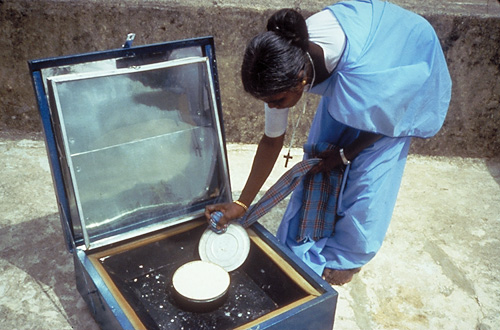
I have been using a solar cooker for about 12 years. I am an ardent admirer of the solar cooker. No day would pass by without the solar cooker being wheeled out on its caster wheels to do its job unless the weather is bad. My wife tells me that years ago in the 1980s in Delhi, where we were then, she mentioned to me about a neighbour of ours using a solar cooker and why not we. It appears I pooh poohed the idea. So it comes as no surprise to me that people either do not know about the solar cooker or even if they have heard about it do not think it is a workable proposition. In our home the solar cooker is the default cooking appliance. When it cannot be used we turn to the gas stove. My wife and I like solar cooking for its own sake. It is enjoyable and convenient and also saves energy. The food comes out much better in it. It preserves the nutrition better. We have not taken to it only because we must save energy. Nor is it a case of putting up with some discomfort in order to save some energy. We have taken to it because solar cooking is physically less demanding. My wife finds it more arduous to stand in front of the gas stove straining to regulate the gas and see that the food does not boil over or catch at the bottom and respond to the whistles of the pressure cooker appropriately and generally be around in the kitchen on her legs for a couple of hours or so. Visit to the kitchen is not a one time stint in a day. Several visits are required. With the solar cooker she can load up to four or five items in as many boxes when the sun is up and she is free to attend to her other chores without a concern. With two cookers we even boil our water needs and we can even cook for the night or for the next day and keep in the fridge if necessary. She is so used to the solar cooker that she is positively unhappy when she cannot cook on a certain day because of rain or cloud cover. She then blames the solar cooker because she has to revert to conventional cooking instead of being thankful for the days she could cook in the solar cooker! This is the typical response of one who gets used to a convenience. you curse the convenience rather than the lack of it before. Why is it that in this country of bright people a country with the largest scientific manpower a country which has several premier technical and management institutions and national laboratories no one has advocated solar energy for cooking seriously? Yes, we have a full-fledged Ministry of Non-Conventional Energy (MNES). They did make a serious effort to popularise the solar cooker many years ago. But they gave it up, all too easily, as something which is not accepted by the people. They are gamely persisting with Adtiya Shops and State Nodal Agencies where, they say,cookers are sold, but it is more in name than in reality in many places. They keep writing in their annual reports, year after year, that more than 4,87,000 cookers have been sold and keep adding a few thousands every year and publishing the cumulative total. Much of this impressive number represents the sales made in the heady days of the late eighties and early nineties. Many of the manufacturers who set up production cannot sustain their costs at the current demand, any longer, and have diversified into other related lines. The solar cooker is made only in a few states in India about six or seven states. This is a sad development. Equally unhelpful has been the views of some energy experts who seem have come to a conclusion that rural energy must necessarily mean biogas or biomass energy. In India, in the household sector, the bulk of energy is spent on cooking. Although in the urban households, there is a gradual shift from fuelwood to LPG (liquefied petroleum gas), 32.7% (as per 1991 census) of the urban poor still use fuelwood. According to 1991 census, about 30% of urban population uses gas and another 30% uses firewood and chips, whereas in rural sector, about 78% of the population rely on firewood and chips. As per the NCAER (National Council of Applied Economic Research) survey conducted in 1978/79, cooking accounted for 85.2% of the total energy consumed in the rural domestic sector. The women in rural India, especially the poor have to trudge long distances to forage for scraps of firewood. All of us agree that the poor rural womenfolk must be emancipated from this drudgery. It needs no reiteration that the abatement of pollution resulting from the burning of wood and protection of trees from indiscriminate cutting are equally important considerations. Dr. Amulya K.N.Reddy has written (Economic and Political Weekly, December 4, 1999) to say that the specific strategies that would advance the goal of sustainable rural development are: --the reduction of arduous human labour (especially the labour of women) for domestic activities and agriculture; the modernisation of biomass as a modern energy source in efficient devices; the transformation of cooking into a safe, healthy and less unpleasant end-use activity; the provision of safe water for domestic requirements; the electrification of all homes (not merely villages); and the provision of energy for income-generating activities in households, farms and village industries. He feels that the thrust must be on energy sources and devices that are renewable, biomass-based, universally accessible, affordable, reliable, high quality and safe. He goes on to observe thus: "Specialised agencies responsible for biomass energy and rural energy are absent in India. Only renewable energy has been given political approval through the formation of a ministry of non-conventional energy sources. But, it is easy to see that, particularly when the efforts are guided by market forces, an emphasis on renewable energy can be restricted to technologies that cater to urban energy demands and/or centralised biomass energy. The rural poor are too weak economically to articulate their needs as market demand. Thus, it appears that the ministry of non-conventional energy sources cannot give rural energy the special attention and emphasis that it deserves. Rural energy requires the co-ordinated effort of several ministries including rural development, power, petroleum, etc, in addition to the ministry of non-conventional energy sources. New institutional arrangements are required such as an inter-ministerial task force." Even for the short run for cooking this is what he advocates: "The predominant fuel in rural areas being biomass, particularly fuelwood and agricultural crop residues a switch to stoves and furnaces fuelled with biogas, producer gas, natural gas and LPG is an obvious next step. But, modern LPG-like fuels derived from biomass, so-called biofuels, syngas in general and dimethyl ether (DME) in particular, may be the medium-and long-term answer." In his articles referred to above Dr Reddy is so focussed on taking a comprehensive view of the rural energy problem and on the need to provide energy services rather than satisfying specific items of energy consumption, based entirely on biomass as the source (the DEFENDUS - -Development-focused end-use-oriented service-directed -- paradigm) that he does not even mention the solar cooker as an option that one could consider even for a part alleviation of the cooking problem in the rural sector . Obviously the solar cooker cannot provide the electrical energy for village industries. But if it can provide the energy for cooking can it not be looked at? Without asking for a drastic overhaul of the governmental machinery cannot a modicum of relief be provided? As for the urban scenario nobody has any qualms, for LPG is there for the asking. Graduating from kerosene to LPG is seen as a status symbol. People strain their finances to be able to afford the initial payment for the stove and deposit for the cylinder. After the initial euphoria = has gone they look at the realities. The price of LPG for domestic use is Rs.17/kg while for commercial use i.e.without subsidy it is Rs.27. It is clear that the burden on government posed by subsidies of all kinds and the increasing trend in the price of oil will see a progression towards increased prices for LPG. The year 2000, when crude prices went past $ 30 a barrel and even hovered around $ 35 is a pointer of things to come. We cannot take for granted that we will have assured oil supply at low prices for all time to come. And we are importing 70% of our oil requirements. The gas bills for an average household is considerable. Surely the solar cooker can come handy in this urban scenario also.
A TERI report goes on to say : "Much analysis has been done on why the rural energy problem stays unabated despite the vast amounts of resources invested. In most cases, the answers lie with the people who, unfortunately, have not been made part of programme planning and implementation. Though decentralized planning was encouraged through programmes such as Urjagram and the Integrated Rural Energy Programme, they could not become workable models largely because they did not envisage any role for the local communities. Perhaps what contributed the most to this is the fact that there has been no change, whatsoever, in the strategy for planning and implementing rural and renewable energy programmes since their inception". Not involving local communities is a failure of implementation and not of technology. Other than improved chulhas and biogas nothing worthwhile has been done to reform the cooking sector in the last 50 years. Improved Chulha still depends on firewood for fuel, firewood which we should cease to use to the extent possible. Biogas can only be a success in a cooperative effort. Individual villagers, especially the poor, do not own so may heads of cattle or have such a lot of agricultural waste that they can have a viable and cheap biogas plant. Cooperative effort as Dr.Amulya Reddy has demonstrated in the Pura Biogas model, in a community of some 450 people, is fine but it is not easy. It is almost 10 years since the Pura project was started and it had its teething problems. Only hard work and sustained effort, and the introduction of a dual fuel engine could revive it. Karnataka is bravely going ahead with the suTRA projects ( Bio-energy for Sustainable Transformation of Rural Areas) project. One wishes it all success. But one cannot therefore conclude that pursuit of the DEFENDUS model should foreclose other energy options for cooking needs even in the interim. Especially in communities where bovine population is scarce and in communities who live in scattered homesteads as in Kerala it would be difficult to make a success of biogas programmes. Whenever solar energy is touched upon in the context of a discussion on rural energy what is brought up as a breakthrough is the photovoltaic system and solar water heating system. This is totally unreal as the rural poor are not so desperately short of energy for lighting as they are for fuel for cooking. The rural villager is not dying for want of hot water for taking a bath. Modern biomass systems and wind energy are wonderful inventions. They are indeed relevant as sources of energy for certain decentralised uses but they are costly and require considerable infrastructural work and organisational planning to deliver in a rural set up; even then they can only be used in a cooperative frame work. On the other hand the solar cooker is directed at the individual household. All that need to be done is to reach it to the individual user, demonstrate its capabilities in a patient way and convince the people that it can save their energy bill to an extent, mitigate the drudgery in the kitchen whether it be gas or fuelwood and above all save the daily grind in search of firewood for the village womefolk. It is conceded that only those homes in which access to the sun is conveniently possible can make a success of the solar cooker. But at least such homes should be identified and an attempt made to sell the idea of solar cooking. Another TERI study makes this remark: "The failure of many rural and renewable energy programmes to meet the expectations of the people has had several adverse effects. Rural people are often apprehensive about whether renewable technologies can actually work in the field. Even the mature technologies fail to perform satisfactorily in the field due to lack of repair and maintenance services, quality control, user education and training, etc. But these aspects are still not given their due in programme planning. An even bigger challenge is to find ways in which the programmes can be made more sensitive to the sociocultural reality in which they have to function." Such remarks are more applicable to more complex technologies like the photovoltaics, wind energy, biogas and hydro power where factory made equipments have to set up and operated and maintained, often in common for a community There will be wear and tear of equipment needing major repair facilities and these will be beyond the capabilities of the rural resource system. Not so with the solar cooker. The solar cooker is the most decentralised and compact system possible. One can use it in a place cut off from the outside world - indeed in Kargil where our Jawans are using it. It does not require any infrastructural support nor does it need cooperative action on the part of a community. An individual can make an individual choice to adopt the solar cooker. It is a compact box, which looks just like a suit case one takes for travel and requires hardly any more maintenance than a suit case does. It is light to carry. It has no moving parts no tubes or nozzles sticking out. It has no installation problems. If one can invest Rs.1500 in a cooker one can start cooking the very same day. Its cost can be recovered in 1 - 2 years and it can go on serving for another 10 years and more. It is a lifetime asset. The flip side is that
1. It requires sunshine for it to work None of these is really such a problem that should force one to give up the solar option. If the solar cooker cannot be used for 365 days in a year because it is cloudy or raining on some days, so be it. One is not ruined. One doesn't have to worry about the heavy depreciation of a costly asset. You just save fuel to the extent you use the cooker. After all the solar cooker is only a supplementary appliance. On the days you cannot use it you can go back to your conventional stove and preferably use it conjunction with a thermal box to save on the fossil fuel consumption (A thermal box or retained heat cooker is one by which you can let food to cook by its own retained heat in an insulated box. A Kerala based NGO has distributed 1 lakh cookers costing only Rs.175 per piece in one year. I use one of these and it comes very handy when there is no sun). People who swear by Photovoltaics ( for lighting; not for cooking) forget that this system also works only when there is direct sunshine -- a solar cooker can at least make some use of diffuse sunshine but not a Photovoltaic system. The mental adjustment required to cook outside of the kitchen might be an initial barrier. But the Indian villager is intelligent enough to realise that if a cooker will effect saving for him on a consistent basis and when he looks at the full package of virtues the solar cooker brings with it he will be willing for some give and take. As for the accusation that it is slow to cook and cannot do certain jobs there is some substance. It cannot do jobs like frying in oil nor can it be used to make "chapattis." The food that most people normally eat is boiled and only the tempering operation with condiments is done in oil requiring high heat. Luckily this is an operation that only takes some minutes. It is a finishing operation and can be done over the regular oven just before you eat. For me dishes which involve considerable amount of frying in oil are best avoided but if they have to be made only a conventional oven can make them. But for the poorer sections of society such fried foods are not what they eat. In that sense the solar cooker will not fall short of their requirements. It is also true that the solar cooker cannot cook as fast a conventional stove. But side by side it has to be said that there are some advantages for such slow cooking. The first is that it preserves the nutrition better. Second, you can "load-and-forget" -- you can set up the cooker and it will quietly do its job without your having to be at hand to stir the food and see it does not burn or catch at the bottom. The housewife's attention does not have to be riveted on the stove ; she can be relaxed and attend to other chores. For jobs such as roasting (nuts etc) it is ideal. It also doubles up as a hot-case. The food remains hot even if left longer than really necessary and you can return to the cooker when it is time to eat without having to reheat it. Thus the advantages with the solar cooker are many. It is really to be seen as an oven kept permanently switched on. You can place any item to be cooked inside and take it out when done. You can easily do two rounds of cooking in a day. The point is conceded that for households, where the routine is such that cooking would have to be done early in the morning before the sun is up or late in the day after the sun is down, or when food has to be made at short notice the solar cooker would not work. But such is not the routine in the bulk of the homes across the country. Let not such special households hold up the progress of the entire country.
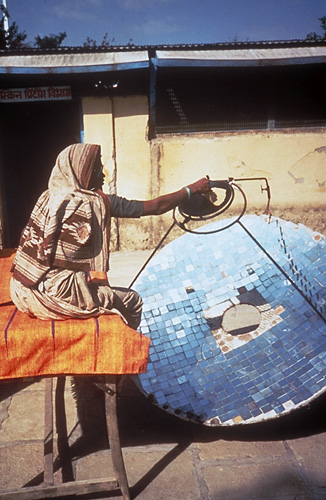
It looks as though we cannot capture all the good aspects in one appliance, in one method. The same Catch-22 situation is true of another variation of the solar box cooker in which there are reflecting panels all round the box, quicker cooking but requiring closer attention. Such ovens are commercially available in U.S.A. The best design option seems to be the simple box cooker with optional extra reflective panels so that for operations requiring stronger heat, such as for baking bread, you can attach the extra panels. The tragedy has been that the solar programme which was launched with much fanfare 15 years ago backed by Central subsidy was allowed to fall by the wayside after the subsidy was discontinued in 1994. It has now to fend for itself. Many manufacturing units which came up have had to face closure because of inadequate demand. It is being made only in a few states in the country. There has to be a persistent effort, over a long period, to popularise the solar cooker which a new technology such as it represents will need to take root. It has to be held aloft as the one programme which is affordable to the common man and held aloft for long. It is this patient and dedicated effort that has been sadly lacking. The failure to persist with a proven technology like the solar cooker for the necessary length of time has led to premature conclusions such as the following drawn from one of the TERI reports: "The present supply-demand scenario indicates that biomass would continue to be the mainstay of the rural energy sector in the foreseeable future The principal thrust of any meaningful rural energy policy is to shift from the present traditional biomass technologies to efficient biomass technologies which provide greater energy service with same resource. While a number of technologies are available for meeting rural energy requirements, some of them need to be developed further to attain techno-economic viability. The penetration of various commercial fuels will remain quite low, and at the present rate, it would take a long time for the RETs (Renewable energy technology) to make any significant impact on the sector." Another rash conclusion is this: "As far as rural energy technologies are concerned, none of them is at the stage where it could be completely commercialised across all parts of the country. Therefore, it is important to identify those technologies and those areas where this would be possible, and take up the task of commercialisation." The simple truth about the solar cooker is that it is most easily fabricated. The materials required are aluminium sheet and channels, rubber gasket, glass wool insulation, plane window glass and glass mirror. Given these materials it does not require complex tools or costly capital equipment to fabricate a cooker which is simply a 2ft. square box. Any village artisan can make a cooker. It is no more complex than the making of a window or a door from wooden slats is to a village carpenter. Promoting solar cooker as a village industry will promote rural employment. It should be possible to set up a solar cooker making unit in every district to start with. One of the TERI reports says thus: "It is increasingly being realized that if local communities are to contribute significantly and find sustainable solutions to their environment and energy related concerns, there is need to build capacities at the grassroots level in terms of creating awareness regarding energy and environment issues, and developing technical and managerial expertise to plan and manage programmes effectively." This comment would not have been made if the writer knew the simple appliance that the solar cooker is. The solar cooker only needs to be made visible. Its full and true potential only needs to be made known. I have mentioned only about the cooking potential of the solar cooker. The solar cooker can do many more things. It can be used for small scale drying needs in homes and other domestic heating jobs. I have dealt with all the aspects of solar cooking in my book "MAKING THE MOST OF SUNSHINE -- A Handbook of Solar Energy for the Common Man" (published January 2001). India has traditionally been the most important client of World Bank energy projects. Until August, 1993, the Bank approved energy projects for this country amounting to 8.6 billion dollars. They all financed thermal and hydro power plants, power grid systems and coal mine projects. In December, 1992, the Bank's Executive Board for the first time approved a project in order to promote the use of renewable energy sources in India. (Actually, this was the first such project in any country in the history of the Bank.) The project was to be funded by IDA (115 million dollars), the IBRD (75 million dollars), the GEF (26 million dollars), bilateral donors (Denmark, 50 million dollars, and Switzerland, 4 million dollars) as well as official and private domestic sources (180 million dollars). The purpose of the project was to stimulate demand for wind, photovoltaic and small hydropower schemes in a way which would render their production commercially attractive. Specifically, the project was to finance the construction of 40 - 50 small hydro schemes, wind farms with a capacity of 85 megawatt, a limited amount of solar panels, a marketing program for such panels, and the expansion of biomass energy projects. It is noteworthy that the World Bank had use for the solar cooker. We should know better than walk on the line drawn by the World Bank. Government could have availed of funds from Aid institutions for the popularisation of the solar cooker. The results would have been far more rewarding than those achievable by the other capital intensive renewable energy technologies. This could be done even now. Thus it would be true to say that the solar cooker programme has not been seriously looked at by the authorities in India, be it government or our technical institutions or the NGOs. It is necessary that the solar cooker should be brought into the centre stage of our renewable energy programmes. It
is my thesis that we need to concentrate on propagating the solar box
cooker for as long as it takes to take root, if need be 50 years. We
need to do the following: India is a country blessed with plenty of sunshine. It has plenty of poor people. The sunshine falling on a square yard of ground is enough to cook for ten people. Why can't we make use of this bonanza of energy for cooking instead of letting it go waste? S.Narayanaswamy
is a retired IAS officer whose last posting was as Chief Secretary,
Govt. of Kerala. He is a passionate advocate of the usage of solar energy
in low-cost ways for enhancing the quality of life. He has written books
on solar cooking in English and Malayalam. Read an article by the same author: Cooking with Sunshine One or more photos in this publication/presentation were selected from Photoshare, the online photo database of the Media/Materials Clearinghouse at the JHU/Population Information Program at www.jhuccp.org/mmc. |
|||||||
| Home | About Us | News | Campaign |Take-a-poll | Articles | Resources | Links | Webrings | Contact | Link to us |
© 2001 Making India Green. All Rights Reserved

Disclaimer: All content on this site is solely for the purpose of information, and is not an endorsement of products or services provided by external links. Contact us for article submissions, suggestions for additional links or to report bad links.
 |
 |
 |
|
 |
 |

|
 |
||
 |
|
|
||