
|
|
The Treaty of Versailles and Subsequent Hyperinflation in Germany: Finding the Culprit On May 7, 1919, several minutes past three in the afternoon at the Palace of Versailles, a man dressed in a dark blue suit adorned with a silver ceremonial chain threw open the glass doors to the Hall of Mirrors, in which were seated diplomats and politicians of myriad nationalities along four green baize-covered tables, and announced in a rousing stentorian, “Messieurs, les plenipotentiaries allemands.” The assembly rose to their feet, and immediately all eyes were centered on a sallow-faced man with dark deep-set eyes proceeding forward with a slight limp, followed by five other delegates. Small beads of perspiration were perceptible on his brow. His manner was stiff, mechanical, stressed, and agitated. Such was the entrance of the German Foreign Minister Count Brockdorff-Rantzau as he approached the French premier Georges Clemenceau to receive the Treaty of Versailles. Twenty-five minutes later, the session concluded. Twenty-five months later, a buckling German economy would blame the very same Treaty for the deplorable quandary from which they strived to extricate themselves. 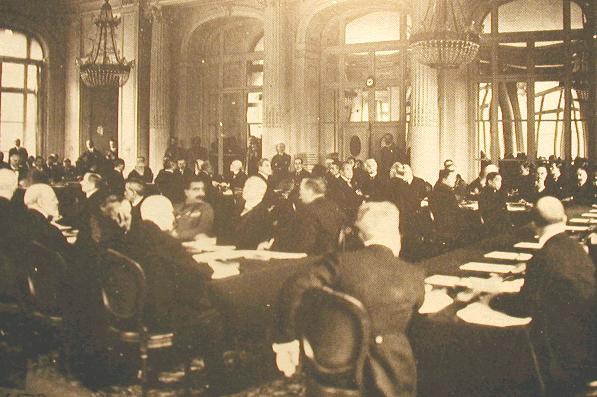 1 1As the 75,000 word-, 200 page-long document was translated, there was an overwhelming litany of German indignation and condemnation of the Treaty provisions. General Ludendorff exclaimed, “If these are President Wilson's fourteen points, then American can go to hell.”2 Count von Bernstorff declared, “It is an imperialistic peace. It is the worst in history. It is the maximum. We cannot sign.”3 Premier Hirsch predicted, “These conditions ... would mean slavery for the Fatherland and fresh unrest and fresh bloodshed for the whole of Europe.”4 Chancellor Philipp Scheidemann echoed, “These conditions are nothing else than the sentence of death for Germany.”5 Footnotes
 
Copyright ©2001-2003, Allegra H., all rights reserved. Please contact me via e-mail if you wish to reproduce this material.
|