Principle of Problem Subjectivity
Version 0.5.0
Contents
1.Introduction
1.1 Introductory Note
1.2 Abbreviations and
Symbols
2.Problem Algebra
2.1 Terms and Knowledge
Base
2.2 Objects, Logical Operations with
Objects
2.3 States of
Objects, Phase Space
2.4 Problems, Composition and
Decomposition of Problems, Phase Space Representation
2.5
Object Representations, Sets of Problems
3. Biology of Problems
3.1 Reflections
of Problems in Human Brain
3.2 Solubility for Man, Sets
of Problems (Man-Dependent)
3.3 Global State
Function
3.4 Disadvantage of State
3.5 Importance of
Problems
3.6 General
Principle of Problem
Subjectivity
3.7
Principle of Problem Subjectivity
3.8 Time
and Limit Properties of Principle of Problem Subjectivity
3.9 Understanding the
Principle of Problem Subjectivity
3.10 Model of
Problem Processing
4.Application in
Psychology
4.1 Defining
Terms
4.2 Psychical
Illness Explained by Well-Known Neuron Properties
4.3 Time
Development of Discontentment - Analytical Model
4.4 Current
Handling of Psychical Illness
4.5
Principle of Problem
Subjectivity - Learning Psychical Stability
4.6 Neuron Level
Explanation of the PPS Functionality
5.Application in
Computer Science
6.The Freedom of Thinking
7.Version History
8.References
1.Introduction
1.1 Introductory Note
We are used to hear the word ”problem” in many various
connections and it usually stands for an object (a part the objective reality) that
appears to be in an undesirable state. This study introduces a general definition of
problem, some of attributes of problems, both man-independent and man-dependent, and
explains the exact validity of so called principle of problem subjectivity.
That a state of an object is regarded as undesirable does not mean that
any other state is desirable - defining the object and its state (the undesirable one) is
not a complete problem specification. We need to define the desirable state as well.
Therefore we employ ordered couple of states of object as the general definition of
problem. Some illustrative examples of problems can be found in Examples of Problems page.
The study consists of two logical parts: chapters two -
problem algebra - deals with
problems as abstract mathematical objects, there are lot of vectors, multidimensional
phase spaces, trajectories in phase spaces, operations with problems and other staff. The
chapter three - biology of problems - considers that the abstract problems from the chapter two can get
incarnations in human brain, the model of pendulum dissatisfaction/contentment mechanism
is introduced and finally the issue wouldn’t be complete without discussion
of principle of problem subjectivity.
The primary application of the principle of problem subjectivity lies in the field of
psychology (chapter four). In the future the principle could help with exact and fast solving
of some types of the functional psychosis. Other attractive applications could lie in the
computer science, neuron networks or artificial intelligence.
The version history was placed at the end of the issue to remind about
stable history of principle of problem subjectivity. The basic definitions and assertions presented in
this issue have not changed since 1994.
1.2
Abbreviations and Symbols
 , , , , |
vectors representing states of objects |
| CNE |
centre of negative emotions |
 |
delta, the change state vector |
| GPPS |
general principle of problem subjectivity |
| GS |
global state function |
| N(t) |
the set of all insoluble problems |
| O |
the set of all objects |
| P0 |
the set of all problems |
| PPS |
principle of problem subjectivity |
| Ref |
reference |
| S(t) |
the set of all soluble problems |
| È |
unification of objects |
| X,Y,Z |
capital letters representing objects |
| X() |
object X in state |
X[, ] ] |
problem |
| x1, x2, .. |
coordinates of object state |
| ø |
empty set |
| Å |
composition (addition) of problems |
| " |
all possible values of a variable |
| Þ |
implication |
| Ì |
subset |
2.
Problem Algebra
2.1
Terms and Knowledge Base
The principle of problem subjectivity is based on modern natural sciences widely
accepted today - it uses terms of the set theory (see e.g. Ref.[1]),
the theory of multidimensional functions, the theory of graphs (see e.g. Ref.[2])
(mathematics), refers to the atomic theory or uses examples from mechanics (physics, see
e.g. Ref.[3]) and finally relies on knowledge about neurons and the
central nerve system gained in biology and biochemistry (Ref.[4]).
Since the study deals with a very complicated and disputable field it uses lots of
simplifications that only help to be more exact and are believed not to be substantial for
the deduced results.
2.2 Objects, Logical Operations with Objects
To build up the system of problems, the basic term we will start from
is ”objective reality”. The term ”objective reality” stands for the
entire surrounding world and, as the basic term, cannot be defined but must be understood
intuitively. Lets look at the general definition of object:
Definition 1 (object): Object is a defined part of the
objective reality.
Two basic means commonly used for defining part of the objective
reality are:
numbers (sometimes we can use values of quantities defined by
mathematics, physics, biology, etc. for objects specifications)
Examples of objects are: an electron, a proton, a neutron, a hydrogen
atom, several electrons, a molecule of H2O, a protein macromolecule, a red
blood cell, a part of our body, our body, the air in this room, the photons
(electromagnetic light radiation) in this room, this building, the 6-th planet in our
solar system, all stars in the Galaxy, etc. (From the physical point of view, every object
is composed of elementary particles - mostly protons, electrons and neutrons - and is
carrying its energy).
Logical Operations with Objects:
We will use capital letters X, Y ,Z, ... as a substitute for
well-defined objects. When thinking, we are logically (virtually) splitting objects into
smaller ones, and consider these smaller objects as independent systems (with the rest of
world reduced to boundary conditions). To describe this we will introduce logical
composing/decomposing of objects.
Definition 2 (decomposition of object): Decomposition of
object Z will be called such objects X and Y that every part of objects X and Y is also
part of the object Z. The sign È (unification)
will be used for composing of object Z = X È Y.
Example: Lets have a car and refer to it as object X. Let's refer to
the left front wheel of this car as object Y and to the rest of the car (except the left
front wheel) as object Z. The car stopped working well and we start wondering what part of
the object X (the car) is broken - we virtually decompose the object into number of
smaller objects. One of possible logical decompositions in this example is X = Y
È Z.
Definition 3 (composition of objects): As object composed
of objects X and Y will be called such object Z that every part of objects X and Y is also
part of the object Z. The sign
È (unification) will be used for composing of object X È Y = Z.
Note1: We use the term "logical operations" for
composition / decomposition of objects and problems since these operations are not
physical - nothing of the objective reality changes when we decompose an object - it is
only a virtual (logical) decomposition, serving for later operations with problems.
Note2: For simplification we will consider composition of objects only
for objects with zero penetration (objects not having any common part - disjunctive
objects, X
ÇY=ø), i.e.
composition XÈZ in Definition 3
is prohibited.
A special case of object according to the definition 1 is the whole
objective reality itself, lets mark it X0. We will introduce the definition of
"complete disjunctive set of objects" that will later serve for construction of
the set of all problems.
Definition 4 (Complete Disjunctive Set of Objects): As
"complete disjunctive set of objects" O will be called such set of disjunctive
objects, that their composition is the whole objective reality: O ={Xi ; Xi
Ç Xj=ø for all
i,j and ÈXi = X0}
Summary: Object is generally a defined part of the objective
reality. Object can be defined by words or by mathematical means and some logical
operations can be defined for objects (composition, decomposition, penetration, …).
2.3 States of Objects, Phase Space
The center of gravity of every object is defined by its position vector
 (x,y,z) and its momentum by vector
  =
= =
=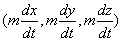 =( px, py, pz)
where m is the mass of the object and
=( px, py, pz)
where m is the mass of the object and  stands
for time derivation. Not taking into account other states of freedom the state of the
object is exactly described by 6 numbers x, y, z, px, py, pz
. These numbers can be understand as components of a vector in a 6 dimensional space, usually denoted to as phase space
where just the values of x, y, z, px, py, pz are marked
on individual axes. Any status of the selected object within given approximation
corresponds to just one point inside the 6 dimensional phase space.
stands
for time derivation. Not taking into account other states of freedom the state of the
object is exactly described by 6 numbers x, y, z, px, py, pz
. These numbers can be understand as components of a vector in a 6 dimensional space, usually denoted to as phase space
where just the values of x, y, z, px, py, pz are marked
on individual axes. Any status of the selected object within given approximation
corresponds to just one point inside the 6 dimensional phase space.
If more grades of freedom are admitted (some internal parameters
describing the internal status of the object) we will have more co-ordinates qi
and corresponding momentum pi , =
(q1, q2, ..., qN, p1, p2, ..., pN
) = (x1, x2, ... x2N ) in 2N dimensional phase space of
the object. Again vector or one point in the
phase space characterizes exactly state of object at one moment. Note: In quantum
mechanics objects are described by wave functions that can be understand as vectors in
µ -dimensional space of wave functions so
analogy is possible when using quantum mechanics instead of classical description of
objects’ status. The expression X()
will here after stand for ”object X being in state ”.
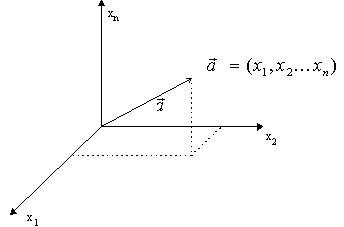
Figure 2: Description of object state in the phase space
Summary: State of every object is defined by a set of
parameters; in graphical way state of object is represented by one point in
multidimensional phase space.
2.4 Problems, Composition and Decomposition of Problems, Phase Space
Representation
Definition 6
(problem): As problem will be called every
ordered couple of states of an object, in symbols
X[,] º [X(), X()]
The square brackets on the right side of the definition stand for an
ordered couple while on the left side they represent the symbolic notation used for
problems. Let’s look at the phase space what is the representation of problem:
instead of one point representing single state of object, problem is represented by two
points in addition with defined order (Figure 3).
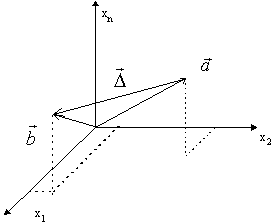
Figure 3: Representation of problem in phase space
Let’s denote term ”initial state” to the first state in
the ordered couple (state X()), ”final
state” to the second (state X()),
”initial state vector” to the vector , ”final state vector” to the vector , ”state change vector” to vector
º - .
This means that whenever we hear or think the word "problem"
we can always find a well-defined part of the objective reality to which the problem is
related. That part of the objective reality is called "problem object". There
are two states of the problem object that determine the problem itself - the initial state
- which is the unfavorable and often the ccurrent state - and the final state being
the favorable one, and usually we would like to achieve that state in the future.
Please have a look at Examples of Problems
to understand more easily what the definition of "problem" as well as the
following definitions mean.
Definition 7 (zero problem): As zero problem will be called
every such problem X[,] that = (it is ai = bi for i =
1,2,...,n ), marked 0
Definition 8 (inverse problem): As problem inverse to problem
X[,] will be called problem X[,]
Definition 9 (serial composition problems): As a problem
composed of problems X[,] and X[,] will be called problem X[, ],
in symbolic notation X[,] = X[,]
],
in symbolic notation X[,] = X[,]
Å X[,] (the symbol Å - read as plus - stands for the operation of composition). Notice: the serial
composition isn’t defined for arbitrary pair of problems but only for such having the
same problem object and such that final state of the first problem is equal to the initial
state of the second problem, serial composition of problems is not commutative - we cannot
exchange problems in the formula.
Assertion 1 (Composition of problem and problem inverse): The
result of composition of problem and problem inverse is the zero problem. (X[,]
Å X[,] = 0 )
Proof: X[,]
Å X[,] = X[,] according to the definition 9 and X[,]
= 0 according to the definition 7.
Definition 10 (parallel composition of problems): As a problem
composed of problems X[,] and Y[, ] will be called problem Z[
 ,
, ],
in symbolic notation Z[
],
in symbolic notation Z[ ,
, ] = X[,]
Å Y[, ] (the symbol Å stands for the parallel composition), Z = X È Y, = (a1,..,an,c1,..,cm),
= (b1,..,bn,d1,..,dm).
] (the symbol Å stands for the parallel composition), Z = X È Y, = (a1,..,an,c1,..,cm),
= (b1,..,bn,d1,..,dm).
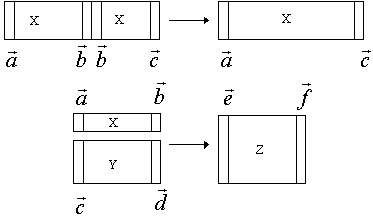
Figure 4: Serial and parallel compositions of problems
Let’s look what the definitions 7,8,9 and 10 mean for the phase
space of problem object. For the zero problem the points representing the initial and the
final state are identical. The inverse problem is represented by the same couple of points
as the original problem but understand in the opposite order. For inverse problem the
state change vector  = - (since
 = -= -(- )= -).
The parallel composition of problems lead to transformation of phase spaces used for
description - the original phase spaces X: n-dimensional with axes x1, x2,
... xn and Y: m-dimensional with axes y1, y2, ... ym
transform into one n+m dimensional space with axes x1, x2, ... xn,
y1, y2, ... ym.
= -= -(- )= -).
The parallel composition of problems lead to transformation of phase spaces used for
description - the original phase spaces X: n-dimensional with axes x1, x2,
... xn and Y: m-dimensional with axes y1, y2, ... ym
transform into one n+m dimensional space with axes x1, x2, ... xn,
y1, y2, ... ym.
Summary: Problem is generally an ordered couple of states of an
object. In the phase space, two points with defined order represent problem. An extended
arithmetic can be defined for problems.
2.6 Object
Representations, Sets of Problems
According to the current knowledge, the total matter and energy of the
universe is final. Therefore the complete disjunctive system of objects (in the sense of
definition 4) contains a final number of objects. Let's mark this final set of objects O,
each elementary particle in the universe belongs to just one element of O.
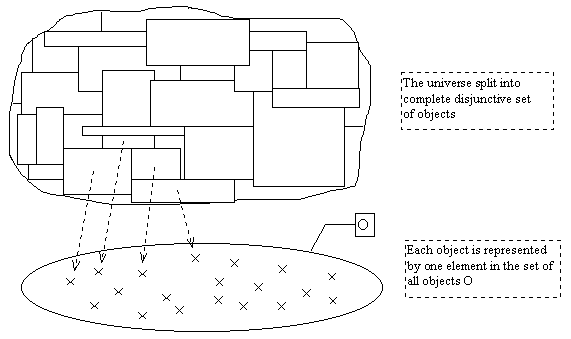
Figure 5: The set of all objects
As it was discussed in chapter 2.3
States of Objects, Phase Space
, state of each object can be
described by a set of parameters - let's take into account all the possible degrees of
freedom of each object. What we get will be further on called "object
representation" and it is a kind of coordination system that enables exact
description of states of all objects. Each object from O has got its phase space attached:
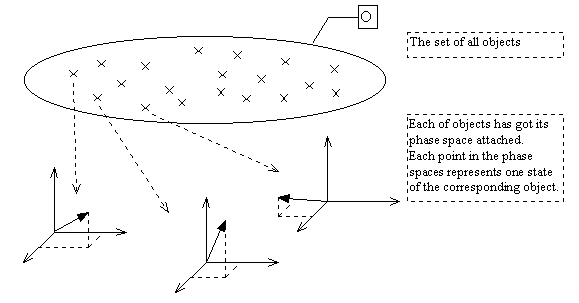
Figure 6: Phase spaces, description of states of objects
If we have selected a different splitting of universe into objects we
would get a formally different "object representation" i.e. different
coordination system. Different values of object state coordinates in the phase space would
represent the same objective reality. These transformations among object representations
will not be discussed in details in this version of the issue.
Let's advance to the construction of the set of all problems P0
(P-zero) . According to the general definition of problem (definition 6) every
ordered couple of points in the phase spaces on figure 6 represents one problem. When we
consider all the possible ordered couples of points in all the phase spaces on figure 6 we
get the set of all problems P0. Every problem we have ever solved or are ever
going to solve has its mathematical counterpart in P0. The logical steps that
lead to the construction of the set of all problems are shown on figure 7.
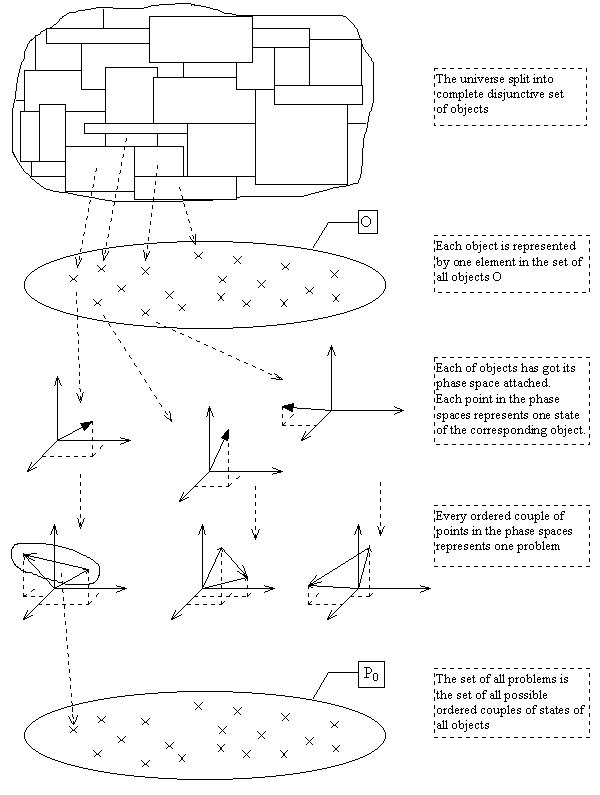
Figure 7: Logical steps leading to the construction of the set of all
problems P0
We can try to understand approximately the size of the set of all
problems P0. We are going to use the sign || (norm) to specify size of a set
i.e. number of elements. Each of ||O|| objects can be considered in  states (average number of points in the phase
spaces, S stands for phase space considered as set). Therefore the size of P0
is:
states (average number of points in the phase
spaces, S stands for phase space considered as set). Therefore the size of P0
is:

The "exponent 2" is caused by the fact that problem is
represented by couple of states, the final "times 2" is caused by the
fact that each couple of states yields two problems (problem X[,] and the problem
inverse X[,]). The number of all objects ||O|| depends on selected splitting of universe
but can be an extremely big number. According to both classical physics and quantum
physics the number of possible states of every object is infinite (
¥ ) therefore also the size of the set of
all problems is infinite.
Finally in this paragraph let's introduce the concept of actual and
virtual problems. On the figure 6, there is just one special point in each of the phase
spaces that represents the current (actual) state of the object X the phase space is
attached to. Let's mark the current (actual) state vector as 0X (a-zero-X) for each object X.
Definition 11(actual problems): As "actual problem"
will be called such problem X[,] that =0X , i.e. the
problem initial state is the current object state.
Definition 12(virtual problems): As "virtual problem"
will be called such problem X[,] that
¹ 0X , i.e. the problem initial state is
not the current object state.
Both actual and virtual problems are important from the point of
view of thinking - we can be troubled and searching solutions also of the virtual
problems. In addition virtual problems may later become actual as states of objects are
changing. However only actual problems can be solved at the present moment.
Mathematical representation of solutions of problems is not yet
included in this issue. Basically solution of problem X[,] is an external force
affection that induces the object X to change its state from X() to X(). It is clear
that such change occurs always along a continuous curve in the phase space. The curve's
boundary points are and .
Summary: The set of all problems is the set of all ordered
couples of states of all objects. Various physical, chemical or other quantities can be
assigned to problems and problems can be grouped into sets based on these properties.
3. Biology of Problems
3.1 Reflections of Problems in Human Brain
All the definitions and system of problems defined in previous chapters
are pure theory - objects exist only in just one state at any time. If no thinking being
existed the system of problems could still be defined, all the relations are
mathematically valid but individual problems would have no real counterparts. Let’s
have a look at what real-measurable objects would correspond to abstract
”problems” when we admit the existence of thinking beings.
We are surely able to notice and/or imagine an object in a state (e.g.
a book lying open on our table). Certainly there is a specific activity of our brain
behind such imagination. For simplicity let’s consider a group of neurons connected
in a ”circuit” that is ”active” - nerve pulse is running periodically
through the active neuron circuit (see e.g. Ref.[4] for a related
issue). Please observe that such activity of the group of neurons is real-measurable
phenomenon, the nerve pulse is carrying its energy. When a state of an object is
considered not suitable we usually search for a more suitable state of the object. The
imagination of the more suitable state may exist almost simultaneously with the original
one and the couple of groups of active neurons will for our purposes represent the
real-measurable counterpart of the abstract ”problem”. This specific activity of
neurons will be further on called ”reflection” or ”incarnation” of
problem in human brain.
Summary: Problems can get reflected in human brain. Reflection
of problem is a real, objectively measurable phenomenon, realized by a neuron activity.
3.2 Solubility for Man, Sets of Problems (Man-Dependent)
Let’s have a certain time interval T. For simple explanation
let’s use the value T = 3 minutes. We will investigate our ability to solve problems
within the time interval T - changing states of objects from one state (the initial one)
to another state (the final one). For sure there are some problems we are able to solve
within 3 minutes - as opening the book lying on our table, going into the next room and
many others. On the other hand there are problems surely not soluble within 3 minutes -
e.g. moving 1000 km away. Every attempt of solving of problem X[,] within time T will
always have an unambiguous result - either the problem will be solved within 3 minutes or
not. There is nothing between. The ability to solve a problem is a man dependent property
of problem (the value depends both on problem and on the person and is objectively
measurable).
Let’s consider a function ST, man dependent and defined
on the set of all problems by the formula:
ST(X[,]) =
 0 if X[,]
is not soluble for within the period T
0 if X[,]
is not soluble for within the period T
1 if X[,] is soluble within the period T
The set of all problems soluble within interval T can be defined as
ST
º { X[,] Î P; ST(X[,])
= 1 }
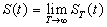
If we prolong the interval T, more and more problems will belong to the
set ST , finally the set of all for man soluble problems is defined as

and the corresponding function S defined on the set of all problems as
will be called ”solubility for man”.

Of course we have got the ability of learning (and forgetting).
Therefore the set of all for man soluble problems is time dependent:
 ,
, 
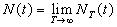
Let’s mark the set of all at moment t for man insoluble problems
as N(t):
NT(t) º { X[,] Î P; ST(X[,],t)
= 0 }
Of course, superset of S(t) and N(t) is P at any moment t and their
intersection is empty (the following assertions are valid):
S(t)
È N(t)
= P for " t
S(t)
Ç N(t)
= Æ for " t
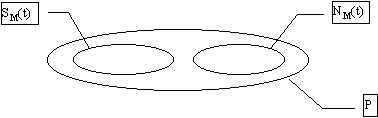
Figure 8: Splitting of the set P by the
solubility for man, M stands for man dependency, t for time dependency
Summary: Our attempt to solve a well-defined problem within a
certain time interval will have an unambiguous result (yes/no). Therefore "solubility
for man" is objectively measurable, man dependent property of problem.
3.3 Global State Function
Many people would agree that the most important value in human life is
contentment. Original reasons for our activity can be diverse - from earning or having
money, doing something for ones health, satisfying basic needs as hunger, being
appreciated by another person, being in love with a person, sexual goals, goals in sport,
... etc. When an obstacle appears to the goal, dissatisfaction appears and it is the fuel
for all our further activity. Without the dissatisfaction we wouldn’t be able to
reach anything. After overcoming the obstacle the dissatisfaction disappears and we are
again content. In a first approximation our activity is propelled by dissatisfaction and
the imprinted tendency to reach contentment. Let’s have a more scientific look at the
pendulum mechanism of dissatisfaction and contentment.
Nowadays science has got great achievements in the study of individual
neurons. Neuron is nerve cell, having all the general properties of cells - it has its
nucleus, external membranes and cell organelles. The specialty of neurons is their form
and the ability to lead and integrate nerve pulses. Nerve pulses consist of flow of sodium
and calcium ions (Na+, K+) through neuron membranes. There is quite
sophisticated mechanism of regulation of the flow. The short projections called dendrites
carry nerve pulses into neuron, after processed (integrated) in neuron body the nerve
pulses are carried by the only long projection called axon out of the neuron toward other
neuron(s). Both dendrites and axon are plentifully split at their ends. The connection
between axon of one neuron and dendrite of another one is called synapse. Human brain
contains about 15 milliards (15.109) neurons and much more synapses.
In addition to the above-described neuron-level activity that in some
parts of central nerve system probably correspond to individual imaginations, ideas and
logical thinking, there is the higher-than-neuron-level activity. It has a more global
character and consists of changing concentrations of diverse chemical compounds in various
parts of the system [human brain], various electric and magnetic field changes. This
higher-than-neuron-level (called further on as 2nd level) activity corresponds to emotions
and feelings rather than individual imaginations and ideas, the most famous representative
is the concentration of chemical compound adrenaline.
Imagine that we have devices able to measure (of course in a
non-destructive way) all the characteristics of the level one and two of in all parts of
the system. After averaging the measurements from lots of people it could be possible to
define such emotions as fear, anxiety, nerves, fright as well as positive emotions, all
based on physical, chemical and biological quantities (that on such occasions appear in
our brain) and with exact mathematical definitions.
Most of time brain exists in its normal state corresponding to
contentment, concentration of chemical compounds and electromagnetic activities have their
standard values. For describing the level of discontentment we will introduce global state
function (denoted to as GS function) by the following description:
Description 1 (Global state function): The global state function is
biochemical quantity describing dissatisfaction objectively measurable in central nerve
system. The values of GS are H(GS) = R+0 (the positive real numbers
plus zero), the value GS = 0 corresponds to normal values found in the status of
contentment, higher values of GS correspond to higher dissatisfaction.
To exactly define the GS function we would need the measurement devices
mentioned above to work out what is the role of individual compounds and measurable
quantities in the dissatisfaction as we feel it. The reason why the description 1 was
introduced is to remind of the matter and objective base of the following assertions.
The time dependency of the GS value is quite complex, there is number
of things that effect human contentment -both status of external objects and internal
neuron interconnections. An example of GS time development is in figure 9.
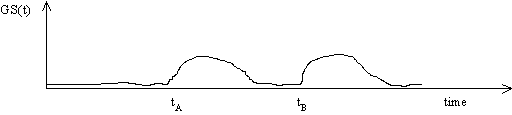
Figure 9: GS (Global state) function time dependency example, at
moments tA and tB serious obstacles (problems) appeared
Summary: Emotions and discontentment are realized by various
chemical compounds and electromagnetic changes in human brain, they are existing,
objectively measurable phenomenon. Global state (GS) function is a biochemical quantity
describing level of discontentment, the value GS=0 corresponds to the state of
contentment.
3.4 Disadvantage of State
When an object X changes its state to X() this fact may have an influence to the global state of our brain.
This influence is objectively measurable. For example we have bought a new jacket and we
have torn it up of a fence. This causes our dissatisfaction, global state of brain has
changed, e.g. the adrenaline concentration can grow. On the other hand for example a fall
of a leave from a tree lets our brain status unchanged in the state of contentment (GS =
0). The global state function GS described and discussed in the previous chapter can be
understand as a function of states of object GS = GS(X()) defined on the set of all states of all objects and expressing the
immediate reaction of human brain to object X appearing in state . This dependence will be below referred to as ”disadvantage
of state X()” being objectively
measurable and man-dependent biochemical quantity.
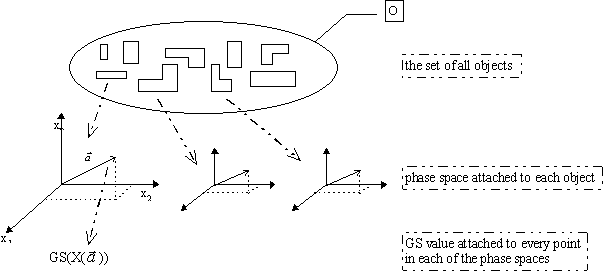
Figure 10: The definition range of disadvantage of state
GS(X())
To progress further in the following chapters we will need to go little
deeper - to the neuron level - and create a basic model of how our discontentment can be
connected to the status of an external object. The model is very simple and with a good
agreement with modern scientific knowledge about neurons and human brain.
We are going to assume that there is a specialized part of human brain
that takes care of generating negative emotions and discontentment. This region of human
brain will be further on called ”center of negative emotions”, CNE. Individual
neuron groups that perform imaginations of objects in various states are connected more or
less strongly, directly or indirectly to the center (CNE) using neuron based
”conductors”.
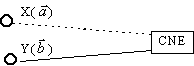
Figure 11: Neuron level model of
disadvantage of states X(),Y()
On the figure 11, if the object Y appears in the state it will bring a higher discontentment than if the
object X appears in the state , since the
neurons that realize the imagination of Y()
are connected to CNE more strongly (the synapses involved have got lower resistance) then
those realizing X(). GS(Y()) > GS(X()), disadvantage of state Y() is
greater than disadvantage of state X().
It is fundamental to realize that the connections between every region
realizing the imagination of an object being in a state and the CNE was generated during
the process of thinking, may vary from person to person and the natural limits are as
follows:
(*) GSmin (X())
= 0 -any synaptic connection between arbitrary couple of neurons has got the
ability to relax (completely disconnect)
(**) GSmax(X())
->
>¥ -any synaptic
connection between arbitrary couple of neurons is able to
evolve to maximum strength
Summary: Various states of objects influence our contentment.
Therefore the global state function can be understand as function of states of objects GS
= GS(X()). This dependency is called
"disadvantage of state" and can be explained by well-known neuron and central
nerve system properties.
3.5 Importance of Problems
Definition 11
(importance of problem): As the importance
of problem X[,] will be called quantity D GS(X[,]) = GS(X()) - GS(X()), where GS(X()) resp. GS(X()) is disadvantage
of object X in the state resp. as described in the previous chapter.
The meaning of the quantity
D GS(X[,]) is that it says something about how much our contentment would
improve if we solve the problem X[,]. Since the importance of problem is directly
derived from the disadvantage of state GS = GS(X()) it is again objectively measurable and man-dependent biochemical quantity.
Summary: Importance of problem is objectively measurable, man
dependent property of problem.
3.6 General Principle
of Problem Subjectivity
Any disadvantage of state GS(X()) greater than GSmin (X()) is not necessary - it was created in our past by our own
”subjective” thinking. Therefore we will call the minimal necessary importance
of problem X[,] the quantity
D
GS0(X[,]) = GSmin(X()) - GSmin(X()) (***)
as the objective (objectively necessary) importance.
After using the equation (*) within (***) we get the general
principle of problem
subjectivity (GPPS) assertion:
D
GS0(X[,]) = GSmin(X()) - GSmin(X()) = 0 for " X[,] Î P
”The importance of arbitrary problem is only subjective (the
objectively necessary importance is zero)”.
The general principle of problem subjectivity de facto says that there exists an
objective possibility (guaranteed by properties of synaptic connections of neurons) that
our brain can stay in the basic state of contentment even if arbitrary object appears in
arbitrary state.
The general principle of problem subjectivity even if it brings really objective
measurable information has no practical significance but serves only as the base for the
contracted principle of problem subjectivity.
Summary: Our brain has got the objective ability to stay in the
basic state of contentment even if arbitrary object appears in arbitrary state (= general
principle of problem
subjectivity assertion). The GPPS assertion brings no direct practical benefit.
3.7 Contracted
Principle of Problem Subjectivity
Assertions about Importance
In the last chapter we have discussed the general
principle of problem subjectivity in
the form
D
GS0(X[,]) = 0 for " X[,] Î P
where P is the set of all problems and
D GS0 is a man dependent property of problem. In
this subparagraph we don’t need to know anything about how D GS0 is defined or what it is. Let A is an
arbitrary subset of P in normal meaning of the word ”subset”: A Ì P (AÇ P=A, AÈ P=P)
X[,]
Î A Þ X[,] Î P (+)
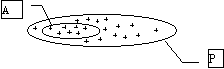
Figure 12: A - an arbitrary subset of P
It is quite clear that if every element of the set P has got the
property
D GS0 = 0
also for every element of the set A the equation D GS0 = 0 is valid. There exist many assertions of this type depending
on what subset A we select. Let's call these assertions as ”assertions about
importance” - all are valid and have the symbolic form:
D
GS0(X[,]) = 0 for " X[,] Î A, A Ì P (++)
The general principle of problem subjectivity is just one special case A = P among all
the assertions about importance. All assertions about importance have been proved by the
fact that the general principle of problem subjectivity is valid:
Let’s have a set A
Ì P, X[,] Î A:
X[,]
Î A Þ X[,] Î P (from (+)) Þ D GS0(X[,])
= 0 (from the GPPS)
in brief: X[,]
Î A Þ D GS0(X[,]) = 0
Contracted Principle of
Problem Subjectivity as a Special Case of Assertion about
Importance
As it was mentioned in previous chapter the GPPS -even if it is exactly
valid - is of no practical significance. If we regarded every problem that appears
as important only subjectively (according to the GPPS) our entire dissatisfaction would
increase - mostly it is of better advantage simply to solve the problem.
To find out what subset A is of the best advantage to select we are
going to investigate the average value  calculated
as contribution of a randomly selected problem to the integral value of GS function. To
calculate the minimum value of depending on
the selected subset A (for that the property
calculated
as contribution of a randomly selected problem to the integral value of GS function. To
calculate the minimum value of depending on
the selected subset A (for that the property
D GS0(X[,]) = 0 will be considered) we will introduce a
very simple model of brain problem-processing by the following assumptions:
Note: Due to complexity it is recommended on the first reading to skip
the following paragraphs and continue from "Assertion (contracted principle
of problem subjectivity)".
1) Appearing of a problem [in our brain] referred here as
”activation of problem X[,]” has got the same probability for all
problems from P
2) Only 1 (or 0) problem can be activated at any time
3)
D GS is
denoted to the contribution of 1 activation of problem to the integral value of the global
state function. The following subsets of P will be used:
A ... the set of problems for that the property
D GS0(X[,]) = 0 will be
recalled
S,N ... the set of all [for man] soluble/insoluble problems, see 3.2 Solubility for Man, Sets of Problems
We will assume the following:
D
GS(X[,]) < D GSA(X[,])) for X[,] Î S
D
GS(X[,]) > D GSA(X[,])) for X[,] Î N
To explain this rather complex assumption 3 that directly leads to the
contracted principle of problem subjectivity we will analyze GS = GS(t) function presented already on
figure 9 now shown with more details on figure 13.
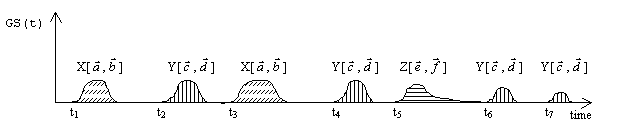
Figure 13: GS function time dependency details
Every peak on the figure 13 was generated by exactly one problem, but
one problem can generate several or many such peaks, depending on how many times it was
activated. The area of peak can be calculated as
D GSpeak =  and represents
peak contribution to the integral value of GS function (corresponding to integral
discontentment). On figure 13 example, at time t1 a problem X[,]
was activated, at t2 Y[,] was activated, at t1 X[,]
was activated again and solved this time, at t4 Y[,] was activated
again, at t5 a new problem Z[,] was activated and solved, at t6
and t7 Y[,] was activated again and again. The problem Y[,]
can be an example of insoluble problem.
and represents
peak contribution to the integral value of GS function (corresponding to integral
discontentment). On figure 13 example, at time t1 a problem X[,]
was activated, at t2 Y[,] was activated, at t1 X[,]
was activated again and solved this time, at t4 Y[,] was activated
again, at t5 a new problem Z[,] was activated and solved, at t6
and t7 Y[,] was activated again and again. The problem Y[,]
can be an example of insoluble problem.
From the
point of view of solubility (soluble/insoluble) and recalling (reminding, yes/no) of the
objective unimportance of problem (general principle of problem subjectivity, the D GSmin(X[,])=0 problem
property) we get 4 categories of problem type-handlings I, II, III and IV:
Category I: After soluble problem is solved the GS value
goes quickly to zero, see figure 14.
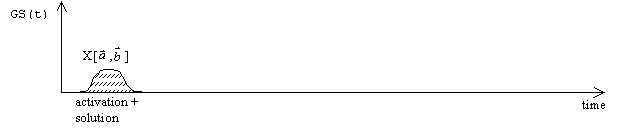
Figure 14: Problem type handling category I
Category II: Not solved problem is re-activated many
times. However its objective importance is considered zero (D GSmin(X[,])=0), in long time scale the
contribution of this problem to the integral GS value goes to zero. See figure 15.

Figure 15: Problem type handling category II
Category III: Not solved problem is re-activated many
times. See figure 16:
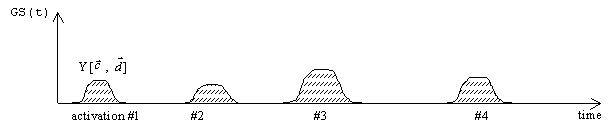
Figure 16: Problem type handling category III
Category IV: Not solved problem is re-activated many
times. However its objective importance is considered zero (D GSmin(Y[,] )=0), in long time scale the
contribution of this problem to the integral GS value goes to zero. See figure 17.

Figure 17: Problem type handling category IV
What the assumption 3 says is that the area under the GS
= GS(t) curve is smaller on figure 14 (category I) than on figure 15 (category II) and
larger on figure 16 (category III) than on figure 17 (category IV):
D GSI(X[,])
< D GSII(X[,]))
for all X[,] Î S
D
GSIII(X[,]) > D GSIV(X[,])) for all X[,] Î N
This in fact means that it is not an advantage to remind
oneself "objective unimportance" of soluble problems but it is an advantage to
do this for insoluble ones. Actually all the mathematical exercise below till the
"contracted principle of problem subjectivity" assertion is about what is quite clear from the
assumption 3 - that the set of problems for which the "objective unimportance" (D GSmin(X[,])=0) shall be
recalled is the set of all insoluble problems N (man and time dependent).
Since S È N = P and
SÇ N=Æ the
splitting of the set of all problems P looks like the following:
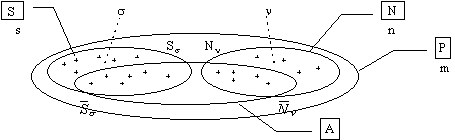
Figure 18: Subsets of P considered for the minimization of
where
P ...is the set of all problems
A ...is the set of problems for that
D GS0(X[,]) = 0 property is recalled
S ...is the set of all (for man) soluble problems, see 3.2 Solubility for Man, Sets of Problems
N ...is the set of all (for man) insoluble problems, see 3.2 Solubility for Man, Sets of Problems
m ...the number of elements of P (here assumed final) = || P ||
s ...the number of elements of S (here assumed final) = || S ||
n ...the number of elements of N (here assumed final) = || N ||
 º S Ç A
Ss º S -
 º N Ç A
N? º N -
s
=  , n =
, n =  where ||”set”|| stands for number of
elements of the set ”set”
where ||”set”|| stands for number of
elements of the set ”set”
Let’s construct the expression for. The probability that the next activated problem will be from the
set S
s is
simply  (since all problems have got the
same probability to arise, according to the assumption 1). Its contribution to will be D GS(S). Analogically, for all the subsets shown on the figure 18 we have:
(since all problems have got the
same probability to arise, according to the assumption 1). Its contribution to will be D GS(S). Analogically, for all the subsets shown on the figure 18 we have:
Subset |
Probability of a problem
activation |
Contribution to |
Weighted contribution to
|
S s |
|
D GS(S) |
D GS(S) |
|

|
D GS(A) |
D GS(A) |
N ? |

|
D GS(N) |
D GS(N) |
|

|
D GS(A) |
D GS(A) |
The expression for the average contribution of random problem to
D GS is the sum of weighted contributions of
all the subsets of P:
=D GS(S) +  D GS(A) + D GS(N)
To test the constructed expression let’s investigate the
dependence =( ) . The fraction
  is portion of soluble problems among all
problems. We will consider all variables but fixed and since s + n = m the substitution n = m - s will be involved:
is portion of soluble problems among all
problems. We will consider all variables but fixed and since s + n = m the substitution n = m - s will be involved:
() = s D GS(S) + (1-s )D GS(A) +  D GS(A) + D GS(N)
() = s D GS(S) + (1-s )D GS(A) + (1-n )D GS(A) - (1-n )D GS(A) + n D GS(N) - n D GS(N)
The partial derivation by provides:
 = s D GS(S) + (1-s )D GS(A) - (1-n )D GS(A) - n D GS(N)
= s (D GS(S) - D GS(A)) + n (D GS(A) - n D GS(N)) < 0
Since the derivation is negative the interpretation of the dependence =() is as follows: the higher fraction of problems
we are able to solve the lower is the average contribution of randomly selected problem to
our discontentment. This is the result that was expected.
Let’s investigate the dependency of on s and n . Both these variables can have the values
from 0 to 1 (included): s Î <0; 1>, n Î <0; 1>. The function =(s , n ) is a function
<0; 1> x <0; 1> -> R+ and can be represented in the 3
dimensional space as shown in the figure 19.
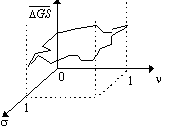
Figure 19: =(
s , n ) dependence
example
Again we will start from the initial expression for derived from the table above:
=D GS(S) + D GS(A) + D GS(N)
The derivation by s yields:
 = D GS(S) - D GS(A) = (D GS(S) - D GS(A)) < 0
is
decreasing with s growing => s min =1
The derivation by
n yields:
 = -
= - D GS(A) +
  D GS(N) = (D GS(N) - D GS(A)) > 0
is
increasing with n growing => n min =0
Due to the limited definition range of both variables <0; 1> has got its minimum value in
s =1and n =0 and in our approximation the dependence=(s , n ) looks like in the figure 20.
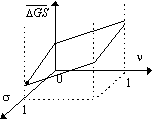
Figure 20: The real=(
s , n ) dependency in
the used model
The
s = 1 and
n = 0 represent the case A = N -
we have the special assertion about importance for which the average contribution of
random problem to the integral (or average) value of GS is minimal:
Assertion (contracted principle of
problem subjectivity):
X[,]
Î N(t)
Þ D GSmin (X[,]) = 0
We can have several word forms for the contracted principle
of problem subjectivity (PPS):
-Any problem is either soluble [for man] at moment t or important only
subjectively at t.
-If a problem X[,] is not soluble [for man] at moment t, X[,]
is important only subjectively at t [
º our brain can stay in the basic state of contentment even if the object X
remains in the initial state ].
-If we are not able to solve a problem X[,] at moment t it
only seems to be important at t.
Summary: Contracted principle of
problem subjectivity is an assertion about
importance ("subset" of the general principle of
problem subjectivity) that under certain
assumptions 1), 2), 3) leads to minimal average/integral discontentment. The special
position of PPS among all assertions about importance was proved by minimization of
contribution of random problem to the GS integral value.
3.8
Time and Limit Properties of Principle of Problem Subjectivity
The contracted principle of problem subjectivity (PPS) brings a relation between two
objectively measurable properties of problems - the solubility for man (see 3.2 Solubility for Man, Sets of Problems) and the importance
of problem (see 3.5 Importance of Problems). Since the
solubility for man is time dependent quantity the PPS has got differential character in
the time scale, it is related to one moment t.
The discussed assertion relies on the general principle of
problem subjectivity (see
chapter 3.6 General
Principle of Problem Subjectivity) that in turn
relies on some properties of neurons known from biology, mainly the basic ability of every
neuron connections to relax (”disconnect”). The PPS is
a special assertion about importance (special ”subset” of the GPPS) that leads to
minimal integral or average discontentment (mathematically represented by integral or
average value of the GS function). A prove of the special position of PPS has been brought
out in the chapter 3.7 Contracted
Principle of Problem Subjectivity.
However it currently relies on rather complex assumptions, these should be simplified in
future versions of this issue.
Since we believe that fundamental properties of neurons are stable and
fixed the future validity of PPS is guaranteed. There is no contradiction in the validity
of PPS as may seem during first reading (remember that it is bound to one moment t).
Let’s have a look at some seeming contradictions:
What may somebody imagine after first reading of GPPS or PPS is the
question: ”What if I would be endangered - this is of course an important problem and
I may not be able to solve it. There is a contradiction in these assertions ...”.
Lets come to the exact handling of such problems slowly.
Only a few people today live to see the 100 years of age. It is almost
sure that we will die before reaching 100 years, if we were 40 in 2000 after 2060 we will
not be alive. Thus said this may seem as a problem. In fact the problem is exactly defined
as: problem object
º our body,
the initial state º current
state - state that leads to the death before 2060, final state - state of our body that
leads to the death later then 2060. Probably, we are not able to solve this problem,
nobody is. According to the PPS this insoluble problem is important only subjectively (it
only seems to be important) at the present moment, we can be completely content even if
the problem object is going to stay in its initial state. Observe that for this particular
problem the assertion of PPS is exactly valid even if we may feel it different at the
first time.
After some practice with using the PPS we can virtually get closer to
our ”abstract unavoidable death” finally we are able to imagine ourselves very
close (for example 3 seconds) before our death. By the way that moment will not differ too
much from presence in the sense that we will not be able to have more than normal
contentment. Unless we will be able to avoid that death it needn’t be important to us
- we’ll be able to be content.
The correct processing of our ”abstract unavoidable death” is
just one example of usage of the contracted principle of problem subjectivity. Of course there are problems
that may bother us more but this one was selected to remind of the fact that there is no
contradiction in PPS when we investigate its validity even in the time limits near our
death. The rather surprising result that even our death may become unimportant for us just
few seconds before it occurs (in the case that we are not able to avoid it) is caused by
assumptions we did at the beginning of the chapter 3.3
Global State Function that the global state of our brain at the present moment is the
basic value all the other values are bound to using ”neuron-based conductors”
with the relaxing ability.
Another interesting feature implied by the validity of PPS is dynamics
of importance: since the solubility for man changes along time so does the importance of
problems. Let's illustrate this on an example: it is very important to avoid car accident
- disadvantage of the state "having ccar accident" is very high. We are trying to
prevent it by all means, e.g. careful driving, complying all rules on roads, etc. However
at the moment when we have one, "not having car accident" is no longer possible
- the problem ["having car accident&qquot;, "not having car accident"] is
not soluble. At the moment PPS asserts that "having car accident" is objectively
unimportant (only seems to be important). The more quickly the disadvantage of the state
"having car accident" becomes zero the better for us and for all the people
around. When the consequences of the accident straighten it is logical that the
disadvantage of the state "having car accident" becomes high again. The
importance has been changing its value from high to zero to high
again.
Summary: Principle of problem subjectivity has got differential
character in the time scale (it is bound to one moment). Therefore there are no
contradictions in its exact validity at any moment.
3.9 Understanding
the Principle of Problem Subjectivity
Since the principle of problem subjectivity is a fundamental piece of
knowledge we will devote yet another brief chapter (this one) to exact understanding of
its consequences. We will utilize two time-views for the discussion: the differential
time-view of PPS and the sequential time-view of PPS.
The differential time-view of PPS means that we
virtually "stop world" at one moment (e.g. at the current one) and analyze
solubility and importance of all problems using PPS: what the
principle asserts is that
everything we don't like about the world, everything we would like to change is either
soluble (we will be able to change it) or it is objectively unimportant. That something is
objectively unimportant means that there exists an objective possibility that we stay
completely content even if we leave it without a change.
The sequential time-view of PPS means on the contrary
that we consider problems coming to our mind one by one as time passes and we analyze
solubility and importance of each problem that comes one by one. Again, every problem (PPS
asserts) is either going to be soluble or objectively unimportant. A problem with unclear
solubility shall be handled as insoluble.
That a problems is insoluble for us can have two basic
reasons: - principle (objective) reason (e.g. when the problem final state is prohibited
by a physical, chemical, biological or other natural laws) or man-dependent reason (e.g.
when we miss a knowledge or means to solve the problem). Please observe that assertion
that "every problem is soluble" does not correspond to the objective reality.
A consequence of PPS assertion validity is that we shall
never get angry or nervous about a problem, as long as we are thinking precisely. If we
get angry or nervous about a problem it simply means that we are mistaken (not thinking
precisely enough) - we are either able to solve the problem or we can just ignore it.
3.10 Model of Problem Processing
The following diagram shows a standard cycle of the problem processing
that in fact more or less consciously takes place in our brain - we are identifying
problems, solving them or forgetting if they are not soluble. The part in the dashed line
is not our job - problems are instantiated automatically. Nobody exactly knows what
problem is going to arise tomorrow, next week and so on. The more precisely and more
swiftly we are used to do the individual steps in the diagram including recognition of
insoluble problems and solving soluble ones, the better for us (in terms of our
discontentment).
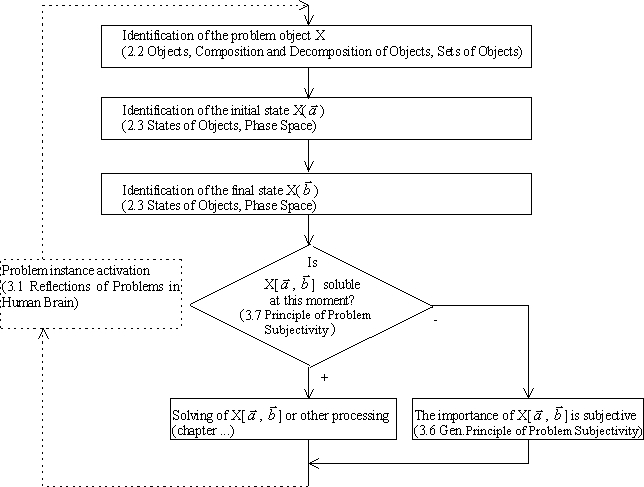
Figure 21: Model of problem processing
Summary: A model of problem processing (above) can be created
based on exact understanding of problems and the principle of
problem subjectivity.
4.Application
in Psychology
4.1
Defining Terms
This chapter is included in order to give a hint of what the
principle of
problem subjectivity can be good for. If we are talking about people suffering psychical illness in
this chapter we will mean people who were quite normal having no physical brain injuries,
who have however become psychically ill e.g. with schizophrenia, depressions, .... For an
overview in this area the following references are recommended: Ref[5],
Ref[6], Ref[7] and Ref[8].
Assisted learning of the principle of problem
principle of problem subjectivity could be considered as kind of modern
psychotherapy, aimed at complete recovery and long-term immunity against emotional
instability problems, while treatment with antipsychotics and other medications may still
be neccesary from short term point of view, as an immediate relieve for the patient.
4.2 Psychical Illness
Explained by Well-Known Neuron Properties
Though most of the time we do not notice it our psychical stability and
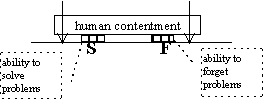
contentment is bared by two basic pillars: the ability to solve problems and the ability
to forget problems. It is hard to remember how many problems we have dismissed during the
past 12 hours (since it cannot be remembered what was forgotten). A scheme of such
”two pillar” model is shown in the figure 22.
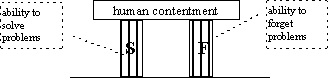
Figure 22: ”Two pillar” model of psychical stability
If either of the pillars is lowered our contentment will decrease. It
is also not true that the more problems we are able to solve the more content we are.
To explain what is happening when the psychical illness is developing
several steps will be presented. In the reality these steps can be interwoven:
- a problem or problems have instantiated that the person is not able
to solve and are regarded as important

- the problem has been instantiated for long time and the connection to
CNE is becoming stronger by positive potenciation of the synapses involved

- after overcoming certain threshold of time during which the problem
is neither solved nor forgotten, the connection to CNE becomes yet stronger, other
insoluble problems reminds the original problem and also cause discontentment

- during the next period a number of other problems evolve a
strong connection to CNE. Activation of any of these problems leads to high discontentment
and further fixing of the connection to CNE by positive potenciation of the neurons
involved
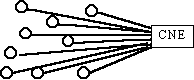
- the result is that the ability to forget problems is significantly
weakened and the person is exposed to long term and very high discontentment
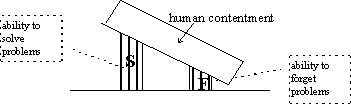
- finally dealing all the time with insoluble problems leads to
decreasing the ability to solve problems, even those everyday life depends on
The long term exposition (weeks, months) to discontentment is big
conflict since human brain has got the imprinted tendency to get rid of discontentment.
There is number of external expression of this conflict: serious problems to sleep, to
work, depressions, schizophrenia, aggression to other people or to the person
himself/herself. Total destruction of personality can be the result if the psychical
illness is not treated by medical care. Even forgetting of the original problem so that it
finally becomes unimportant doesn’t prevent other ”secondary” problems and
future problems to become cause of high and long term discontentment and continuation /
regression of the illness.
4.3
Time Development of Discontentment - Analytical Model
Due to complexity of the whole system (human brain), it is possible to describe time
changes of the global state function representing discontentment using analytical
functions only under very simplified preconditions. The example of an analytical model
below depicts existence of the threshold in the average discontentment ( ): under the threshold in the
average discontentment tends to drop down to zero, above the threshold it tends to grow
above all limits - corresponding to the state of psychical illness.
): under the threshold in the
average discontentment tends to drop down to zero, above the threshold it tends to grow
above all limits - corresponding to the state of psychical illness.
Let's assume that one problem is instantiated (appears in somebody's brain) at time ti
and has got assigned the initial discontentment GSi.
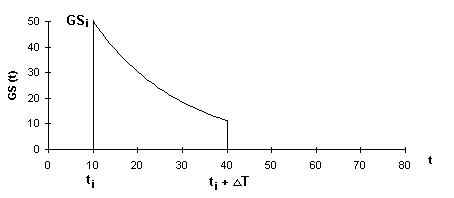
Let's assume that the discontentment caused by the problem goes down exponentially with
time:
 (A1)
(A1)
The parameter KDD will be called "coefficient of discontentment
dropping" and describes how quickly the discontentment GS goes down, the
higher KDD the faster GS drops. If KDD=0,
 the discontentment will
not drop at all. If KDD goes to infinity,
the discontentment will
not drop at all. If KDD goes to infinity,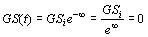 , the discontentment will go to zero extremely
fast. After a time period
, the discontentment will go to zero extremely
fast. After a time period  during which the
problem is active, the problem is either solved or forgotten. In both cases at moment
during which the
problem is active, the problem is either solved or forgotten. In both cases at moment  the discontentment drops to
zero.
the discontentment drops to
zero.
The contribution  of this problem to the
total discontentment (=GS integral value corresponding to the area under the graph)
is:
of this problem to the
total discontentment (=GS integral value corresponding to the area under the graph)
is:
 (A2)
(A2)
The average discontentment experienced during the time interval  when the discussed problem was active is
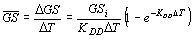
In reality, not only one problem, but many problems are activated in our brain, one
after another. In order to simplify the analytical description we will assume that all
problems will have assigned the same initial discontentment GSi and the
same duration  :
:
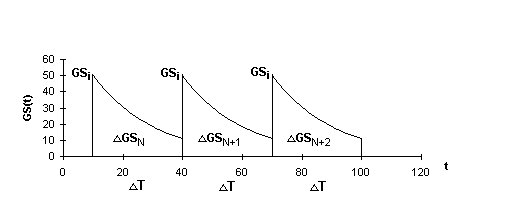
The only parameter that may vary in this model is the coefficient of discontentment
dropping KDD. In real life, our ability to forget problems (modeled here
by KDD) depends (besides others) on our history - e.g. how many and what
problems or stress situations we were exposed to. We could model this for example by
having KDD indirectly proportional to average of the historical
discontentment  :
:
 , where K0 is
a constant.
, where K0 is
a constant.
Notice that this way the higher has been the average discontentment in the past, the
lower is the KDD value (and ability to forget problems). As it would be
difficult to calculate average over a large number of problems, we will yet simplify this
by making KDD depend only on average discontentment from the previous
problem:
 (A4)
(A4)
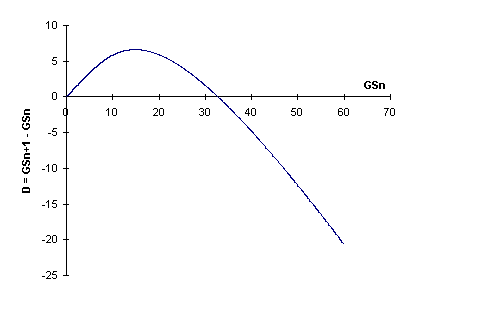
Now we will investigate difference  . If it is positive the discontentment tends to grow, if negative tends to drop, if D=0 it
is the threshold mentioned above.
. If it is positive the discontentment tends to grow, if negative tends to drop, if D=0 it
is the threshold mentioned above.

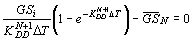 Substitution
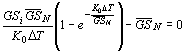
The function looks like
the following in dependence on :
 (A5)
(A5)
So in this simple model, if the average discontentment is lower than the threshold (A5), it tends to go to
zero (and KDD tends to go to infinite). If is greater than the threshold (A5), it tends to
increase above all limits (and KDD tends to go to zero) - this
corresponds to the state of psychical illness.
4.4
Current Handling of Psychical Illness
Fortunately we are not quite helpless when facing psychical illness. In
addition to number of various therapies that more or less convincingly work nowadays
medicine offers number of drugs called antipsychotics that efficiently help people who are
facing such problems. The principle of its functionality is a partial blocking of the
neurotransmitters e.g. dopamine at the synaptic connections of neurons:


Of course there are drawbacks in this ”hardware” approach,
e.g.:
- the drug influence is not ”selective” -even good knowledge
of thus cured people becomes dimmed or lost
- there is high probability that the illness will regress after the
drug supply is stopped
4.5
Principle of Problem Subjectivity
- Learning Psychical Stability
As it was described in chapter 4.2 the psychical illness is developed
by pure thinking. Since the properties of neurons that take part in the process are
reversible it seems to be highly logical and expected that there should be a pure thinking
way to return from the state of psychical illness (when big number of insoluble problems
is strongly connected to human discontentment) back to normal.
The way of course exists and it is the exact problem discrimination
according with the principle of problem subjectivity (PPS):
-the solubility of problem should be investigated / guessed for each
problem (the question "Am I able to solve this ?")
-it should be recalled as quickly as possible for every problem that is
not soluble for sure that it is unimportant (important only seemingly) at the present
moment
-soluble problems on the other hand should be consistently and with all
responsibility solved
A more exact scheme is presented in the chapter 3.9 Model of Problem Processing.
There could be a few potential difficulties in adopting the logic of
PPS:
1) PPS vs. emotions conflict - it may happen that there is disagreement
between what PPS asserts and what emotions are suggesting about importance of a problem.
In such case it should be clarified that PPS assertion is right while emotions are
subjective.
2) Modification of thinking patterns - adopting PPS may mean little
modification to number of thinking patterns that has been adopted in the past. Example: A
quite usual life concept is "It is important to be neatly dressed".
Unfortunately it is not exact enough for patient suffering psychical illness.
PPS modifies
this concept to "It is important to be neatly dressed as long as one is able to be
neatly dressed". The modified concept contains correct handling of the situation when
one is not able to be neatly dressed (because then it is unimportant). It may be very
difficult to change what we are once used to.
3) High level of abstraction - it requires high level of abstract
thinking to identify the vast variety of things that can trouble us (ranging from feelings
possibly connected to health, through interpersonal relations to tasks in occupation,
etc.) as problems.
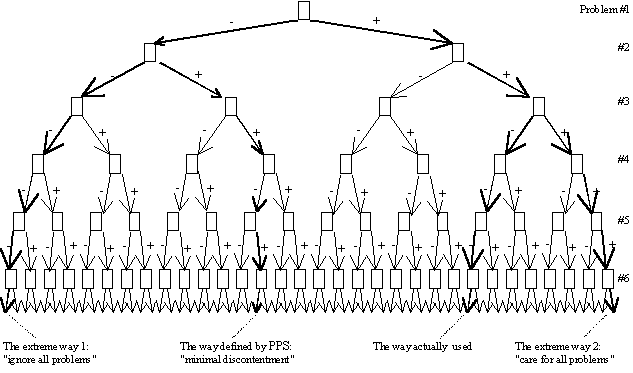
As it will be shown the seeming simplicity of principle of
problem subjectivity disappears when hundreds or thousands of problems are being incarnated. To depict the
usage of PPS in the time scale let’s have a certain period of time, e.g.T=5 minutes
and let’s presume that during this period 6 problems were incarnated. In a basic
model any of these problems can be considered as important with an attempt to solve the
problem (+) or as unimportant without an attempt to solve it (-).
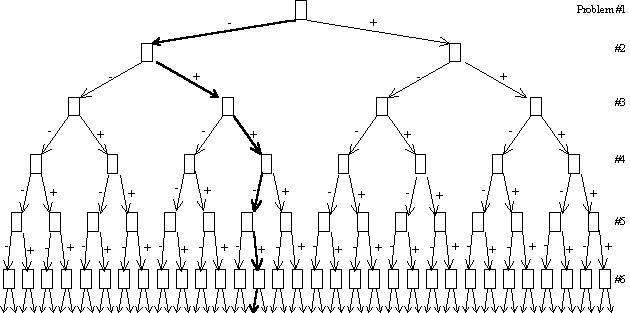
In this model there is 26 = 64 ways how to handle these six
problems. It is an extreme maze that is posed by nature on us - the actual rate of
problems coming to our mind can be tens during several minutes. A hundred problems give 2100
= 1,267 . 1030 (a number with thirty zeros) ways how to handle them. The
principle of problem subjectivity defines just one among them - the thick line example in the
picture. With a small exaggeration we can say that going out of the proper way may lead
back to the relapse of the psychical illness for somebody who is facing it.
The initial simplicity finally fades out when we discuss the
abstraction that is necessary for correct understanding of the PPS logic. Let’s
assume that we are troubled by a problem X[,] and we are not sure whether we are able to
solve it. Then it should be regarded as ”it only seems to be important”. However
it may happen that we are not able to get rid of thinking about X[,]. Then
”thinking about X[,]” rather than the problem X[,]
itself should be understand as the problem we have. We can try some tricks how to stop the
thinking about X[,] - thinking about something else, counting sheep and so on. If it
doesn’t help then we are not able to ”get rid of thinking about X[,]”
- according to the principle of problem suubjectivity there is an objective possibility that we
stay completely content even if we are going to stay ”thinking about X[,]”,
the problem is unimportant. Then we discover that due to ”thinking about X[,]”
we are not able to fall asleep. We may try to breathe deeply, think about something nice
and we probably succeed with sleeping for many hours. If we do not it should be recalled
that it only subjectively seems necessary to fall asleep (since we are not able to do
it),..... and so on.
It was not mentioned yet that the next problem can be the same as just
the ”processed” one. The principle of problem subjectivity should be used as many
times as the problems is coming - every time again the solubility should be investigated
as quickly as possible.
Perhaps it is clear now that the abstraction necessary is extreme and
the simplicity of the principle of problem subjectivity is only principial. A background for the
exact validity of the PPS was discussed in chapter 3 - PPS is a relation between two
objectively measurable properties of a problem incarnation with differential character in
the time scale. The principle of problem subjectivity can be learned as any other normal
knowledge.
4.6
Neuron Level Explanation of the PPS Functionality
Let’s return back to the neuron level model of the psychical
illness and have a look at how the principle of problem subjectivity is able to ”cure”
it. We will start from the picture describing high number of insoluble problems strongly
connected to the center of negative emotions (CNE):
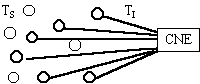

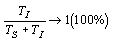
The time portion during that insoluble problems are active is close to
100%, soluble problems have got a weak or no connection to CNE.
Consistent and careful discrimination between soluble and insoluble
problems and applying the PPS leads to decrease of time portion during that insoluble
problems are active, while connections between insoluble problems and CNE are still
strong:
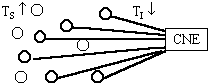

Originally strong connections between insoluble problems and the CNE
are not active. The lack of positive potenciation of synapses involved leads to weakening
of these connections.
Yet further consistent and careful usage of the PPS leads back to
normal state when the portion of time during that insoluble problems are active goes to
zero. The average value of the global state function  is close to zero. The importance of soluble problems is growing.
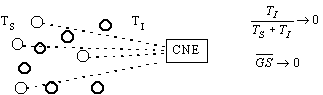
The normal state of human neural activity can be characterized by
relatively quick forgetting of insoluble problems while most of the time we are seeking
solutions and dealing with the soluble ones.
5.Application
in Computer Science
T.B.D.
6.The Freedom of Thinking
The most widely spread view of interpersonal relations today is the
liberal one: as long as it doesn't breach other people liberties, it is everybody's
free will what he does, what he believes in and most of all what he thinks. We
shall cherish the variety of opinions and be very happy, that it exists.
Principle of
problem subjectivity very well fits into this picture - it mostly provides means for mere description
of the thinking process (based on problems) and in the case of the principle of
problem subjectivity (PPS) defines the way of thinking, that leads to minimal discontentment.
Principle of
problem subjectivity does not suggest in any way to think according to the PPS -for example sometimes
we don't want to be content at all (however this does not collide with the exact
mathematical validity of PPS assertion!).
As it is very important to make no mistake about
PPS
breaching the freedom of thinking, we will describe this with the example from chapter
4.5: If there are 6 problems, in the basic model of considering each of them either
important (with an attempt to solve the problem) or unimportant (without such attempt), we
have got 26 = 64 ways of thinking. Two extreme ways of these 64 are 1) to
ignore all the 6 problems (consider all of them unimportant) and 2) to care for all of
them (consider all of them important). Somewhere in between is the way that leads to
minimal discontentment (minimal integral value of the global state function would be
measured in CNS) - as PPS asserts, the way is derived from the objective ability to solve
these 6 problems. However the principle of problem subjectivity does not suggest which way of these
64 shall be selected - it is completely everybody's free choice, which one is actually
selected, neither of these 64 is better than the others by default are. In the case of
somebody suffering the psychical depressive illness or if somebody is merely too devoured
by problems and feeling too discontent, to get out of such state, the solution is to
follow the exact way defined by the PPS for some time. But again it is everybody's free
choice which way of thinking is actually selected.
Therefore there is no conflict between the
principle of problem subjectivity and the complete and untouched freedom of thinking.
7.Version History
Version |
Year |
Description |
0.1.0 |
1993 |
The discovery
of the principle of problem subjectivity |
0.1.1 |
1994 |
General definition of
problem, operations with problems |
0.2.0 |
1995 |
Sets of problems,
representation of problem in the phase space |
0.2.1 |
1996 |
Law of the composed problem
solution, GS function on the phase space |
0.2.2 |
1997 |
General
principle of problem subjectivity,
proof of GPPS |
0.3.0 |
1998 |
Incarnations of problems |
0.3.1 |
1998 |
Proof of the special
position of PPS |
0.3.2 |
1999 |
Application in psychology
included |
0.3.4 |
2000 |
Summaries added, HTML
version |
| 0.3.5 |
2001 |
The third assumption of PPS added |
| 0.3.6 |
2001 |
Simplifications in Abstract Properties of
Problems |
| 0.4.0 |
2002 |
The Freedom of Thinking added |
| 0.4.2 |
2002 |
Time Development of Discontentment -
Analytical Model, Foreword |
| 0.4.3 |
2003 |
The Example of Problems page added |
| 0.4.6 |
2003 |
Abreviations and symbols table added |
| 0.5.0 |
2008 |
Law/theory renamed to "principle" |
8.References