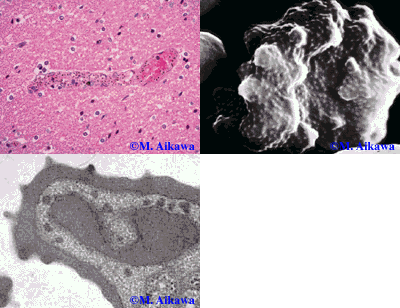
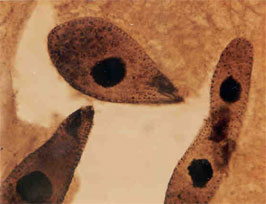
The protist Plasmodium is a spore-forming parasite with a complex life cycle that alternates between two hosts. Plasmodium cuases malaria, a serious disease characterized by severe chills, fever, sweating, an enlarged spleen, confusion, and great thirst. Plasmodium spends part of its life cycle growing in mosquitos of genius Anopheles, and another female mosquito acquires Plasmodium, when she bites an infected human. Later, when she feeds off a different human, she injects saliva, into the wound to prevent her victims blood from clotting. Her saliva transfers Plasmodium into the bloodstream. In humans, Plasmodium parasites are carried to the liver, where they reproduce. They reenter the bloodstream and invade blood cells. Plasmodium divides so rapidly that by 48 hours the cells rupture, releasing toxic substances into the bloodstreamand cuasing a high fever. The cycle repeats itself every 48 hours until the infection is brought under control by the person's immune system, or until the person finally dies.
Over 100 million people are infected with this protist at any one time, and every year about 1 million of them die of malaria. Since Anopheles, mosquitos are abundant in the tropics, nearly all of malaria's victims live in Africa, Asia, and South America. |
|