The purpose of my experiment was to compare the recruitment dynamics of the foraging ants in two identical scenerios, only two completely different forms of prey were used for each test and then the results were compared. In both tests a large fish aquarium that had been modified with plaster was set up and connected to the nest with a tube that was 2 feet long. A line was marked on the tube 8 inches from the end that exits into the aquarium.
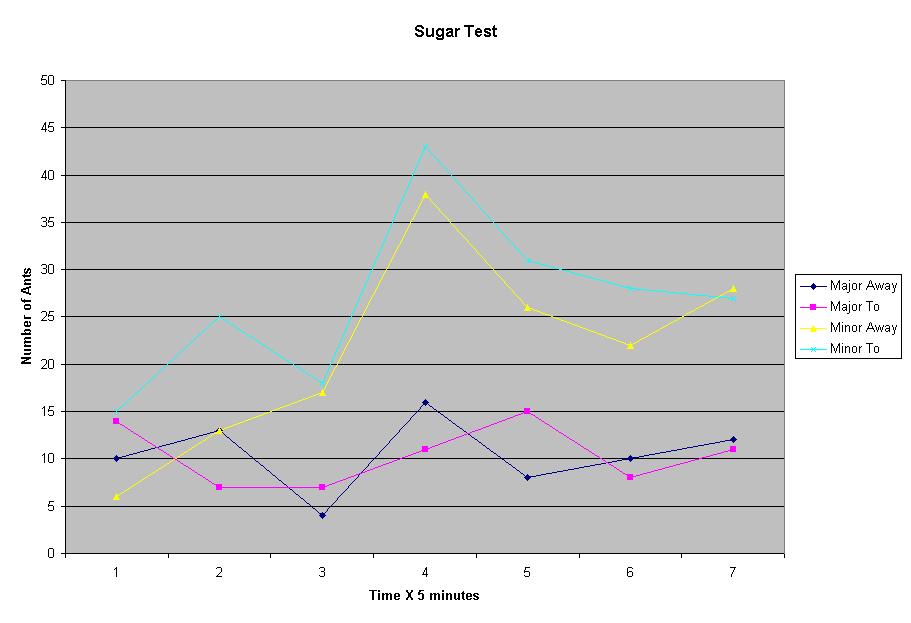
In the first test (Sugar Test), a pile of cane sugar weighing 3 grams was place 12 inches from the mouth of the tube. The ants were then allowed to travel between the nest and the aquarium through the tube. The ants were counted as they passed the line in the tube, the caste members and direction were counted(ie: worker major going to aquarium, worker major going away from aquarium). This was counted for 35 minutes, and at each 5 minute point the talley marks were circled and labeled(to give us a time fram to measure). The data was collected and graphed(see table 1).
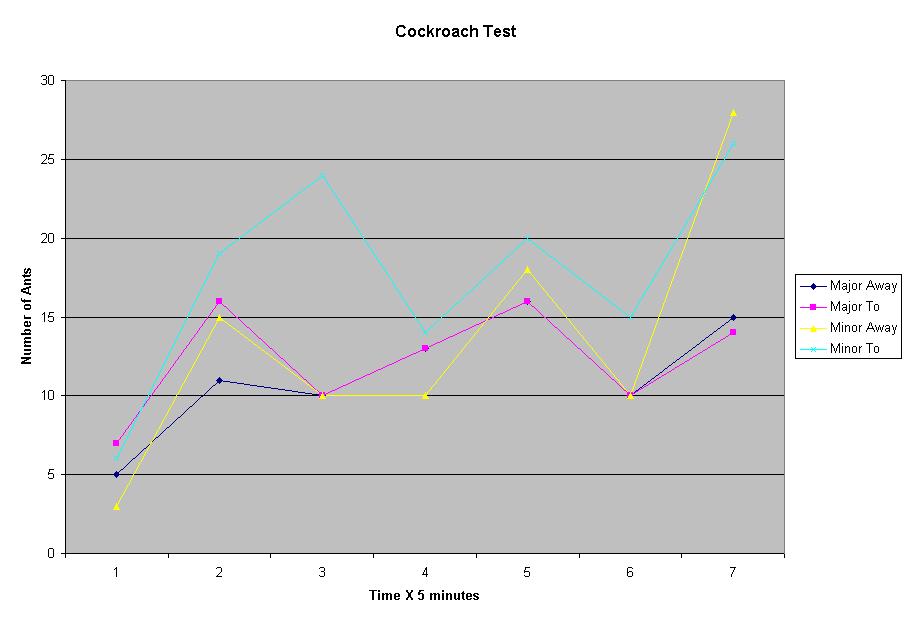
The second test was identical to the first, except the prey was a live cockraoch that had been injured and immobilized(see table 2)
The hypothesis was that the dynamic of pherimone recruitment would be greater when the prey being retrieved was less retrieveable. In other words, the rate at which ants move to and away from the aquarium should be greater and more accelorated when the cockroach is introduced than when the pile of sugar is. |