| The Ant Project |
| I am very obsessed with ants, it is a crazy thing I must admit, yet very true. My obsessions go in this order: Bagpipes, Celtic history/geneology, Ants,... Ants are so incredibly perfect, their social skills are flawless, they truly are the "perfect society." If only human society could be so efficient and productive. This year (2001-2002) I took an Advanced Biology course at my high school and at the end of the school year (now) we are supposed to do an experiment that pertains to something in a paper we were supposed to write. Of course, my paper was on ants, and so is my experiment. However, my experiment requires a little more than just experimentation, it requires hours and hours of mental and manual labor, and problem solving. Because of this, I prefer to call this an "Ant Project." This page will be a step by step "journal" of sorts of what was done to make the experiment work. As I write this now the project is not completed, so therefore, I will have to make a continuation. |
| Part 1: The Building of the Nest |
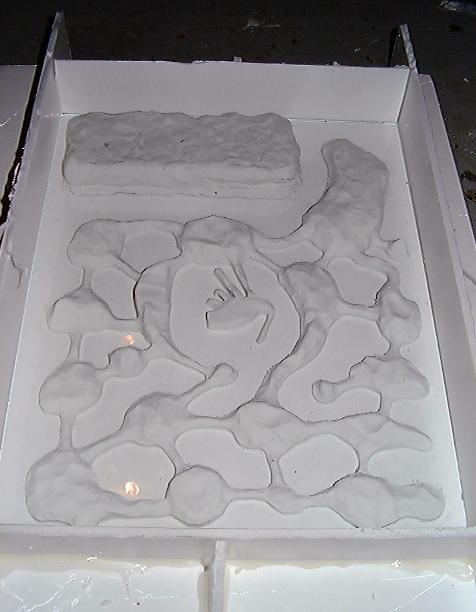
| My plan was to build an artificial nest to house an entire colony of ants, queen and all. I chose to build my nest out of plaster with the matrix of chambers already formed for the ants, so the ants shouldn't have to do any digging related work at all. To do this I took a pane of glass (8" X 14") and molded the reverse of what the chambers would look like to the glass, I then built a frame around the glass for when I poured the plaster (see figure 1). |
 |
| Next I mixed up the plaster and poured it in, but first I inserted two tubes into spots where I fancied putting entrances. I let the plaster set and cure (see figure 2). |
| Figure 1: This photogragh is actually reversed so that what you see is the way everything will be after the nest is cast. |
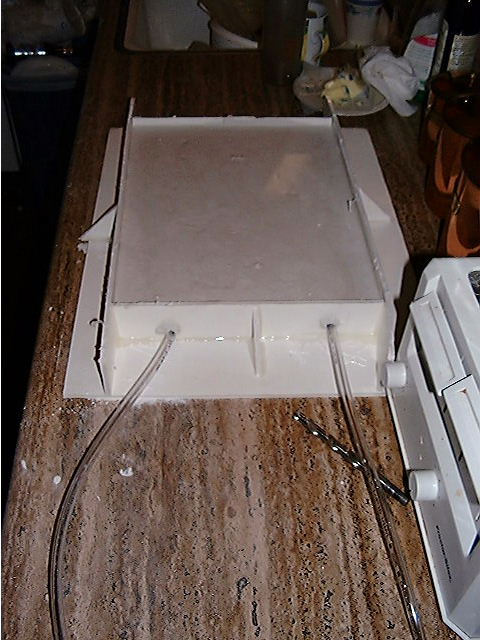 |
| Figure 2: The tubes I used were 3/8" by 1/4" |
| After the plaster had cured, I carefully removed the frames, flipped the entire unit over, and very very very very carefully removed the glass with four butter knives. After the pane had been removed, I then proceded to scrape the clay from the glass and clean the glass up very well (It is important to clean it now, because the ants like to poop on it and rub thier nasties all over it when they are inside). after this was done the chambers were all smoothed out and scraped clean with sand paper (see figure 3). |
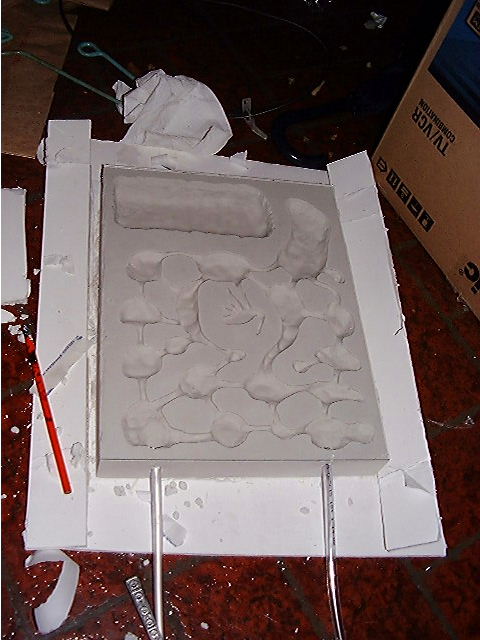 |
| Figure 3: A'i'n't she a beauty |
| Note: The large rectangular cell is for holding water in order to keep the proper humidity in the nest, the humidity also provides condesation on the glass which is a convenient way of spreading drinking water to the entire colony. |
| On to Part 2 ----------> |
 |