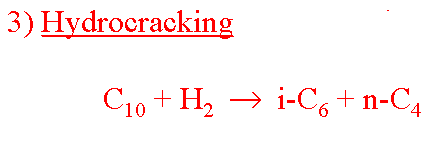
|
Catalytic Reforming
1. Purpose: Unlike catalytic cracking and hydrocracking, the objective of catalytic reforming is to convert heavy straight run gasoline and naphthas that have a low octane number into gasoline products with a high octane number (RON=100). Also, a valuable by-product of this process is hydrogen that can be used in hydrotreating or hydrocracking. 2-Reactions: The two major reactions that take place in a reformer unit are cyclization and isomerization. The extent to which these reactions take place increases as the number of carbons per molecule increases. For this reason, only heavy gasoline streams are fed to a reformer unit. Desired reactions:
Undesired reactions: Formation of butanes and lighter fractions through dealkylation of aromatics and naphthenes along with hydrocracking of paraffins and naphthenes
3. Process Diagram
|
|