About
Vega de Liébana |
Activities - Adventure | Food and Restaurants
| Bathed
by the river Deva and its tributaries, this is an extremely
mountainous region with peaks such as Peña Prieta,
at 2,536 m altitude. It borders on León, in the
foothills of the San Glorio pass.
In the Early Middle Ages, it was called Valle de Cereceda,
and settlements appeared during the repopulation instigated
under the reign of King Alfonso I. This is the land
of the Salcedas, valiant fighters against the Moors,
which were the cause of many clashes for ownership between
the nobles of Manrique and Mendoza, finally falling
to the future Marquis of Santillana.
Vega de Liébana has considerable ethnographic
wealth. It currently upholds traditions like the popular
dances of Pericote and Trepeletré. Ledantes preserves
the only pisa (a primitive wooden device for textile
manufacture) in Cantabria.
Artistic expression is mainly rural and highland in
nature. The historical monuments at Dobres and Cucayo
are particularly outstanding and have been declared
a cultural heritage site.
The countryside in the area is exceptional, containing
places of impressive beauty and villages of peculiar
charm. Llesba vantage point, at 1,609 m altitude, provides
a magnificent glimpse of the Picos de Europa.
Local cuisine is known for its Liébana cocido
(a type of stew) and Toranzo wild mushrooms. |
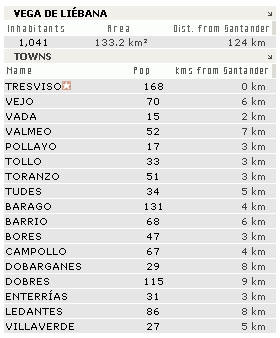
 Capital
of municipality Capital
of municipality
|

Horse-riding, snowboarding, white-water rafting,
walking, diving, sailing, canoeing, guided tours, climbing...
Everything your body can handle can be found on offer from
the specialist companies presented here.
| Adventure tourism has combined
a growing interest in outdoor holidays, the rapid
growth of equipment manufacture and the increased
capacity of commercial operators, including clothing
and equipment wholesalers, to provide a wide range
of "activity" holidays. |
 |
Nowadays,
adventure tourism is one of the fastest growing
sectors in the tourist industry and has increased
its presence and attraction in the world of tourism
and international travel. The variety and easy availability
of adventure tourism products for a wide range of
interests and abilities seems to be limitless. |
| We propose
this heady setting for your adventure of choice:
paragliding, hang-gliding, abseiling down a rock
face or pot-holing in underground caverns. |
 |
| The heights come courtesy of the
Cantabrian landscape, one of the largest protected
areas in Europe; all you have to do is bring the
adrenalin and chose your form of descent. Just let
yourself go. |
|
- Rafting
Get ready for a soaking! It's part of the fun of white-water
rafting. From simple river trips to the excitement
of major rapids.
- Wave Canoeing
Use the force of the sea to move and the paddles to
steer, although you can also use them for propulsion.
- Hang-gliding
Gliding on a simple rigid structure, whose movement
control system is the weight of the pilot.
- Walking
The pleasure of following a path, although not necessarily
in the countryside, but still guaranteed to include
elements of natural or cultural interest.
 Check Guias
de Montaña Las Hazas website to know more
about the activities in Vega Liébana.
Check Guias
de Montaña Las Hazas website to know more
about the activities in Vega Liébana.
(Site in Spanish)
|

The Cantabrian sea supplies the region with
its most characteristic food: the finest fish and seafood.
The turbulent waters provide goose barnacles, all kinds of
crab, clams, lobsters, crayfish and king prawns, not to mention
squid of the highest quality, also sea bream, scorpion fish,
anchovies and roast sardines (traditional in the region) served
on a simple wooden dish. These waters also provide some of
the most renowned Cantabrian dishes: hake in salsa verde,
maganos encebollados, or baked clams.
| Beef is the finest Cantabrian meat, in particular
the beef of the Tudanca cow. Also, the largest livestock
fair in Spain is held in the region: the Feria Nacional
de Ganados in Torrelavega. There is also high quality
game: wild boar and a variety of venison. Pork is a key
ingredient of the "cocido montañés",
which also includes beans, cabbage, rice black pudding
and other ingredients.
The desserts are also particularly delicious, especially
the "quesadas pasiegas" (cheesecakes). Pastries
are also traditional and are given different names in
different areas: Corbatas in San Vicente de la Barquera;
Polkas in Torrelavega; or Sacristanes in Liérganes.
|
|
Restaurants
Below a list of restaurants that
you will find in the area:
|
|
|


