
I was recently posed the problem of devising something which wouldn't
have the 'rigour' of nipple clamps or nipple rings, but could be
reliably and repeatedly attached to encircle the nipples, other than
the slightly fiddly process of tying cord around them. All the above information assumes you have a little successful knowledge of DIY. If you have little ability and aptitude in this area, it may not be for you. The information here is presented in good faith, but the writer cannot accept responsibility for any subsequent accident or injury, however caused. This page hosted by
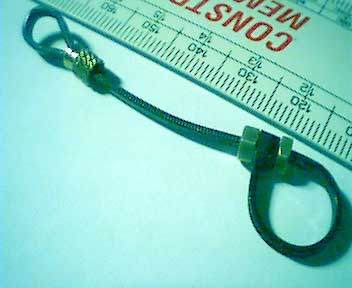 I used 2.5mm (1/8") plastic cable ties, with the 'tail' pushed the
'wrong' way through the locking part, to form a non-locking variable
'noose'. Prior to making that loop I threaded a very small hexagon nut
onto the tie, to act as a 'forestop', to prevent the band being over-tightened, and after the loop was made, a further nut of the same size
threaded on, to keep the loop closed. The adjustment of the 2 nuts
gives a very precise and repeatable setting to how tight the bands are
applied.
I used 2.5mm (1/8") plastic cable ties, with the 'tail' pushed the
'wrong' way through the locking part, to form a non-locking variable
'noose'. Prior to making that loop I threaded a very small hexagon nut
onto the tie, to act as a 'forestop', to prevent the band being over-tightened, and after the loop was made, a further nut of the same size
threaded on, to keep the loop closed. The adjustment of the 2 nuts
gives a very precise and repeatable setting to how tight the bands are
applied.
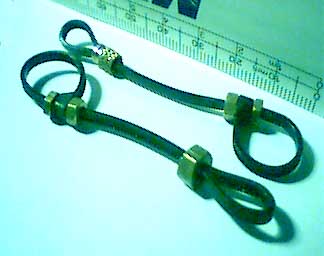
A third slightly larger nut was used to form a second loop,
by doubling over the remaining 'tail' of the cable tie, allowing easy
tying of the bands to other things?
Fortunately in my 'bit box' I had a single small knurled and threaded brass collar, which was just the right size to make the second loop. Unfortunately I only had one of those, so on the second band of the pair, a conventional hexagon nut is used.
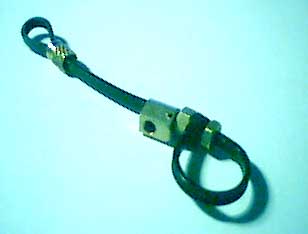 The final pic shows the band with the 'tamper-resist' collar added. This is made from the small brass inserts, which are part of
'terminal strip' (12 brass terminals in a polythene insulated block,
used to connect electrical wires), and are conveniently sized to fit over the pin of a buckle to prevent it being undone.
The final pic shows the band with the 'tamper-resist' collar added. This is made from the small brass inserts, which are part of
'terminal strip' (12 brass terminals in a polythene insulated block,
used to connect electrical wires), and are conveniently sized to fit over the pin of a buckle to prevent it being undone.
The full details of how to make the 'tamper resist' collars can be found here.
If the corners of the 'backstop' hexagon nut prove to be an undesirable 'irritant' to the wearer, the width of the locking part of the cable tie can be reduced, by filing or cutting with a hobby knife. This will move the nut further to the 'corner'. Alternatively, or additionally, the corners of the hexagon nut may be filed more to a 12 sided, or circular profile. This will make 'field' adjustment of the ties less easy, but the brief was to produce something which would just grip, with a minimum pain or discomfort, so smoothing the profile the inner nut may be necessary to achieve that.
 Get your own Free Home Page