
There are a few locking-buckling arrangements generally available, from the D-ring type,
which fits through slotted holes in the strap, with a padlock locking through the D-ring, to buckles with a loop-end to the
pin, allowing a much smaller padlock to be fixed through the loop. All the above information assumes you have a little successful knowledge of DIY. If you have little ability and aptitude in this area, it may not be for you. The information here is presented in good faith, but the writer cannot accept responsibility for any subsequent accident or injury, however caused. This page hosted by
If you already have the buckling 'device', but would like to lock it,
or at least make it difficult to remove, the options are usually
limited. They may spoil the appearance and workings your 'device', and are not always practical.
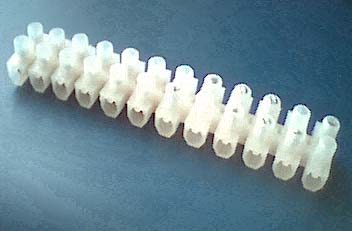 I've recently found that the small brass inserts which are part of
'terminal strip' (12 brass terminals in a polythene insulated block,
used to connect electrical wires) are conveniently sized to fit over
the pin of a buckle to prevent it being undone.
I've recently found that the small brass inserts which are part of
'terminal strip' (12 brass terminals in a polythene insulated block,
used to connect electrical wires) are conveniently sized to fit over
the pin of a buckle to prevent it being undone.
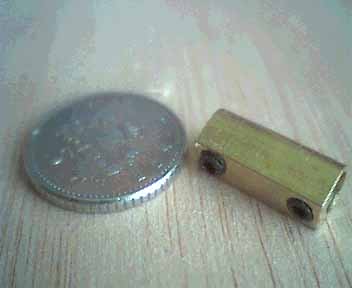 The more resourceful escapees could find some screwdriver-like blade
to undo the screw of the brass insert? A useful coincidence is that
the 13 amp sized terminal strip screws, seem to have identical threads
to the small grub screws, which sit in Fender (and copy) guitar
bridges. These require the correct size Allen key to undo, after
modest tightening.
The more resourceful escapees could find some screwdriver-like blade
to undo the screw of the brass insert? A useful coincidence is that
the 13 amp sized terminal strip screws, seem to have identical threads
to the small grub screws, which sit in Fender (and copy) guitar
bridges. These require the correct size Allen key to undo, after
modest tightening.
Before you raid your local music emporium, and to save
you leg work, engineer's merchants often keep the same screws which
are M3 and various lengths. M3x5 is probably optimum, although M3x3
can present a 'flush' finish to the brass strip, but can be screwed
completely 'through' the strip and drop out, if careless.
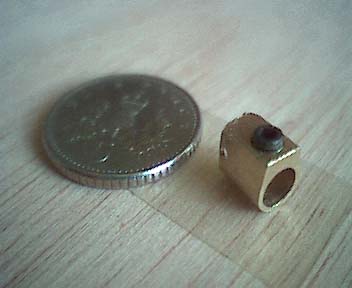 Each insert can take 2 screws and can be cut in two to secure 2
buckles, providing you are dextrous enough to deal with the smaller
size. The non-cut inserts don't have sharp edges, but do have edges
which could indent your straps, so if in doubt, best to smooth down
the edges with a small file, and emery cloth to finish.
Each insert can take 2 screws and can be cut in two to secure 2
buckles, providing you are dextrous enough to deal with the smaller
size. The non-cut inserts don't have sharp edges, but do have edges
which could indent your straps, so if in doubt, best to smooth down
the edges with a small file, and emery cloth to finish.
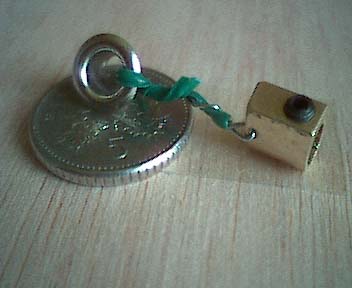 If you're using the smaller 'half-insert' size, which suits use with small buckles, you may want to drill a small hole through the insert at the edge away from the grubscrew, so that a wire or fine line can be threaded through and a bead or other visible marker attached. This will aid holding the insert, and also aid finding it if accidentally dropped.
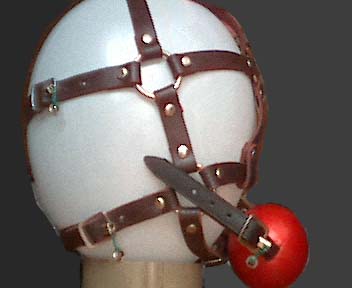 The head harness shown here has 7 buckles in total. The T/R-inserts can be seen used at the 2 buckles at the head part of the harness and one T/R-insert at the buckle of the ball gag.
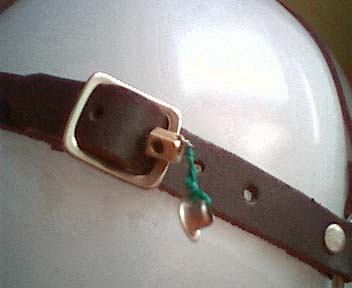 This is a close-up of the T/R insert used on one of the harness buckles. The attached marker eyelet can easily be seen.
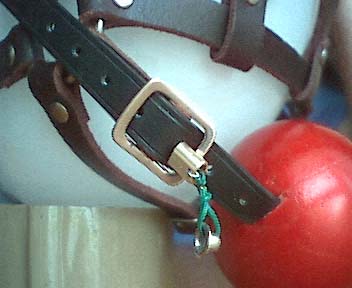 This is a close up of the insert used at the gag position of the harness.
Best to have 2-3 correct size Allen keys at your use only, to avoid
embarassment/disappointment/accident, and if your escapee is very
resourceful, rubber gloves and a metal detector?
 Get your own Free Home Page