 |
 |
 |
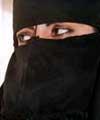
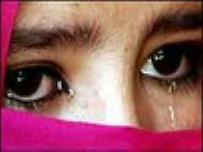
| BRIEF DESCRIPTION OF THE VEIL A veil can be described in many ways. According to online dictionaries, it can be used to describe the headgear accessory of a bride, a part of a nun's headdress that surrounds the face and cascades to the shoulder, the life or promise of a nun, a netting material that is worn on a woman's hat for the purpose of decor or to protect the face, and/or in biology terms it is a covering body part or membrane. However, the most controversial use of the term veil is when it describes the headdress of Muslim women. The veil may also be defined as a hijab, burqa, burka, chador, kimaar and/or niqab. The main features of the veil is that it is a head piece that covers the entire body and hides the face only leaving small hole or netting for the user to see. HISTORY OF THE VEIL The establishment of the veil has been presented in many different forms. It can go back in time with Muhammad or it is was also said to be established on religious concepts and beliefs. According to history, the veil was created after several incidents when Muhammad's wives were insulted by individuals who were going to the Muslim sanctuary in search of the prophet. (Fernea 20) These individuals mistaked the women for slaves, so Muhammad believed that his women should be placed in a special genre. That is when Muhammad established the hijab. (Fernea 20) According to historian Nabia Abbot, "Muhammad's women found themselves, on the one hand, deprived of personal liberty, and on the other hand, raised to a position of honor and dignity." (Fernea 20) Of course, on the religious concepts of the establishment of the veil, the Koran (which is the prinicple religious book of almost the whole Middle-East) states that Islamic women should be modest with their clothing and behaviour. There is a Koranic verse which dictates a barrier between men and women is known as the Sura of the hijab which proposes, "Prophet, enjoin your wives, your daughters, and the wives of true believers to draw their veils close round them. That is more proper, so that they may be recognized and not molested. Allah is forgiving and merciful." (Fernea 20) SYMBOLISM OF THE VEIL (either for or against the veil) The veil like many other issues across the world has become a symbol of numerous concepts and descriptions. The veil is of course a symbol of the ideology of religion in the Middle-East because it holds the modesty that the Koran dictates. This holds close to it being a representation of resurgence of spirituality. It can also be considered as a symbol that proves mens' dominance. According to French ethonologist Germaine Tallion, the veil can be a symbol for that of "slavery of one portion of humanity" (Fernea 19). Since poor families cannot afford the veil, it can represent wealt and upper-middle class status. A worthy, respectable women who wears a veil in public signals, "Hands off. Don't touch me or you'll be sorry." (Fernea 23). Since prostitutes wear the veil in a sexual manner, the veil can either be a garment that is "sturdy, utilitarian, and forbidding" or "filmy and decorative, hinting at the charms beneath it" (Fernea 23). The two conflicting symbols is that of the veil holding the honor of the family and that of seclusion. |
 |