
March-April 1997
Volume 49, Number 2
Sheriffs Take On Rural Patrol Challenge
by
Richard B. Weinblatt, M.P.A.
Deputy II., Patrol Division, Santa Fe County, NM, Sheriff's Office
(Cover Story on pp. 10-11, 13)
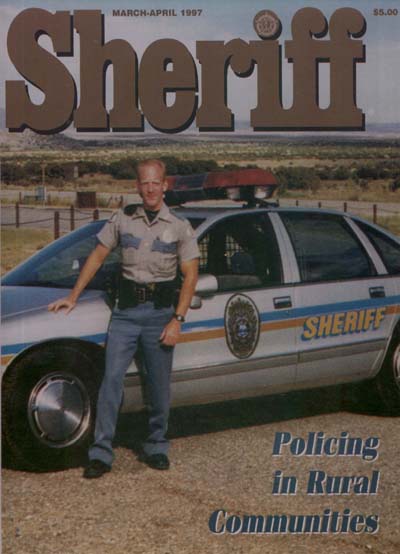
Sheriffs have learned to contend with limited manpower and a dwindling source of local government funding. Coupled with vast expanses of territory and increased demands for police services, sheriffs and their dedicated personnel have had to become creative in order to meet constituents' mandate for quality law enforcement.
Holding the enviable position of actually having adequate resources is the San Bernardino County Sheriff's Office. Resposnibile for a whopping 20,160 square miles, the alrgest geographical county in the nation, the California county has 1,093 deputies to provide services to a 1,757,000 population spread out over the unincorporated areas, 24 incorporated cities, and 13 contract service districts replete with an abundance of mountains and ranches.
In Wyoming, Park County Sheriff Bill Brewer has seen his 6,400 square mile county's valuation plummet from $750 million in 1985 to the present $280 million. Such a drop impacts his budget negatively as his agency has been cut back fiscally each year.
"We have eight people less than we did 10 years ago," lamented Sheriff Brewer, a former City of Powell, Wyoming, police officer and Wyoming Highway Patrol officer who has worn the sheriff's star for over 20 years. He has a total of 35 people in his office: 14 in patrol, 10 in the jail, and five in dispatch, as well as two cooks.
In Burke County, North Dakota, the presence of one of three 24-hour border passages to Canada keeps Sheriff Fred Marquardt and his four-person sheriff's office busy. His office also provides contract law enforcement services to three small cities located in the 3,000 population, 1,100 square mile county on the Saskatchewan, Canada, border.
"We've learned to prioritize since we can't be everywhere," explained the former university law enforcer who has served as sheriff since June 1989.
With one of the busiest per deputy call volumes in the southwestern U.S., Sheriff Benjamin L. Montano has been forced to become an innovator to stretch out his resources. The two-term sheriff of the 2,500 square mile, 121,000 population County of Santa Fe, New Mexico, which covers the state capital of Santa Fe, has recognized the hard work done by the 40 deputies in his patrol division (there are 72 sworn personnel total).
"The guys are tired answering all the 911 calls, but that's police work and we all do the best we can with what we have. It's not pretty," said Sheriff Montano who served as a City of Santa Fe police officer prior to his election.
Alabama's Shelby County Sheriff's Office, like the others, faces a large geography which appears daunting to many officers from more populated areas. Deputies are getting more calls and have found themselves to be 911 response oriented, as in Santa Fe County. A thinking appraoch is critical as the manpower is not available to surmount problems when a multitude of calls are received simultaneously.
"Our deputies have had to learn to use judgement because backup is further away and law enforcement visibility is lower than in a city," commented Shelby County Captain Chris Curry from his office in Columbiana, Alabama.
The six-year veteran said his 75 total sworn deputy agency with 38 patrol deputies to cover an 800 square mile, 130,000 population county immediately adjacent to metropolitan Birmingham. He added that the time for general patrol is rapidly dwindling in the face of increased calls for service without a commensurate deputy increase.
Mutual Aid
One common way that sheriffs have met the challenge of problems caused by geograph gaps is by mutual aid pacts reached with other area law enforcement agencies.
Santa Fe County, a heavily violent, call-laden jurisdiction relies extensivley on officers from the New Mexico State Police, bordering sheriff's offices, and several local tribal police forces. Cross commissioning has enabled those less busy officers to provide back-up to the call-driven deputies of Santa Fe County.
Park County uses the deputized officers of the Powell and Cody Police Departments and also gets backup from the Wyoming Highway Patrol to help their 14 patrol deputies (there are 35 total people in the agency).
Wisely not becoming complacent with their size, San Bernardino County has also welcomed assistance from fellow law enforcers. The sheriff's public information officer, Jim Bryant, indicated that officers with the California Highway Patrol and two large military base police contingents, such as 29 Palms, lend a hand, as do rangers with the United States Forest Service. Even Nevada officers are invited to cross the state line and assist.
The four-man Statenville, Gergia-based Echols County Sheriff's Office, 20 miles east of Valdosta, Georgia, actively participates in a five area county regional drug task force and relies heavily on the Georgia State Patrol. Echols County Sheriff Barry Sasser encourgaed fellow strapped sheriffs to explore encouraging their state police/highway patrols to handle the state roads in their counties.
[email protected]