
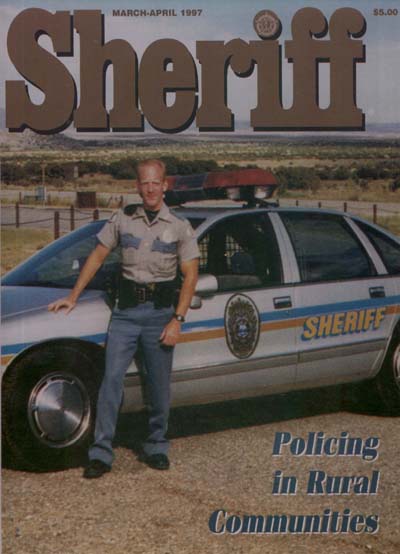
March-April 1997
Sheriffs Take on Rural Patrol Challenge
by
Richard B. Weinblatt, M.P.A., Deputy II., Patrol Division,
Santa Fe County, New Mexico Sheriff's Office
PAGE 2
Given the distances, sheriffs find their manpower even more thinly distributed as they have to use a resident deputy system for quicker response. Even California's San Bernardino County uses resident deputies in Trona and Barton Flats.
"I have an undersheriff and four deputies who work out of Powell and another deputy in the Crandall area," explained Sheriff Brewer from his Cody, Wyoming, headquarters of his allocation of the meager 14 patrol deputy force availbale to him.
Sheriff Montano has placed two deputies at the north end of Santa Fe County, near Espanola, New Mexico, as well as a sergeant and two deputies at the Edgwood south end, to speed up calls response.
Agents with the U.S. Border Patrol and even Canadian officers pitch in to help the Burke County Sheriff's Office keep the peace in the North Dakota/Canadian border county.
Reserve Deputy Assistance
One route to alleviate the problem is the extensive use of volunteer and part-time reserve type officers. Reserve deputies are often called at home and are able to respond quicker to a nearby scene than an on-duty deputy poised more often than not at the other end of the county.
"We have several reserves in the south county Edgewood area, near Albuquerque, and can call them out to handle a call quickly instead of sending a busy deputy out of Santa Fe with an hour's drive," said Sheriff Montano.
Shelby County has 12 reservists to aument the beleaguered patrol force, many of whom are fully certified as Alabama state law enforcement officers. Using deputies who reside in different corners of the county enables the sheriff to extend his reach and profile into the various communities.
San Bernardino has long been a proponent of reserve utilization and has one of the largest volunteer programs in the U.S. Over 1,000 state-certified reserve officers donate a minimum of 20 hours per month. The 23 units of the Search and Rescue/Mounted Posses, serving in such challenging locales as the Colorado River, donated 139,526 hours in 1995.
Take-Home Cars and Improved Equipment
The implementation of take-home car programs has gone a long way towards lowering costs, increasing law enforcement visibility, and expediting response. From the four-man Burke County Sheriff's Office to the much larger Santa Fe County, most sheriffs have moved to the use of individually assigned marked units.
Shelby County made the move in 1991 and Santa Fe has embraced teh concept since 1986. In fact, both counties aggresively issue take-home cars to qualified reserve deputies which enhances the agency's response time capabilities.
"With take-home cars, we get more coverage, a quicker response time, more recovery value for resale, better mainenance, and less downtime," opined Captain Curry.
While cars are the only source of transportation for most hard pressed sheriffs, San Bernardino boasts seven operational helicopters staffed by full-time deputies and augmented by reservists on the weekends. Based out of the Rialto Municipal Airport heliport, a helicopter from the fleet is also sent to the high desert area of Apple Valley, Victorville, and Hisparia from 2:00 pm to 10:00 pm.
Captain Curry said that boat house property theft and residential burglary problems identified at Lay Lake, at the south end of Shelby County, have been alleviated with the purchase of a $15,000, 19-foot boat used from April through October.
Radio systems were another problem cited by sheriffs who contend with terrain not encountered in city settings. Communications, vital for officer safety, is being recognized as just that- vital - and more elected officials are ansering the call for a solution than ever vefore.
Sheriff Montano said the Santa Fe County Commission has come through with around $1 million for a new 800 mhz trunk radio system which would effectively eliminate the many dead spots his mostly mountainous jurisdiction creates.
In its aim for officer safety, Shelby County is in the process of updating their computer aided dispatch to get quicker warrant and records checks and call location history. Such a system is vital when backup takes so long to arrive. Coupled with the improved setup will eventually be a global positioning satellite system to locate patrol cars.
Funding
Of course, central to the sheriff's duties are funding the patrol apparatus. Money, as exemplified by Wyoming's Sheriff Brewer, is tight. He was, however, able to get some additional monies for federal and city prisoners housed in his jail facility.
Some counties are on an upswing. Sheriff Montano recently garnered $3 million from teh county commission for a new headquarters on Highway 14 south of the City of Santa Fe, and Shelby County reversed its trend of being seriously underfunded for years. The county was tagged by The Wall Street Journal as being the fifth fastest growing county in the United States.
Sheriff Marquardt's location on the border is a two edged sword as demands increase, but so too does the opportunity for asset sharing forfeiture funds. While not as much as perhaps sheriffs in the southern border states reap, his share of the Canadian action makes a difference in the fiscal picture.
The federal COPS FAST grants have made an impact for some sheriff's offices. Sheriff Sasser reported that his four-man crew responsible for 429 square miles in the 3,000 population Echols County includes one recent addition addition made possible by the Community Oriented Policing Services grant program. Needless to say, the sheriff is a big advocate of his colleagues seeking federal grant money to add personnel.
Sheriff Montano, and the others interviewed for this article, emphasized the need for sheriffs to trust the people that elected them. The public's involvement in their law enforcement is utlimately the pivitol point, rather then more equipment or deputies. Such a mutaully embarked on agenda makes all the difference in teh challenging mandate to police rural territory which sheriffs across the U.S. contend with on a daily basis.
About the Author: Richard B. Weinblatt, a deputy II. with the Patrol Division of the Santa Fe County, New Mexico, Sheriff's Office, writes regularly for national law enforcement magazines. He holds a Master of Public Administration in Criminal Justice degree.
[email protected]