Commission News
HOUSEHOLD PRODUCTS DATABASE
Date: 24 Dec 2003
From: "Peter Montague" {[email protected]}
By Erin E. Dooley, Environmental Health Perspectives, 16 December 2003
Each day most of us spray, spread, squeeze, pour, and shake any
number of chemical products onto our bodies and into our home
environments as part of our daily routines. Household shelves display
a bounty of chemical products ranging from pesticides and drain
cleaners to shaving cream and air fresheners. In 2002, U.S. consumers
bought more than $20 billion worth of household cleaners alone. To
provide consumers with a reliable source for information on how to
safely use household chemical products, the National Library of
Medicine (NLM) offers the Household Products Database, located at
http://householdproducts.nlm.nih.gov/index.htm.
The database, which is planned to be updated periodically, currently
contains information on more than 4,000 consumer brands. (The initial
brands included were selected based on market share and shelf presence
in the Washington, D.C., and San Francisco metropolitan areas; today,
users may nominate additional products for inclusion.) The site also
offers contact information for manufacturers and poison centers, as
well as a glossary of terms and acronyms used in material safety data
sheets (MSDSs), access to toxicity reports, and other resources that
consumers may consult for more detailed chemical information.
The Products page groups products into seven categories: Auto
Products, Home Inside, Pesticides, Landscape/Yard, Personal Care/Use,
Home Maintenance, and Hobbies & Crafts. Selecting a category pulls up
a list of more specific product groups (for example, insulation-
related items) and then a list of product types (for example, duct
wrap or spray foam). Selecting a product type pulls up a list of
specific brand-name products, each with its own comprehensive entry
based on data from the product's MSDS. Visitors can also browse
through an alphabetic product listing or search for specific products
by brand name, type, or manufacturer.
Individual brand entries include complete manufacturer contact
information, an overview of acute and chronic health effects the
product may cause, recommendations for first aid, tips for safely
storing and disposing of the product, and a listing of ingredients
from the MSDS or product label. Each ingredient name links to more
detailed information including synonyms, health studies done on the
chemical, toxicity information in the NLM's TOXNET database, and
chemical information in its ChemIDPlus database.
On the Ingredients page, information on product constituents can be
accessed using either a chemical's name or its Chemical Abstracts
Service registry number. Searches bring up information on the chemical
as well as a listing of products containing that ingredient. The MSDS
page allows visitors to search for information on specific health
effects. Entering a health effect (for example, muscle pain or nausea)
into the search field pulls up a listing of relevant products.
The website also lists other resources of interest including links to
the Environmental Protection Agency Consumer Labeling Initiative and
its site on hazardous products in the home, and to the American
Association of Poison Control Centers.
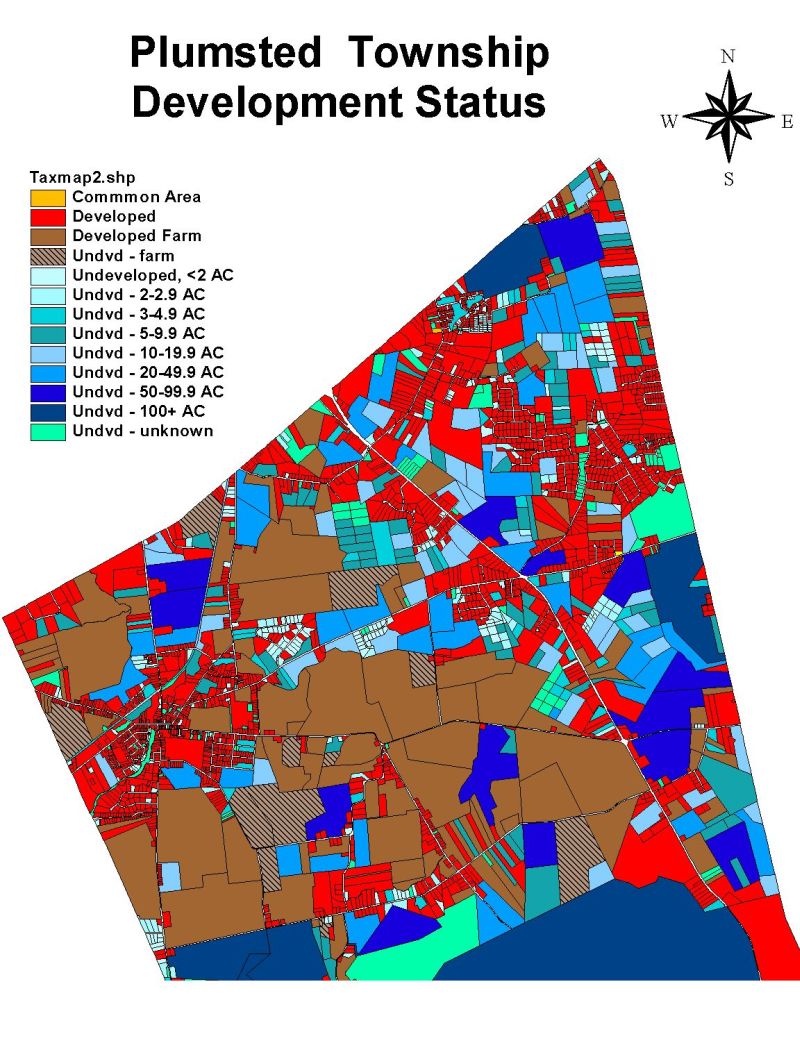
New Open Space Plan
Under the direction of Chairmain Ralph Bitter, the environmental commission has created a Plumsted Township Development Status map.
ATCM to Limit School Bus Idling and Idling at Schools
http://www.arb.ca.gov/toxics/sbidling/sbidling.htm
Check out this important link about school bus idling. Because children breathe 50 percent more air per pound of body weight than adults, they are the ones who become most affected. Find out more at the above website to understand the dangers of school bus idling and to find out what you can do to help.