
|
|
Texas
Holdem Rules |
|
Highest hand wins ||
Players may use one, both or neither of their hole cards to make their
highest hand || Ace plays both high and low for straights || Three
raise limit per round || Cards speak |
|
Card
Distribution and Betting Procedure
|
|
|
|
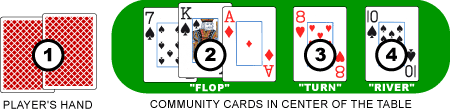
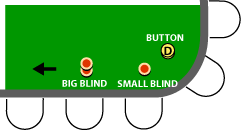
Example: $2/$4 Hold'em with a double blind At casino Hold'em tables, a round plastic marker called the dealer "button" is placed in front of the player who would be dealing if a house dealer were not provided. The button is moved one seat clockwise after each game and the card distribution and betting starts to the left of that position. Each player is dealt two cards face down. Then, a total of five community cards are dealt face up in the center of the table in three betting segments (3-1-1). After all the cards are dealt the players make the best hand that they can by combining either one, both, or neither of their two hole cards with five community cards. Using the illustration above, a player holding a king and a ten would end up with two pair, kings over tens with an ace. With this board, that player's two pair would be vulnerable to higher two pairs, trips, straights and flushes. |
|
||
| When the betting gets back around to the small blind, he or she can fold and lose only the half minimum bet of $1 placed earlier, call the amount necessary to get up to the betting level or raise $2 if there is a raise left. The big blind is then the last to act before any cards are turned up in the middle. The blinds are played in the first round only( 2.) The dealer turns three cards up in the center of the table. This is the "Flop". As always, the player at the left of the button is first to act. There are no more forced bets and the players can all check around if they want to. Bets right after the flop are at the $2 minimum bet level. (3.) Now comes the "Turn" card with more betting that now goes to the $4 level (4.) Finally the last, or "River" card is turned up. The last $4 betting round takes place. The players still in the contest reveal their hole cards and the highest hand wins the pot. | ||
Hold'em Strategy General Hold'em Strategy: Hold'em is basically HIGH card game. The players holding two good high cards have the best chance at the best hand or a draw to the best hand after the flop. Only play strong hands, that will stand a raise or multiple raises, from early betting positions. Play medium strength and other playable hands from the later positions if you have a good chance of seeing the flop at a reasonable price. Play strong high hands MOST of the time, and play them very aggressively. Take all the raises you can get. If you don't thin out the competition, you reduce your chances of winning. Plus, your aggressive play before the flop can add credibility to any strong play you might want to use on the next round if a garbage flop falls and you want to try a steal. Be ready to fold your high pair if you get a lot of action with a threatening flop. |
||
Definitions: HIGH CARDS - A thru 10 (Aces, Faces and Tens) MEDIUM CARDS - 9 thru 7 LOW CARDS - 6 thru 2 SUITED PLAYER HAND (S) - Both cards of the same suit. NUT HAND - An unbeatable hand. Sometimes called a "lock". FLOP, TURN. RIVER - The community cards in the order of distribution. See top illustration. FAST PLAY - Bet, raise and re-raise to get as many other players out as possible. SLOW PLAY - Just check or call along to keep other players in the game to increase the pot odds. CHECK-FOLD - Check when you can and fold if you are bet into. Gladly accept all free cards offered. |
Tips:
- Read books to learn more about proper strategy.
- Only play in low limit games as a beginner.
- Practice at home with tutorial software.