|
The Mysteries of ancient civilizations like magnet are attracted to themselves more and more people all over the world. The modern people want to reveal secrets of ancient civilizations which inaccessible for the fundamental science. We want to get outside ancient knowledge, find the secret of eternal life and understand ourselves.
Secret knowledge is opened to people when they ready to perceive them. Since ancient times mankind has used the language of a symbol. Our ancestors had great wisdom while giving their knowledge and experience through symbols. This is very powerful language of the subconscious which have got a plenty of information of the wisdoms and power. In this article I want to tell about the mystic's symbolism in miniature sculpture of the Oriental Asia like netsuke.
A wide of motifs are used for netsuke designs. More motifs were adopted from Chinese legends and stories. Generally speaking the most of Japanese heroes, sacred subjects, objects of faith and worship, mythical beasts and birds were being appeared when Buddhism and Daoism were extended to Japan. In fact, it is safe to say that is hardly a design possibility left unexplored. I would be difficult to say all of them, so I will tell about more interesting of them.
Sennin
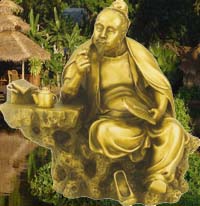
Sennin are sages who possess magic power, the ability to appear in various manifestations, and the secret of eternal life. There are two books from the Han and the Chin dynasties which listing various sennin and giving their individual biographies, name seventy-three and ninety-two sennin respectively, with only three sennin appearing in both books.
With some of the netsuke in this volume, it is not certain exactly which of sennin is depicted. In this case, I have used general descriptive terms such as "tiger sennin" or "dragon sennin".
Tekkai
Tekkai (T’ieh Kuai) is a sennin from the Sui dynasty. Tekkai entered the body of a beggar who had died of starvation; hence he appears as a lame and poorly dressed figure. As Tekkai is said to have breathed himself out of this manifestation, he is sometimes portrayed as a small figure coming out of the mouth of a larger one.
Gama-sennin
Gama-sennin (Ko Hsuan) is toad sennin. He is from the ancient state of Wu. Often associated with toads (gama). He is the subject of ballad and a dance drama in Japan.
Tobosaku
Tobosaku (Tung Fang Shu) is sage enjoyed the favor of the Han emperor Wu Ti, whom he advised. Having stolen and eaten one of the magic peaches in the garden of the Queen Mother of the West His Wang-mu (Seiobo), he obtained immortality. His story appears in the Stories of the Han Emperor Wu.
Chokaro
Chokaro (Chang Kuo Lao) is a sennin from the Tang dynasty. He rode a white donkey and could travel tens of thousands of miles in one day. When he took a rest he would fold up the donkey and place it in a gourd. Whenever he needed it again he would pour out the liquid from the gourd and it would turn back into a donkey. A Japanese proverb about “the horse from the gourd” is a modification of this story.
Taketori monogatan
This is the tale of the bamboo cutter were written in the Heian period. This story tells of the rivalry between the emperor and five young nobles for the hand of the princess Kaguyahime, who had been found as a baby in a stalk of bamboo and raised by a bamboo cutter. At the end of the story she returns to the moon, her real home.
Urashima Taro
This motif revolves around the legend of Urashima Taro of Tango Province (the northern part of present-day Kyoto Prefecture) who was carried to the Undersea Palace of the Dragon King on the back of a five-colored tortoise. Urashima stayed there for three years, and as he was about to return home one of the ladies of the palace gave him a jeweled box, warning him not to open it. After returning to his village he opened the box and instantly aged the three hundred worldly years he had actually been away. This legend appears in ballad-dramas and a No play, as well as in classical poetry.
Horai
Horai (Mt. Feng Lai) is a mythical island to the east of China. It was thought to be inhabited by Taoist immortals. In designs it often appears in conjunction with treasure ships in which the Chinese were said to have set sail in their search for the island. The island is described in the Han shu, a history of China up through the Han dynasty, begun in the year A.D.78.
Shoki
Shoki (Chung K’uei). This was a Chinese god believed to protect against those demons and evil spirits that caused illness. A T’ang period story tells of Chung K’uei appearing to the emperor Hsuan Tsung (685-762; this emperor is most famous for having ruined his empire for love of the beauty Yang Kuei-fei) in a dream and exorcising the demons that were causing the emperor’s illness.
In Japan, Chung K’uei called Shoki, was used as a motif in the dolls and banners associated with the fifth month festivities for boys. A Shoki doll or image painted red was supposed to ward off smallpox. Shoki is usually depicted as having large eyes and a long beard. He wears a black helmet and long boots, and is shown holding a sword and grasping a small demon.
Kan’u
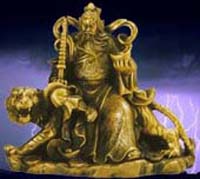
Kan’u (Kuan Yu) is a general from the state of Shu during the Three Kingdom period. He served Ryubi (Lui Pei) the king of Shu. He was later assassinated. Kan’u is depicted as very well-built, with a fine beard. There are numerous shrines in his honor in China. China. Kan'u is noble protector of weak people, faith and honor.
There are the Seven Gods of good fortune who were collected from other religions.
Ebisu is the protector of sailors, fishmen and tradesmen. He is usually depicted wearing a flattened hat and fishing for sea bream.
Daikokuten is protector of the nation and the household. He is usually shown wearing a hood. He has a large sack slung over his left shoulder, a small mallet in his right hand, and stands on bag of rice.
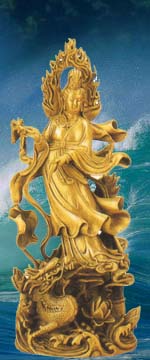
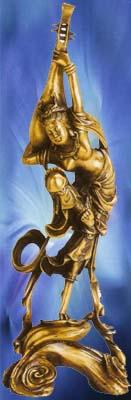
Benzaiten (also called Benten) is the goddess of music, oratory, good fortune, happiness and victory. Shi is usually depicted playing a lute. She sometimes has two, sometimes eight arms.
Bishamonten is one of the Four Guardian Kings (shitenno). He is protector of the North. He is usually shown as yellow, wears armor and holds a small jeweled pagoda in one hand and a halberd or jeweled staff in the other.
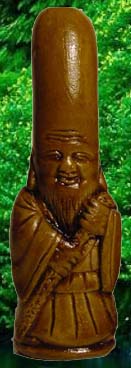
Jurojin is the god of longevity. He is shown as having an elongated head and holding a fan and a staff at the end of which is attached a scroll.
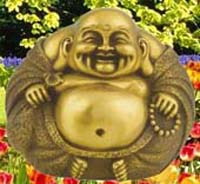
Hotei has a plump and amicable appearance and is popularly thought to be a manifestation of the Buddha Maitreya.
Fukurokuju is the god of wealth and happiness. He is often depicted with a short body, elongated head and long beard. He carries a staff on the head of which is attached a sutra scroll and he is seldom accompanied by a crane.
The precise names and attributes of the Seven Gods of good fortune have varied from age to age. The above list reflects the beliefs current at the end of the Edo period. The Seven Gods of good fortune were frequent subjects of popular ballads, as well as common design motifs. Netsuke of one or more of them was often to be found onside the home.
In addition to form and size, the selection of proper materials is also vitally important to netsuke making. From the standpoint of production, a material that lends itself to carving is needed. From the standpoint of use the maker looks for a material that is pleasing to the touch, free from flaws and not easily damaged or worn away.
Wood and ivory are the most often used materials for netsuke. Among woods, boxwood (tsuge) is considered to be the most suitable. This wood is fine-grained and durable. It has a fine luster and is the best wood for netsuke carving. Boxwood is also used for combs and carved seal stamps. Other woods are also used for making netsuke: cherry (sakura), black persimmon (kurogaki). Yew (ichii), tea bush (cha), camphor (kusunoki) and others.
I want to say that netsuke is very good gifting which is necessary to give the close people. This is the symbol of love happiness and good luck.
P.S. This is the fragment of my book about The Netsuke which is being waited its publisher. If you are interested in my book, please send me your message.
Happy journey on my planet and good luck!
|