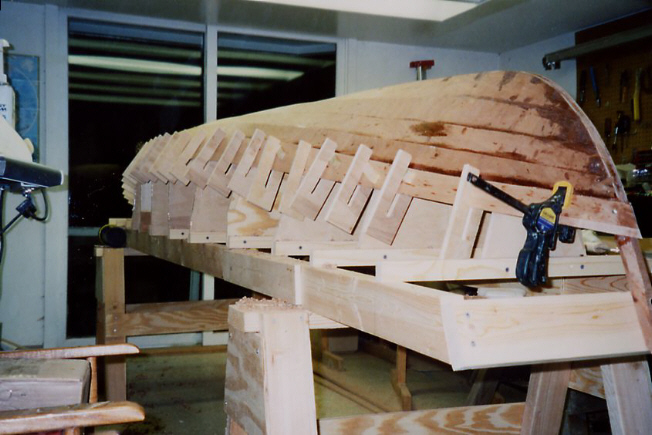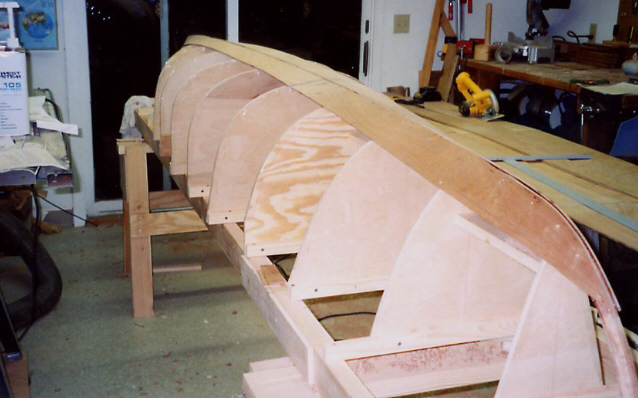
There is one thing that made this Wee Rob not quite a Wee Rob according to the plans. Ian Oughtred recommends making a pattern for every plank. I thought, �Do I really want to make a pattern from 3 mil wood to transfer it onto 4 mil wood?� It would be sort of like building two boats. So I cut six-inch �blanks� from my scarfed plywood and held them up against the molds to mark the lands directly on the stock. That worked fine for the first three planks, but then you get into a couple with a lot of shape. (Plank shapes on a curvy little boat are a mystery. You lay them out and there are all these forward curves and reverse curves and bends at the ends, and you think �That can�t be right.� Then you clamp the plank on, and somehow it jumps into shape beside its brothers and you have a boat.)
For planks four and five I just didn�t leave enough stock by maybe 3/8s of an inch. So to get four to mate correctly to the other planks and to hit the mold, I had to bend the heck out of it and screw it down far too tight. In the UK they call this construction �tortured ply� and I became the Torquemada of boatbuilders. The next plank just didn�t want to go on correctly at the stern of the boat. I tried to force it, but it was pulling away from the aft molds by almost an inch. But it looked okay that way, and when I loosened up the screws in the previous plank, they both looked even better. So I went with �if it looks right, it is right,� and now have a Wee Rob that�s about an inch fatter than it should be from stations 8-11. There is one person on the face of the earth who would notice, and he lives on the Isle of Skye, Scotland. In the future, I will do things the right way and make patterns.
I strongly encourage glued lappers to use the almost foolproof �screws and battens� planking technique used by John Brooks to get fair curves and minimize the problems of working with very slippery materials while alone (it�s described in WoodenBoat). But working with 4 mil plywood and wanting a bright finish, I compromised and used screws as extra hands and plywood clamps to hold the planks to the lands.
Once you've practiced a bit with your planes and have them good and sharp, I really don't think planing the lands is all that big a deal. Just keep checking the angle against the mold with a straight edge, and running your hands along the bevel to sense how it's supposed to change. It's a lot of work, but it can't hurt to offer up the plank to the boat several times and simply see if it fits, if you are really concerned about this.
When you use screws to attach the planks to the inner stem, you get a lot of squeezeout. and epoxy ends up smeared all over everything. I worried incessantly about this (as by now you know I do about everything), but when you clean things up and put on the finish, the solvents in the epoxy tend to mix with the solvents in the varnish, and it doesn�t really show.
There are fourteen planks on this boat, and on at least two of them I got tired and forgot to crawl up inside the molds and clean up the glue. The five minutes I saved cost me two days of cleanup. Live and learn.