
Once you�ve built your first glued-lap boat, you will find the lookers and spectators coming up to examine the �gains� � the area where the plank overlaps magically disappear into the stem and stern. This is done with what�s called a �disappearing half lap.� You gradually plane and chisel about a half-inch rabbet seven or eight inches long into the plank that's on the boat. Then you do the same to the inside face of the plank that�s going to be attached to the boat. Voila, the planks mate and become as one.
The problem is that hand-cutting gains is a delicate and time-consuming job. (With thicker stock the rabbet actually �rolls� and you end up cutting them at an angle. With 4 mil you can more-or-less bend them together.)
At WoodenBoat school we butchered a bunch of these. I personally cut one so thin that the final product was mostly epoxy. We got at least one on the wrong side of the plank, and the class idiot decided that the sheer strake needed a gain on the top for some reason � meaning we had to come back in the middle of the night to make a new plank. (Since there is absolutely nothing to do at night in Brooklin, ME, but work or sleep, this was not much of a hardship.)
On the last day of class John Brooks brought in a router jig he had dubbed the �Gain-o-Matic,� put a piece of scrap in it, buzzed the router for about 2 seconds � and out came a perfect gain. After hand-cutting 48 gains at about a half-hour apiece � not including the screwups � we all sat down and had a good cry.
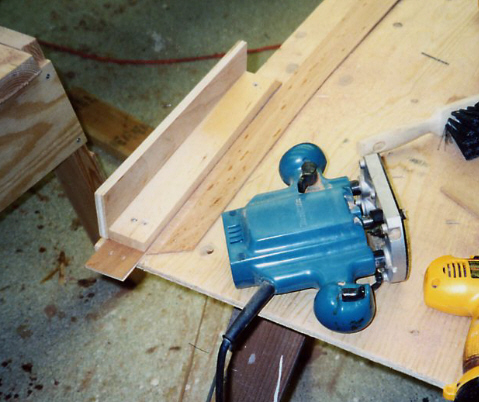
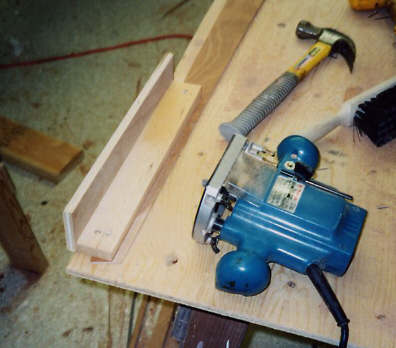
I determined to make a minor �Gain-O-Matic� myself. All you have to do is plane a piece of stock the width of your router base to match the length and depth of the gain. Screw a piece of scrap to the edge of the stock for the router to ride against. Screw (or clamp) the whole jig to the plank and rout the outside edge. For the opposite gain, put a piece of planking stock under the jig and rout the inside edge. To keep the plank from moving while being routed, I nailed it to the bench with brads. For thicker stock, you�d need to clean up the angle with a rabbet plane. For this thin planking, I put them right on the boat and bent them into place with screws and clamps.