
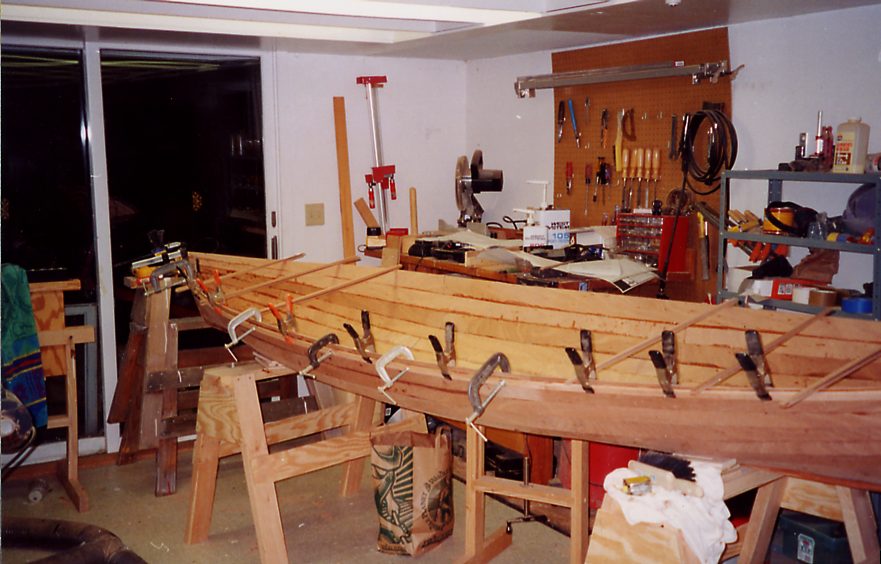
The teachers at WoodenBoat School talk about �getting a fair curve� incessantly and it�s as common in boatbuilding books as the "a�s" "and�s" and "the�s".
At first, I thought it was a lot of Maine boatbuilder bullshit. But now that I have built two boats and seen a half-dozen more boats built, I think the quest for the grail-like Fair Curve is a lot of what boatbuilding is about.
Most of us come to boatbuilding from furniture making or house remodeling or building stuff for our kids. 90% of all angles are right angles, and we have shops full of power equipment set up to achieve those perfect right angles. We build from plans that insist on perfect measurements to obtain results with no gaps or dips or odd curves.
Boats (other than those designed by Phil Bolger) have virtually no right angles outside the centerboard case. Beautiful, flowing, constantly changing curves are what make them go through water correctly and make them beautiful. I just sat thinking about it for five minutes: Wee Rob has no right angles in the whole boat. None. She is 100% curves.
If you try to force a boat exactly to the plans after a little mistake in the lofting, a little mistake in the molds, or a little to much to drink when setting up, you will get flat spots, flat sight lines and an ugly boat.
Two examples: 1) We were laying out a plank for a John Brooks "Ellen" dinghy. The batten looked funny as we put it down, with S curves and a hook at the end. John had us pull up the batten and nailed it to just a couple of points on the spiled line. Then he grabbed the end and gave it a twitch to allow it to assume the natural curve of the wood. Voila, the rest of the batten came right down to the lines � with the exception of one mark that had been throwing us off. We checked and checked and some of the guys swore the mark was right and we should force the batten to it. John said that would make an ugly boat and to go with what looked right. Believe me, that Ellen did not turn out to be an ugly boat � and now I always monkey around with the end of the batten no matter what I�m laying out to make sure I get a smooth curve.
2) Wee Rob has a lot of curve in the back as the planks sweep back from the seating position to the stern. I think it could probably use another mold to make sure the planks take that curve, but I didn�t know that, and at about plank number 5, I saw a flat spot. As I looked at the boat from a distance, I could see the flat spot growing and growing as I added more planks. It was making me ill. I thought I would have to add some wierd, heavy internal bracing to bring the curves back in. Then I clamped on the gunwale, a long, beautiful piece of mahogany. Like magic, the planking assumed the curve of the gunwale, and all was well. One minute, ugly, two clamps later, perfect. My wife couldn�t figure out why I was so deliriously happy that night, but I knew from that point on that Wee Rob would be a beautiful boat. The elusive �fair curve� had been achieved.
So throw away your squares, micrometers and calipers when boatbuilding and simply spend a lot of time looking at your boat from every angle. If it looks good, it probably is good. If you can�t tell what looks good, collect stamps.