Home
Cropcircles
UFOs
Bermuda Triangle
Formosa Triangle
Nazca Lines
Devil's Sea
Easter Island
Ummo Aliens
Vile Vortices
Contact
Guestbook
The Easter Island
Easter Island, known in the native language as Rapa Nui ("Big Rapa") or Isla de Pascua in Spanish, is an island in the south Pacific Ocean belonging to Chile.
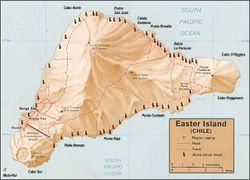
Located 3,600 km (2,237 statute miles) west of continental Chile and 2,075 km (1,290 statute miles) east of Pitcairn Island, it is one of the most isolated inhabited islands in the world. It is located at 27°09'S 109°27'W, with a latitude close to that of the Chilean city of Caldera, north of Santiago.
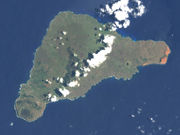
View of Easter Island from space, 2001
The island is approximately triangular in shape, with an area of 163.6 km² (63 sq. miles), and a population of 3,791 (2002 census), 3,304 of which live in the capital of Hanga Roa.
Easter is made up of three volcanoes: Poike, Rano Kau and Terevaka. The island is famous for its numerous moai, the stone statues now located along the coastlines.
Administratively, it is a province (containing a single municipality) of the Chilean Valparaíso Region. The standard time is eight hours behind UTC (UTC-6) (five hours behind including one hour of daylight saving time).
Cultural Artifacts:
- The Moai
- Stone Chicken Houses
- Rongorongo
The Moai
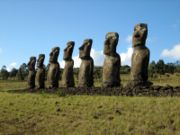
Ahu Akivi, the only moai facing the ocean
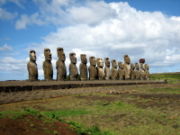
Ahu Tongariki, restored in the 1990's
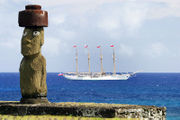
Moai from Ahu Ko Te Riku in Hanga Roa, with Chilean Navy training ship Buque Escuela Esmeralda cruising behind.
This moai is currently the only one with replica eyes
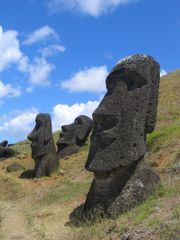
Moai at Rano Raraku, Easter Island
Stone Chicken Houses
There is archaeological evidence of intensive agriculture, including 1,233 prehistoric stone chicken houses (hare moa), which are more conspicuous than the remains of the prehistoric human houses (which only had stone foundations).
They were 20 or more feet long, 10 feet wide, with a small entrance for the chickens connecting to a stone-walled yard. The houses are believed by some to have originally served as graves.
Rongorongo
Tablets found on the island and bearing a mysterious script known as Rongorongo have never been deciphered despite the work of generations of linguists.
In 1932 Hungarian scholar Wilhelm or Guillaume de Hevesy called attention to apparent similarities between some of the rongorongo characters of Easter Island and the ancient Indus script of the Indus Valley civilization, correlating dozens (at least 40) of the former with corresponding signs on seals from Mohenjo-daro, Pakistan.
More Info see External links:
Click for Current Moon Phase
Registered Research Member of NSPIRES, NASA :

Affiliated Members of:


 Copyright© 2000-2009, All Rights Reserved. Design by Webmasters

