|
|
| |
| Anantnag |
| Information |
| Kashmir |
| India |
| General |
| |
| |
| |
| |
| |
| |
| |
| |
| |
| |
| |
| |
| |
| |
| |
| |
| |
| |
| |
| |
| |
| |
| |
| |
| |
| |
| |
| |
|
|
| |
| |
| |
| |
| |
| |
| |
| |
| |
| |
| |
| |
| |
| |
| |
| |
| |
|
Hari
Parbat Kashmir
Hari Parbat situated at the periphery of Srinagar
city is an ancient and one of the holiest places of Kashmir. It
is the abode of Mahashakti-the Divine Mother Jagatamba Sharika Bhagwati,
also known as Maha Tripursundhari or Rajrajeshwari (locally called
as harie). The eighteen armed Goddess Sharika is regarded as the
Presiding Deity (Isht - Devi) of Srinagar city. The Godess Sharika
is represented by a Sayambhu’ Shrichakra (Mahamaha Shrichakra),
also called Mahashriyantra, which consists of circular mystic impressions
and triangular patterns with a dot (bindhu) at the Centre. The mystic
Shrichakra engraved on a vertical holy rock (Shila) is located at
the middle of western face of Hari Parbat. The shrine can be approached
from Deviangan by a flight of chiseled stones, numbering one hundred
and eight. The number one hundred and eight has mystical signficance
in Hindu mythology. It is perhaps due to the Goddess Shrichakra
that the capital city of Kashmir is said to have derived its name
of Srinagar (Shrinagra)
As per the ‘Visishtadhvaita’ doctrine, ‘Shri’
is the Divine consort of of the Lord and is said to play on intermediatory
role between God and the human soul.
The Shrine of Chakrishwar has been a place of worship from the day,
the Goddess Sharika manifested Herself in the form of a ‘Shila’
on the Hari-Parbat.
To worship the Supreme Godess, the devotees used to go to Hari Parbat
regularly and reach the Shrine of Chakrishwar to be at the holy
feet of the Divine Mother in the wee hours of the morning. Phagun
Krishna Paksh Ashtami (Hora Ashtami) and Ashad Shukla Paksh Saptami,
Ashtami and Navami (Har Satum, Har Aatham and Har Navum) are the
auspicious days for the devotional congregational prayers at the
Sharika-peeth Chakrishwar.
Ashad Navami (Har Navum) is said to be the Birthday of Sha-rika
Bhagwati. On this day of Sharika Jayanti the devotees make sacrificial
offering of ‘Teher-charvan’ (rice boiled with turmeric
po-wder and mixed with oil and salt and cooked liver of goat) to
the Supreme Goddess. This ritual is locally known as ‘Chout
Kharoun’. On ‘Navreh’ (The new Year Day of Kashmiri
Pandits, during the month of Magh and ‘ ‘Navratra’,
the devotees regularly visit the Hari Parbat for special prayers
and worship.
Shree Yantra or Shree Chakra |
Shree Yantra is considered one of the most auspicious,
important and powerful Yantras which not only gives the maximum
benefit, but also proves beneficial for almost everybody. While
this Yantra has been used as a source of attaining all worldly desires
and wishes, the Yogis, saints and spiritual personalities, by virtue
of their devotion, have used it as an instrument to attain the ultimate.
To attain the ultimate, the great spiritual personalities have always
focused their energies on a “ Swayambhu” Maha Shree
Yantra considered to be in the old city of Srinagar, Kashmir. While
in India there are 52 energy centres, but the energy centre of Hari
Parbat Srinagar is considered the only of its kind in the entire
universe which has a great significance in terms of attaining spiritual
bliss.
The word “Shree” means wealth and “Yantra”
an instrument— and it makes the sense of “Instrument
for Wealth”. At Hari Parbat, where the Shree Yantra is considered
to be in the shape of a rock, people have craved for spiritual wealth
and they attained what they wished.
The whole hill of Hari Parbat seems to be the multi-dimensional
figure of geometrical figure of Goddess Sharika and at the corner
of the hill is this magnificent and holy rock and those who have
the eye to look at it can find different geometrical images in the
shape of triangles, squares and pentagons . On gets lost while gazing
at this energy centre as it emits different figures while concentrating
on it.
Although most of the lines and shapes are not so visible due to
the “sindoor” coated on it yet those who can see through,
can identify themselves to be a part of this holy rock.
It was great painter-cum-scholar of Kashmir— Late Ghulam Rasool
Santosh who was benefited by this Yantra in his art. Those who have
gone through his art work, could see how Santosh painted Shree Yantra
in his master-pieces in a bid to reach near to the ultimate.
Santosh could not carry forward his dream of deciphering all those
geometrical figures emitting from this holy rock and kits sorroundings.
There were many reasons for that.
After the mass migration of Hindus from the valley in 1990, this
place is presently a little in a state of neglect although visited
by people in one or two once in a blue moon. This author had an
opportunity to visit this foundation rock of Kashmiri Pandits in
recent past only to see some security personnel guarding it. Those
on the guard had high regard for the place but were unaware of the
importance of this Shila of Sharika— the Maha Shree Yantra.
The security personnel posted at this place said that there exists
a committee and it members visit quite often this place and also
arrange religious functions. They, however, regretted that under
the present circumstances, when Kashmir is in turmoil, this place
is by and large ignored in terms of visit by devotees and daily
prayers.
An elderly Muslim recalled those golden days when the Kashmiri Pandits
in thousands would visit this holy place every day. The youngsters
had no knowledge of this Yantra. A youth wondered how a person by
name of Ghulam Rasool (Santosh) was obsessed with this rock and
place.
This Shree Yantra has a great significance for Hindu community.
Those who have its knowledge, categorize it in two forms—
Evolution Yantra of Samyachar Order of Kashmir and Involution Yantra
of Koulahar order of Kashmir.
There are nine folds of Shri Yantra— Outer three circles that
depict the Chakra ruling the three worlds; Sixteen petals depicting
16 Yoginies associated with the attainment of desires; Eight petals—
depicting power of speech, holding, walking, excreting, pleasure,
abandoning, concentration and detachment; Fourteen triangles describing
all good fortune and associated with chief nadis or currents of
bio-energy; Ten outer triangles depicting Yognies of 10 vital breaths;
Inner ten triangles depicting Shakties of 10 vital fires; Eight
triangles depict powers that rule cold, heat, happiness, sorrow,
desire and three gunas— Sativas, Rajas and Tamas; Central
Triangle depicts Chakra giving all success and Bindu depicting Maha
Tripura Sundari— the ultimate.
According to Kamlesh Tufchi, member Satisar Foundation, the entire
hillock of Hari Parbat is a great Yantra. While Yantras are normally
two dimensional, this Yantra is a three- dimensional and that is
why it holds great spiritual importance, Tufchi said. The concept
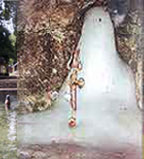
of three-dimensional Yantra is also vived by this rare picture that
was clicked by the author on his recent visit.
This foundation rock of Kashmiri Pandits has withstood the evil
and bad times. It is witness to number of occasions when Kashmiri
Pandits had to migrate from the valley. It is also witness to the
fact that Kashmiri Pandits have firm belief and faith in this energy
centre, the description of which is in Nilmatpuran and Rajtarangani.
.Earlier, the Birthday of Jagat Amba Sharika Bhagwati used to be
celebrated by performing a ‘Mahachandi Yagna’, which
would commence on Ashad Saptami (Hari Satum) and culminate on Ashad
Shukla Paks Navami (Har Navum) with a sacrificial offering of a
lamb called ‘Raze-Kath’. Presently ‘Har-Naum’,
the holy birhtday festival of the Goddess Sharika is celebrated
at Chakrishwas Shrine with a night long singing of hymns and bhajans
in the praise of the Goddess.
Some of the devotees prefer to do parikarma for the complete month
of Magh right from the Lord Ganisha’s temple), passing through
Devi-angan right upto Kathi-Darwaza. A legend from ‘Sharika
Mahatmya’ records that inorder to save and free the residents
of the valley (Satidesh) from the evil deeds of the demon, the Mother
Goddess Ashatadushbuja Jagatamba Durga took the form of a bird (Haer
in Kashmiri) On the day of Ashad Shukla Paksh Navami (Har Navum),
it is believed to have carried a celestial pebble in its beak and
dropped it on the demon to crush it to death.
A miracle happened and the celestial pabble is said to have assumed
the shape and form of a hillock giving it the name of Sharika Parbat
or Hari Parbat. Subsequently the Goddess Sharika (represented by
the mystic ‘Soyambhu Shrichakra’) made Her permanent
abode on the western face of the hillock (Hari Parbat) on the vertical
rock (Shila) to assure the native people of Her presence and protection.
The whole of Hari Parbat is a hallowed place. A number of temples
and holy temples representing the different deities are located
on its all sides. It is due to this belief that the devotees undertake
a circumambulation of the whole hillock of Hari Parbat. The parikrama
starts from the Lord Ganesh Shrine, which is located on the south-western
corner of hari Parbat. Inisde the temple, the deity is represented
by a huge ‘shila’ from Lord Ganesh’s temple, there
are two parikarama’ routes; one along the foot-hill of the
hillock and the other along the fortified stone well, locally known
as ‘Kalai’. The devotees have the option of taking either
of the two routes. The next place of obeisance on parikarama route
is the ‘Saptrishi sthapna (Satresh) which is marked by an
open space on the slope of a hillock near a big boulder in the vicinity
of a chinar tree. Here, the devotees ascertain their luck (locally
known as ‘phall’) by random picking up of some rice
grains scattered on the boulder.
Furtheron, the next holy spot on the ‘parikarma’ is
the ‘sthapna, of the Goddess Kali, which is marked by a small
temple adjacent to a Chinar tree. Infront of the Kali temple, a
large flat chunk of pond measuring about ten Kanals or so is known
as ‘Sidh-Peeth’-- a place of awekened Divine presence.
The ‘Sidh Peeth’ is said to be invested with strong
divine spiritual vibrations.
Next, on the parikrama route is a vast stretch of open space known
as ‘Devi Angan’- the playfield of the Cosmic Mother.
It is studded with small hutments for the purpose of worship and
meditation. Due to its scenic charm and absorbing natural beauty,
Devi-Anagan is also a place for religious and social festivities.
Next holy spot on parkarama of Hari-Parbat is the ‘sthapna’
of Hari, represented by a rock located on the north eastern face
of the hillock. The devotees after performing pooja here, take a
symbolic ‘round turn’ parkrama infornt of the ‘Shila’
pronouncing loudly the holy words ‘Hari Kartum Yaeri (Mother
Goddess bless me). Infront of Devi-Angon, the two perikarma routes,
one along the fortification wall (Kalai) and the other below the
foothill merge together. Next on the parikarma route, the devotees
pay their obeisance to the Goddess Mahalakshmi a next and opposite
to Mahalakshmi sthapna, on the left side of parikarma route, there
is a temple called ‘Amber Kouls’ mandir, though some
wrongly refer it as Ram Koul’s Mandir.
Next on the parikarma, falls the sthapna of ‘Vamdev’,
which is located on the left side of the parikrama route. ‘Vamdhev’
is regarded as the Divine Consort of the Goddess Reghnya. Earlier,
there existed a stone statue of Lord Vamdev and a small ‘dharamshalla’.
The devotees also perform parkarma here. Pakhribal, the shrine of
the mother Raghnya is the next holy spot on the parikarma route.
It has a holy spring inside the temple complex. A ‘yagnya’
is performed in honour of the Goddess Raghnya especially on Shiklapaksh
Ashatmi’ and other auspicious days. A small Hanuman temple
located on the right side of the foothill is the last holy spot
on the parkrama route. The circumbatation (parikarama) of the Hari-Parbat
ends at ‘Kothi-darwaza’, which is one of the two main
gates of the old township around Hari Parbat, the other being ‘Sangeen-darwaza’
towards Hawal. It is rightly believed that those who worship at
Hari Parbat are deemed to have worshipped all the Gods and Goddesses
of the Hindu mythology.
Hari Parvat Srinagar
The hill is considered sacred to the Hindus due
to the presence of temple of Sharika, which is believed to be a
form of goddess Durga or Shakti. The wall around the hill was built
in 1592-98 AD. The hill is surrounded by almond orchards, which
make a lovely sight during April when the trees blossom, heralding
the advent of spring in Kashmir.
According to the local legend, this hill was once
a lake as large as a sea and was inhabited by the abominable demon
known as Jalobhava. The inhabitants called on Goddess Sati, spouse
of Lord Shiva for her help. She took the form of a bird and dropped
a pebble on the demon's head, which kept on increasing in size until
the demon was crushed by it. Hari Parbat is revered as that pebble
and it is said to have become the home for all 33 crore gods of
the Hindu pantheon.
Another version of the myth that involves the hill, says that two
demons, Tsand and Mond occupied the fair valley. Tsand conceded
himself in water near the present location of Hari Parbat (Hari
Parvat ) and Mond somewhere above the present Dal Gate. They were
a menace to the people of the valley, which could not be inhabited
owing to their dreaded presence. Thus, the gods invoked Goddess
Parvati who assumed the form of a Hari (myna) and flew to Sumer
from where she got a pebble in her beak and threw it on the demon
Tsand to crush him. The pebble grew into a mountain. She is worshipped
as Sharika in Shri Tsakra (an emblem of cosmic energy pervading
the universe) occupying the middle part of the western slope of
the hill. The hill is also called Predemna Peet or Kohi Maran. The
inscription in Persian at the Kathi Darwaza commemorating this work
can be read even today. The ruins of certain terraces can still
be seen on the side of the Pokhiri Bal. The views of the Dal lake
and a part of the valley from the fort are spectacular.
The Hari Parbat (hari Parvat)Hill occupies more or less a central
position in the valley, exactly as the Mandalay Hill does in the
Irrawaddy Valley. It consists of a type of basaltic rock favourable
to the growth of almond trees. The whole of the hill-every stone
and every dust particle of it-is sacred to the Hindus. On the southern
side is situated the shrine of Maqdom Sahib and the mosque and monastery
of Akhun Malla Shah the preceptor of Dara Shikoh, the eldest son
of Shahi-Jahan the great Moghul ruler.
Ashada Naumi, whick falls some June or July, is a great festival
associated with the shrine which is invariably visited by devout
Hindus on this day. The outer wall was built by Akbar the Great
in A.D. 1590 at a cost of one crore and ten lakhs of rupees. This
sum was sent from the Royal Treasury, and along with it also came
Indian artisans skilled in masonry work. The inscription in Persian
at the Kathi Darwaza commemorating this work can be read even today.
He intended to lay the foundation of a new capital inside the fort
and call it Nagar Nagor. The ruins of certain terraces can still
be seen on the Pokhiri Bal side.
The view of the Dal lake and a part of the valley from the fort
is most charming. Just near the southern side of the outer wall
there is a Guru Dwara which commemorates the visit of Guru Hargobind
Singh. |