WEBSITE
What is Aikido?
By Powell Phillips, Jr.
By Powell Phillips, Jr.
| Aikido
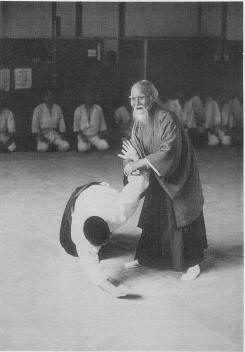
is a relatively new martial art developed by Morieh Ueshiba based on
traditional Japanese martial arts. In Aikido, the practitioner blends
with the energy of an attack rather than resisting or clashing with it.
The attacker is safely projected away or he is immobilized with a pin
or joint lock. Ueshiba O‘Sensei developed Aikido as a martial
way
or "do" rather than just a physical fighting technique or "jutsu".
Because of this, Aikido can be used in all confrontations not just
physical confrontations. I’m a paramedic. Most people at work know I study Aikido because of my recruitment efforts to get more members into our dojo. Whenever we have a difficult patient or an unruly by stander, my coworkers sometimes ask me "why didn’t you use some Aikido on ‘em", thinking that at the first sign of trouble I’m going to dislocate someone’s arm or throw them out a window. I have occasionally used some of the pins to hold patients down in cases where they were a danger to themselves and needed treatment. Rarely have I needed any of the more dynamic techniques but that doesn’t mean I haven’t used Aikido. If someone is trying to argue with me or start a fight, I can still use Aikido without getting into a physical battle. One aspect of Aikido that makes it different from other martial arts is the stance or hanmi. It is a natural stance that does not look threatening or provoking. You can stand in "hanmi" in public without looking like you’re ready to punch or kick someone. If you walked up to someone and assumed karate styled stance, you have already set things up for a confrontation without even saying a word. At work I often find myself in places where I am not welcomed. Keeping a stance and posture that does not provoke people can stop a lot of the confrontations before they start and keeps confrontations from elevating if they do start. In class we are taught to get off the line of attack and to take the attackers balance. This idea is also useful for verbal attacks. I find the best way to "get off the line of attack" is to not let myself be offended by a verbal attack. If someone calls you a "butthead" and you respond by calling that person a "double butthead" back, it’s similar to him punching you and you punching him back harder. After that, he’ll probably try to punch you back even harder (or maybe call you a "triple butthead"). If someone verbally attacks you and you don’t respond in an offended way, this will some times confuse the attacker and in a sense takes his balance. At the very least you have not escalated the confrontation. Whether they’re sick or their loved one is injured, almost everyone I’m confronted with at work is having some kind of problem. If I allow my self to get drawn into a fight with them, I will also have a problem in addition to compounding their problem. So when someone tries to insult me or makes a personal attack, I understand that they have a problem that needs help and I choose not to let their attack give me a problem. If I have been able to accomplish all of these goals, I can better handle the problem causing the confrontation. I can now redirect the attackers energy and hopefully resolve the problem. One common confrontation I encounter at work involves family members becoming angry because we are not immediately taking their injured or sick loved one to the hospital. Telling them, "you just need to step back and let us do our job", probably won‘t improve things. The family member will become angrier causing you to spend more time dealing with that confrontation and less time helping the patient. Starting off with "I understand why you feel that way, but..." and then going on to explain why the treatment you are giving the patient is needed and that just transporting the patient will just delay that needed treatment would more likely improve the situation. By doing this you are: 1) getting off the line of attack by not getting angered by the attack, 2) blending with the attack by showing empathy for the way the subject feels, 3) taking his balance by not reacting in an expected way, 4) by explaining what you are doing, you are redirecting their energy and hopefully dissipating the attack. Since I started training in Aikido, I have found myself using these Aikido techniques often. In fact I had been using many of them before and never knew I was practicing Aikido. It’s nice to know I have a few more tools to use if a confrontation does becomes physical, but I find I rarely have to use any of the other tools if I apply Aikido beyond just the physical techniques. So when someone at work asks me, "why didn’t you use some Aikido on that guy," I say, "I did!" |