WEBSITE
History of Aikido
By Powell Phillips, Jr.
By Powell Phillips, Jr.
| Aikido is a relatively new martial art developed by Morihei Ueshiba, but it is
based on a synthesis of several traditional martial arts. In Aikido, Ueshiba,
also called O'sensei, combined not only his martial philosophies but his
religious philosophies and world view as well. Since it's creation, Aikido has
gone from a relatively small martial art practiced only in Japan to a world wide
fellowship with Aikido dojo's in many nations including such countries as Iran
and Lebanon.
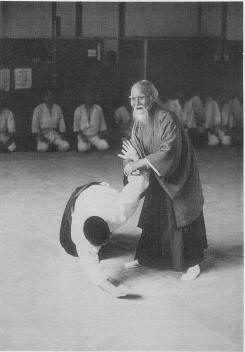
Morihei Ueshiba was born on December 14, 1883 in Tanabe, Wakayama Prefecture, Japan. It is said that he inherited a samurai's determination from his father and an interest in religion and art from his mother. As a child he was fascinated with Buddhist rituals and had considered becoming a Buddhist priest. O'sensie became more interested in martial arts after seeing his father physically harassed by thugs hired by his father's political rivals. He trained in many martial arts including weapon and empty hand arts. After serving in the army as an MP during the Russo-Japanese War, O'sensei came home and started to study Jujutsu from Tataki Kiyoichi at a dojo built on O'sensei's father's farm. At age 29, O'sensei moved his family to help build a community in the then mostly wilderness area of Hokkaido in northern Japan. It was in Hokkaido that O'sensei met and started to train under Sokaku Takeda, the notorious grandmaster of Daito-ryu Aiki Jutsu. Takeda had used his skills in real life and death struggles which supposedly included live blade sword duels. O'sensei also trained under Takeda after O'sensei moved to Ayabe. It was during this period that O'sensei received his kyoju dairi certificate from Takeda giving him the status of a Daito-ryu instructor. It was also in Ayabe where O'sensei met Deguchi Onisaburo, leader of the Omoto-ryo religion. Omoto-ryo believed in attaining a utopia of world harmony and peace, called Shambhala. These philosophies had a strong influence on O'sensei and his development of Aikido. It was during this period, in his early 40's, that O'sensei realized that the true meaning of Budo is love. It's purpose was to resolve conflict and bring harmony, not destroy your enemy. In 1927 O'sensei separated with Omoto-ryu at Onisaburo's urging. This was possibly to spare O'sensei from the political turmoil caused by conflicts with the imperial government and certain beliefs of Omoto-ryu such as Shambhala being ruled by a one world government that was not the Imperial Japanese government. Even though the Omoto-ryu did not call for the overthrow of any government, the Imperial Japanese government saw the Omoto-ryu organization as a threat. Onisaburo spent most of the years during World War II in prison due to these beliefs. After this separation, O'sensei moved to Tokyo and started what would later become the Aikikai Hombu Dojo. In 1942 O'sensei moved to a farm in the village of Iwama, leaving his son, Kisshomaru, to run the dojo. Prior to this move O'sensei called his art Aiki Jutsu and then Aiki Budo. It was during his time in Iwama that many say O'sensei's religious philosophies and martial art merged and he started to call his art Aikido. It was also during this time that O'sensei started to suffer from an intestinal disorder and he lost much of his muscular strength he had in his youth. After this change, many of his followers noticed a shift to more circular blending techniques instead of the harder jujutsu styled techniques. Aikido grew rapidly after World War II being one of the first martial arts allowed to be taught after the war. O'senei continued to teach and refine his art right up until his death in 1969 at age 86. After O'sensei died, his son, Kisshomaru Ueshiba, became head the Hombu Dojo and the Aikikai Foundation. Many of O'sensei's senior students went off to start their own schools of Aikido which helped spread Aikido beyond Japan. Fumio Toyoda Shihan and the Aikido World Alliance Fumio Toyoda was born in 1947 in Tochigi Prefecture, Japan. He started training in Aikido at age 10 under Koichi Tohei Shihan, receiving his Shodan at age 17. Toyoda would eventually train at the Aikikai Hombu Dojo prior to O'senei's death and lived as an ichideshi for two years while Kisshomaru Ueshiba was the Doshu. In 1974 Koichi Tohei Sensei left the Aikikai and started his Ki no Kenkyukai (Ki Society) Aikido. Toyoda remained loyal to his original instructor and followed Tohei Sensei. It was Tohei Sensei who sent Toyoda to Chicago to teach Aikido and eventually promoted him to Rokudan (6th degree black belt). After a disagreement with Tohie Sensei, Toyoda Sensei split form Tohei's organization and started his own, the Aikido Association of America. Through extensive traveling and hard work, Toyoda Sensei grew the AAA into one of the largest Aikido organizations in the United States and eventually started a sister organization the Aikido Association International (AAI) which included dojos in Bulgaria and Poland. The AAA became the first organization in the US to hold instructor seminars teaching teachers how to teach instead of just teaching technique. Toyoda Sensei eventually re-establish ties with the Aikikai in 1994. Toyoda Shihan died in July of 2001 at the age of 53. Andrew Sato Sensei became the Chief instructor of the AAA and AAI. Sato Sensei started training in Aikido in 1977 under Toyoda Shihan while Toyoda was still affiliated with the Ki Society. In 2005, Sato Sensei's position as chief instructor of the AAA ended and he started his own organization, the Aikido World Alliance to further spread Toyoda's Aikido and teaching methodologies. Starting with a small group of dojos which grew as more followed and new ones formed, the Aikido World Alliance has grown and with Sato Sensei's leadership will assure that O'sensei's and Toyoda's Aikido will continue to spread. Bibliography Books: Stevens, John. Invincible Warrior. Boston, Massachusetts: Shambhala Publications, 1997. Westbrook, Adele and Ratti, Oscar. Aikido and the Dynamic Sphere. North Clarendon, Vermont: Charles E. Turtle Co., Inc. 1970. Web: "Aikido". Wikipedia. 7 Sept. 2008. 9 Sept. 2008. <http://en.wikipedia.org/wiki/Aikido> . "Aikido Development and History". The Aikido FAQ, History of Aikido. 4 Sept. 2008. <http://www.aikidofaq.com/history/index.html>. Binder, Mark. "Interview with Fumio Toyoda". Aikido Journal. 1996. 4 Sept. 2008. <http://www.aikidojournal.com/article.php?articleID=128> . "The Founder of Aikido". The Aikido FAQ, History of Aikido. 4 Sept. 2008. <http://www.aikidofaq.com/history/osensei.html> . "Fumio Toyoda". Wikipedia. 6 July. 2008. 4 Sept. 2008. <http://en.wikipedia.org/wiki/Fumio_Toyoda> . "Morihei Ueshiba". Wikipedia. 13 Aug. 2008. 4 Sept. 2008. <http://en.wikipedia.org/wiki/Morihei_Ueshiba> . "Onisaburo Deguchi". Wikipedia. 22 June. 2008. 4 Sept. 2008. <http://en.wikipedia.org/wiki/Onisaburo_Deguchi> . "Sato Sensei". Aikido World Alliance. 4 Sept. 2008. <http://new.aikidoworldalliance.com/SatoSensei/tabid/57/Default.aspx> . "Takeda Sokaku". Wikipedia. 29 Aug. 2008. 4 Sept. 2008. <http://en.wikipedia.org/wiki/Takeda_Sokaku> . "Toyoda Shihan". Aikido Association of America. 2006. 4 Sept. 2008. <http://www.aaa-aikido.com/founder.htm> . "Welcome to AIKIDO-IRAN.COM". Aikido Association of Iran. 1997. 4 Sept. 2008. <http://www.iranaikido.com/> . |