Welcome to my Praying Hands page.
THE PRAYING HANDS
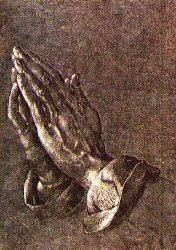


Back in the fifteenth century, in a
tiny village near Nuremberg, lived a family with eighteen children. Eighteen!
In order merely to keep food on the table for this mob, the father and
head of the household, a goldsmith by profession, worked almost
eighteen hours a day at his trade and any other paying chore he could
find in the neighborhood.
Despite their seemingly hopeless
condition, two of Albrecht Durer the Elder's children had a dream. They
both wanted to pursue their talent for art, but they knew full well
that their father would never be financially able to send either of
them to Nuremberg to study at the academy.
After many long discussions at
night in their crowded bed, the two boys finally worked out a pact.
They would toss a coin. The loser would go down into the nearby mines
and, with his earnings, support his brother while he attended the
academy. Then, when that brother who won the toss completed his
studies, in four years, he would support the other brother at the
academy, either with sales of his artwork or, if necessary, also by
laboring in the mines.
They tossed a coin on a Sunday
morning after church. Albrecht Durer won the toss and went off to
Nuremberg. Albert went down into the dangerous mines and, for the next
four years, financed his brother, whose work at the academy was almost
an immediate sensation. Albrecht's etchings, his woodcuts, and his oils
were far better than those of most of his professors, and by the time
he graduated, he was beginning to earn considerable fees for his
commissioned works.
When the young artist returned to
his village, the Durer family held a festive dinner on their lawn to
celebrate Albrecht's triumphant homecoming. After a long and memorable
meal, punctuated with music and laughter, Albrecht rose from his
honored position at the head of the table to drink a toast to his
beloved brother for the years of sacrifice that had enabled Albrecht to
fulfill his ambition. His closing words were, "And now, Albert,
blessed brother of mine, now it is your turn. Now you can go to
Nuremberg to pursue your dream, and I will take care of you."
All heads turned in eager
expectation to the far end of the table where Albert sat, tears
streaming down his pale face, shaking his lowered head from side to
side while he sobbed and repeated, over and over, "No...no ..no ...no."
Finally, Albert rose and wiped the
tears from his cheeks. He glanced down the long table at the faces he
loved, and then, holding his hands close to his right cheek, he said
softly, "No, brother. I cannot go to Nuremberg. It is too late for
me. Look ... look what four years in the mines have done to my hands!
The bones in every finger have been smashed at least once, and lately I
have been suffering from arthritis so badly in my right hand that I
cannot even hold a glass to return your toast, much less make delicate
lines on parchment or canvas with a pen or a brush. No, brother ... for
me it is too late."
One day, to pay homage to Albert
for all that he had sacrificed, Albrecht Durer painstakingly drew his
brother's abused hands with palms together and thin fingers stretched
skyward. He called his powerful drawing simply "Hands," but the entire
world almost immediately opened their hearts to his great masterpiece
and renamed his tribute of love "The Praying Hands."
The next time you see a copy of
that touching creation, take a second look. Let it be your reminder, if
you still need one, that no one - no one ever makes it alone!
More than 450 years have passed.
By now, Albrecht Durer's hundreds of masterful portraits, pen and
silver-point sketches, watercolors, charcoals, woodcuts, and copper
engravings hang in every great museum in the world, but the odds are
great that you, like most people, are familiar with only one of
Albrecht Durer's works. More than merely being familiar with it, you
very well may have a reproduction hanging in your home or office.
The above, while it is a
beautiful thought may have changed over the years. Durer was in a
family of 13 but 8 of them died early in life. There is also a
possibility that the brother depicted above was a close friend.
Look at the hands, do they really
appear to be work-worn and work-damaged? From the meager research I've
done, it appears that this has been replicated from the same source,
many of the sites describing this artwork have exactly the same story,
identical wording, etc.
He was the eldest
of the 5 surviving children. His education consisted of being
apprenticed to his father, a goldsmith and traveling abroad to Italy
where he learned what was being discovered about the art he was
studying. It was questionable about there being an art department at
Nuremburg. There was no mine near Nuremburg for the brother to work in.
So it does appear that the story of "The Praying Hands" is an
example of teaching a biblical parable without a complete basis in the
facts. You be the judge, true or false, it is still a wonderful tool
for reflection.
|


 Don Wood