|
|
|
|
Blaney Bog |
Blaney BogWithout the support of some of our membership, we may never have seen the preservation of Blaney Bog. The Blaney Bog Committee of the Pitt Polder Preservation Society was instrumental in seeing the bog purchased by the Municipality of Maple Ridge, the Greater Vancouver Regional District and the Provincial government. Annette LeBox, chairperson of the Blaney Bog Committee, attended the press conference at Blaney Bog on behalf of the Pitt Polder Preservation Sociey, when the Minister of Environment, Joan Sawicki, made the announcement that Blaney Bog had been purchased from Mr. Luigi Aquilini. Blaney Bog is now a regional park. (The following information was provided by Annette LeBox)
A Natural TreasureBlaney Bog and its catchment area is located north of the 13600 block of 224th Street in Maple Ridge, British Columbia, only a few minutes from the centre of town. Uniqueness and DiversityBlaney Bog is a special kind of wetland. It is composed, not only of a bog ecosystem, but also a woodland ecosystem, a riparian ecosystem (a shore line or along a stream), a fen (a grassy wetland) and a tiny marsh. In addition to these five distinct ecosystems, the bog is also composed of transition zones between the ecosystems. An ecotone is an area where two ecological zones overlap. When flora and fauna are brought together within ecotones, this overlapping increases the uniqueness and biodiversity of an area. In short, Blaney Bog is more than the sum of its parts. The Historic Loss of WetlandsThe loss of wetlands is devastating to wildlife. If we consider that 50% of original wetlands in the Greater Vancouver and Greater Victoria areas have been converted to agricultural activities and an additional 25% has been converted to "urban activities," only 25% of our natural wetlands remains. In some areas, wetland loss is even more extensive. About 96% of the wetlands in the North Arm of the Fraser Estuary have been lost since the turn of the century. With the recent loss of thousands of acres of wet meadows in the Maple Ridge-Pitt Meadows area to industrial cranberry farming, it was crucial that Blaney Bog be preserved in its wild state. Rare and Endangered BirdsBlaney Bog is home to a variety of rare and endangered birds. At the
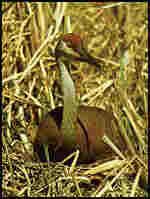
time of this writing, there are only seven to nine Greater sandhill
cranes left in the Pitt Meadows and Maple Ridge area. The sandhills
utilize Blaney Bog. Not only does Blaney Bog harbour sandhill cranes, but it is also home to other blue-listed species such as the American bittern, Great-blue heron, Green-backed heron, and winter rarities such as Virginia and sora rails, Audubons, Yellow-rumped and Orange-crowned warblers. Blaney Bog also harbours the red-listed Peregrine falcon. Blaney Bog, A Nursery for FishFish sampling results for Anderson Creek by wildlife biologist, Mark Adams of Envirowest, include chinook salmon, coho salmon, cutthroat trout, prickly sculpin, threespine sticklebacks and northwestern salamander. Blaney Creek is a fine example of a healthy salmon stream. Formation of the The BogBlaney Bog is a special kind of wetland. A bog will form only under specific conditions: high water table, acidic soil with little oxygen and little availability of nutrients i.e. the water is usually slow-moving. Under these specific conditions spaghnum moss, the key plant of the bog, begins to form. Spaghnum moss contributes to the bog's formation by turning the water surrounding it into acid. The nutrients become locked in the peat, which does not decompose. Therefore, plants such as Labrador tea, bog laurel, bog rosemary, the sundew, an insect-eating plant, will only be found growing in a bog. Blaney Bog has a healthy population of all these plants, as well as even rarer plants such as the cloudberry (Rubus chamaemorus) and arctic starflower (trientalis arctica). These plants are normally found in the northern muskeg. A Baby BogIn August of 1997, Dr. David Bellamy, a world authority on peatlands, visited Blaney Bog. Bellamy remarked that the hummocks (mounds or hills) of moss in the bog were 'amazingly large; as large as hummocks get'. Bellamy called Blaney Bog a 'baby bog' because it is relatively small and because the hummocks are characteristic of a younger bog. He also likened the bog to a baby with all its fingers and toes, a completely intact bog, unlike the larger Burns Bog. He compared Burns Bog to a torso without its limbs, because it had been impacted by peat mining, industrial cranberry farming and the Vancouver landfill. Blaney Bog had been slated for an industrial cranberry operation. If the efforts to preserve this urban wilderness had failed, the bog would have been dug up and scalped. Native plant communities would have been replaced by a monoculture subject to chemical applications, water level manipulation and increased human intrusions. These would have been devastating to wildlife. A Vision for the FutureAs Blaney Bog is located only minutes from the centre of Maple Ridge, the site is an ideal place for environmental education and tourism. However, because of the sensitive nature of the bog ecosystem, it is crucial that the bog proper be classed as an ecological reserve rather than a people park. In other words, the general public would not be allowed access. The periphery of the bog, however, could be open to the public for educational purposes. Education and InterpretationThe Pitt Polder Society would like to see an interpretation trail, viewing towers and an interpretation centre built along the periphery of the bog proper. A man-made mini-bog could be constructed which would enable students to observe, touch, smell and experience bog plants up close. Local stewardship organizations such as the Polder Society, the Alouette Field Naturalists and Alouette River Management Society along with the District of Maple Ridge and the Greater Vancouver Regional Park representatives are working on a management plan for the nature park. What is the Value of Blaney Bog?The lower Fraser Valley is one of the most polluted places in the Lower Mainland. Not only do we produce our own pollution from the thousands of cars we drive, but we also inherit pollutants from the city of Vancouver. Peatlands such as Blaney Bog help to alleviate some of the adverse effects of pollution. The Benefits of Blaney BogBlaney Bog strain sediment and toxins from the Pitt River watershed. Aquatic plants that live in the bog absorb toxins and actually change them into non-toxic substances. Theses substances are then released into the air or water. Studies show that bogs are often more effective at cleaning water than comparable engineering systems. Bogs take in and hold excess water, releasing it as the water level drops. Bogs such as Blaney serve as huge storage tanks during high water periods. Then during dry periods, the bog releases water only as the surrounding area can handle the excess. Bogs take in and store carbon from car and industry fuel emissions. But the carbon is stored only as long as the bog remains undisturbed. When bogs are drained or dug up, methane and carbon are released into the air. These gases contribute to global warming. Bogs produce oxygen. Scientists estimate that through photosynthesis, bogs produce more oxygen than rainforests. Bogs serve as a breeding ground for salmon, and later, as a nursery for their offspring. Bogs are home to many endangered plants and animals. Bogs are the most productive ecosystems on earth. Bogs are places of great natural beauty. |
|
Home - Introduction - Mission statement - Events - Contacts - Blaney Bog - Photo gallery - Links - Membership - Teacher Resources Last modifiedDecember 2000. Website design & maintenance Emay Ko |
|