| Back to Homepage |
spirals
methods of construction as used by the Pictish 'school'
As mentioned elsewhere in these pages, I believe the great beauty and aesthetic achieved by Pictish designers owed as much, if not more, to their knowledge of geometry as to the skill of their hands and eyes. I do not believe this to be an unreasonable assumption given the time period we are primarily concerned with here. After all, many centuries had passed between the time of Plato and Pythagoras and the transference of geometrical ideas into the Art and Design of the Picts. What is interesting is that the rediscovery of antique, and specifically, Grecian ideas is so much associated with the European Rennaissance of the middle ages, that it is interesting to find evidence of antique mathematical knowlegde on the outer edges of Europe, in the midst of what has subsequently become known as 'the dark ages'.
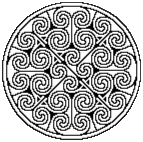
One of the most comically replicated pictish designs is probably that of the beautiful sextuplet triskele found in the centre of the Aberlemno Cross.
Why this should have proved so problematic to the illustrators of antiquity gazetteers, is in itself something of a mystery. It takes no great knowledge of mathematics to know that six discs of the same size fit exactly around a seventh.

This design can be used as an all over repeat, or, as in this case one leg of each triskele is used to encircle the group, the remaining two legs joining the triskeles alongside.
As an experiment, it would be interesting at this point to attempt to replicate this design freehand.
When discussing spirals it is normal to digress into a description of the 'Fibonacci Series' . I suspect that the truth abut Pictish spirals has long been missed because it was assumed that they conformed this this series. Known to Plato and Pythagoras, found everywhere in the natural world, this series is so associated with the spiral pattern ( although it applies to much else), that in a way it's not surprising that it has long been assumed that every spiral conformed to this principle. (Especially those that were aesthetically pleasing).
Bearing this in mind, it is perhaps even more interesting that the pictish spirals do not conform to the Fibonacci Series, than if they did.
Because firstly, and most importantly to anyone who would attempt to replicate them, this means that it is possible to draw a Pictish spiral with a pair of compasses, which would not be possible if they conformed to the Fibonacci Series or the 'phi' spiral ( the logarithmic spiral also known as the 'whirling squares'.
That the Picts used compasses is plainly obvious when studying their spirals. The Museum of Scotland in Edinburgh contains a beautiful example of unfinished work where the scratch of the centre point is quite easily visible.
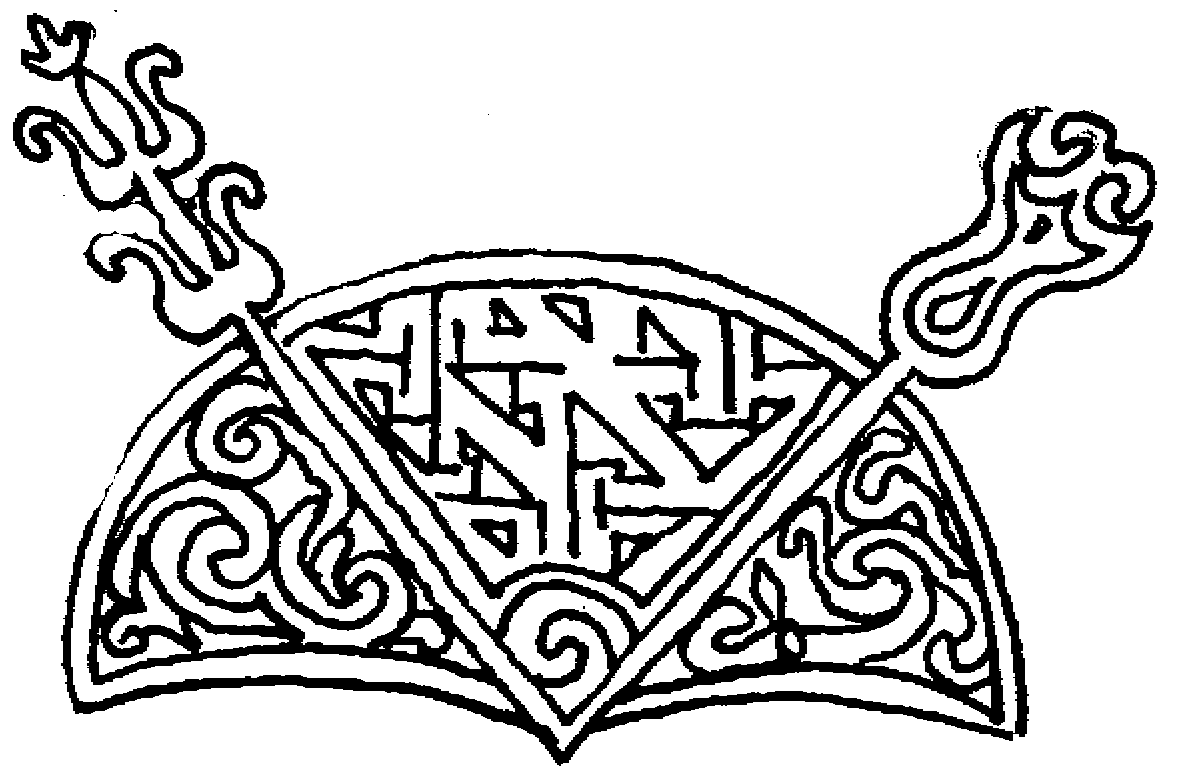
I have often wondered if the 'mysterious' 'V' rod is simply a representation of the artist's tools. The 'V' being the compasses and the half moon an intersected protractor used to measure the angle between the compasses legs.