| Back to Homepage |
Methods used to create spirals in the Pictish Style
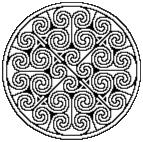
A close look at the spirals which regularly appear in Pictish Art will confirm that where ever they appear, whether it's the intricate linked spirals on the Aberlemno Cross or the still mysteriously tiny spirals in the book of kells, they generally all have one thing in common; that is; that the spaces between coils are always of a constant size.
The first stage, therefore, in constructing a spiral is to draw a straight line and mark upon it the points at which the spiral's leg or legs will intersect. Thus:

This line represents the diameter of the circle we are drawing, with the ten points at which the spiral intersects it marked.
To draw a spiral with a single line, or 'leg' where 'X' is the centre of the diameter line...
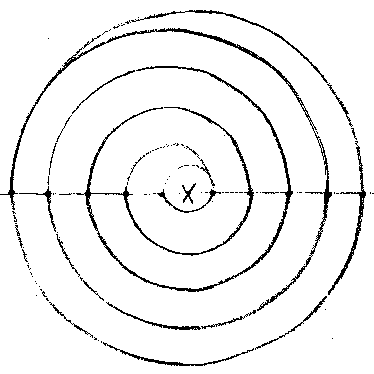
...need not be the work of hand and eye alone. All the semicircular lines above the diameter line are perfect semi-circles, to draw them, place your compass point one half measure to the left of the central 'X'. ( The point marked '5' on our ten space diameter, in fig.)
All the semicircular lines below the diameter have 'X' as the point at which you would place the point of your compasses to draw them.
This is how to use compasses to draw a single line spiral. But this motif occurs only rarely in pictish art. Much more common are the two and three-legged (Manx flag) style triskele designs.
The two-legged spiral is drawn by having the two points at which you place your compasses' point on the diameter line each one half-measure on either side of your central point, thus...
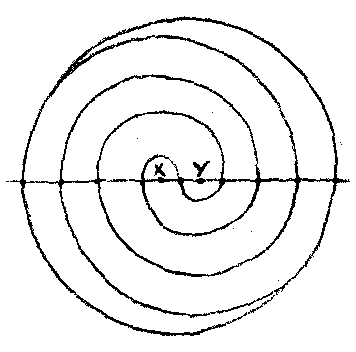
'X' is the point at which you place the point of your compasses to draw the lines above the central diameter and 'Y' is the point at which you place the point of your compasses to draw the lines below the central diameter.
To draw the most frequently seen spiral in pictish art, the triskele, or three-legged spiral, you start, not with a straight diameter but with a geometric 'Y' each leg 120 degrees apart. The points at which trhe legs intersect this line remain constant and are measured along the three legs.
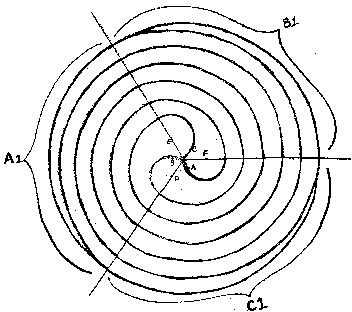
Now the point of the compasses must be placed at three different points to draw the three sections of the spiral, section A1 at point A; section B1 at point B and C1 at point C. D, E and F are the points at which to place the point of the compasses to complete the spiral.
This motif works so beautifully using this technique it is easy to see why early artists used it so often.
The four-legged spiral also appears, although less often. By the time we go to four 'legs', there start to be problems in resolving the centre of the spiral. Of course the early artists found ingenious and exquisite ways of solving this problem, but it is easy to see why three remained the most popular.
To draw a four-legged spiral start with a cross of four radiuses (radii?) and proceed as with the earlier examples.