The Myler Names in Early Irish History
First, a bit about how people got their names. Until about 1100 A.D., most people in Europe had only one name. As the population increased it became awkward to live in a village where perhaps 1/3 of the males were named John, another sizeable percentage named William, and so forth.
And so, to distinguish one John from another, a second name was needed. There were four primary sources for these second names: a man’s occupation (Cook), his location (Overhill), some peculiar characteristic of his (Little or Lytle), or his father’s name (Irish – “Mac”, Norman - “Fitz”).
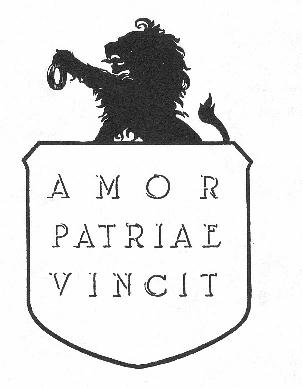
In addition to needing an extra name for identification, one occupational group found it necessary to go a step further - the fighting man.
During the Middle Ages soldiers wore a metal suit of armor for protection. Since this suit covered the head, a knight in full battle dress was unrecognizable. To prevent friend from attacking friend during the heat of battle, it became necessary for each knight to somehow identify himself. Many knights accomplished this by painting colorful patterns on their battle shields. These patterns were also woven into cloth surcoats, worn over their suit of armor. Thus was born the term, “Coat of Arms.” Here is the Myler Coat of Arms – a Crest and a Motto. The crest is a demi-lion holding in the forepaw an annulet (a ring). The Motto is “Amor patriae vincit” – Love of country prevails.
Since my father's familiy came from Ireland, I thought that it would be interesting to see the Irish flag and learn a bit about it. The present day flag dates from about 1700. The flag is a tri-color flag
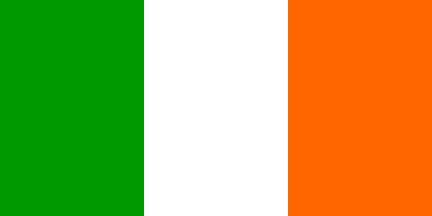
with three vertical stripes of color: green, white and orange. The green is for those whose ancestors originated in Ireland. The orange is for those whose ancestors originated in England. And the white is for the hope that both groups will be united into one Irish nation.
The Myler Book, (Vol. 1), compiled by my grand uncle, Thomas Trimble Myler, Jr., and published in Pittsburgh, PA, in 1911, gives a very brief history of the Mylers in Ireland.
First it explains that the name “Myler” is sometimes known as “Maelor”, “Meyler” or even “Mailor”. Robert Mailor of Duncormack (who married Rose of Ross), a renowned soldier, went out of Pembrokeshire, Wales, to the Conquest of Ireland with Strongbow. The place from which he came is still called “Lough Meyler”. Since then the name has been continuously connected with the County Wexford, and from a very early period the family held the Manor of Duncormack down to 1641.
The Book also says, “In 1168, Strongbow and Fitz Henry Myler, our ancestor, landed in Bannow, County Wexford. They were chiefs among the first Anglo Normans who invaded Ireland.” In checking on the Internet, I found a Web site that listed the genealogy of some of the prominent early Irish people. Fitz Henry Meiler (Myler) was the illegitimate son of King Henry I and Nesta, Queen of Wales. His son was named Meiler Fitz Meiler.
Other Possible Myler Ancestors that Appear in Irish History
- Pierce Ritz Meilor was summoned among the Magnates in 1302.
- Sir Ralph Mailor was the first Commissioner over the Abbey of Dunbrody, in 1347.
- Ralph’s son, Robert of Duncormack, was married to “Rose of Ross” and died in 1356
- John Meeler of Duncormack was Custodian of the Peace of County Wexford in the reign of Edward the Third (1327-1377). The King committed him the custody of the county during “pleasure”.
- Adam Meyler was summoned among the gentlemen of Wexford, in the same reign, with Horse and Arms.
- Patrick Meyler of the Dirre was one of the gentlemen of the barony of Shelmalier in 1608.
- Nicholas Mylor (who died in 1583) of Duncormack, married Annie Fitz Henry and had two sons, Walter and Patrick. There follows a list of their children and grandchildren who lived in the same area until after 1650.

County Wexford, Ireland, in the Twelfth Century
But being curious to know more about who these people were, I have delved a bit further into some Irish history. My primary source has been a book called Old Ross, the town that never was – a community biography compiled by Bernard Browne, and published by Sean Ros Press in 1963. It goes into much detail about the area , and concludes that “judging by the plentiful remains of ringforts ... that have survived ... the Old Ross landscape in the first millenium was well settled. The abundance of these forts, which date from 1200 B.C. to 800 A.D., is a good indication of the prosperity of the area in pre-Christian times.”
“As the forests disappeared, they were replaced by permanent grassland on the better lowland soils and by moorland, suitable for rough grazing, on the uplands. These two forms of vegetation ... are largely the products of farming activity and much of the land if (left) unattended would revert to it’s natural condition of deciduous woodland.”
It seems that the Normans came to Ireland several times. The first being “in the winter of 1168 when Dermot Mac Murrough, Provincial King of Leinster, sought their assistance to reclaim his territory” which he lost, save for a parcel that was “about the size of the modern county of Wexford. ... This Norman army was mainly a collection of grasping, unattractive mercenaries whose only redeeming characteristic was their courage.”
“On May 1, 1169, a force of 30 knights, 300 archers and 60 other horsemen disembarked on the eastern side of Bannow Island from three small, open ships. They were led by Robert FitzStephen.” This, I believe, rather than in 1168, was when Strongbow (better know as Richard Fitz Gilbert de Clare, later Earl of Pembroke) and Fitz Henry Meiler (Myler) came to County Wexford. (Strongbow “got his name from his father, who was a famous archer".)
“Following the capture of Wexford, Dermot swiftly regained his kingdom and nearly all of the province of Leinster. He offered Strongbow, a widower, the hand of his daughter Aoife in marriage. The marriage took place in 1170 when Strongbow was between 50 and 60 years of age. Dermot died, aged 61, on May 1, 1171, after reigning for 46 years.”
“Strongbow was created Guardian of Ireland in August 1173. Under Irish Brehon Law only a male heir could succeed to that post. Strongbow died from blood poisoning in 1176. Despite his success in gaining control of the kingdom of Leinster, he did not manage to establish a family dynasty, leaving no male heir. His infant daughter Isabella de Clare, by his Irish wife, was heiress of Pembroke and Leinster (and) was made a ward of the Crown. His legacy and inheritance from his father-in-law, Dermot MacMurrough, passed into the hands of the English Crown. Isabella became a ward of Henry II, who reigned from 1154-1189. In the closing days of his reign, the king granted William, the Earl Marshal, the license to marry Isabella when she came of age.”
From Lewis’ Wexford by Elizabeth Browne and Tom Wickham, on p. 126, I learned that the origin of the name “Ross” is derived from the fact that the castle (built in the parish by Strongbow or his daughter Isabella) was on an extensive tract of elevated meadow land, which in Wales is called "Rhos" or "Ros".
In Browne’s Old Ross, he writes that “the Normans required strongholds to secure their new territories. The earliest form of stronghold was a motte-and-bailey earthwork. In Old Ross it is popularly called the moat. The castle was probably a tower house, which was a fortified single residence built of stone, usually square or rectangular in plan, and four or five stories high.
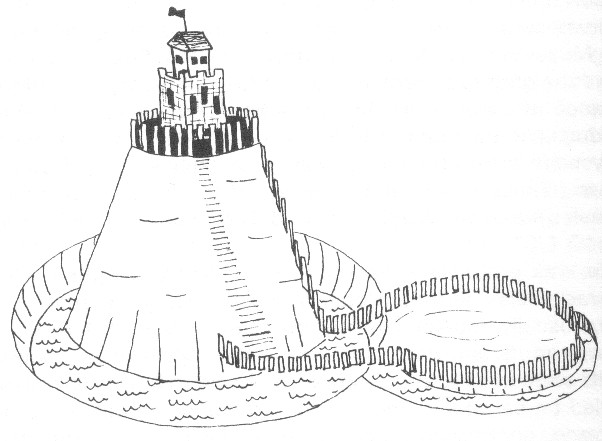
This sketch of a motte-and-bailey is from Browne's Old Ross
County Wexford in the Present Time
This book continues to chronicle the various men who were of importance in County Wexford, but notes that “the Normans were here to stay and their influence on the political and social development of Irish society was to forever change Ireland. Old Ross had played its part!”
“Situated five miles north-east of the port town of New Ross, in rural splendor, lies Old Ross. Once a thriving medieval settlement, it is today but a combination of townlands converging on a crossroads.” To be more exact, it is in the Parish of St. Mary’s, Old Ross, in the Barony of Bantry, County of Wexford, and Province of Leinster, on the old road to Wexford.
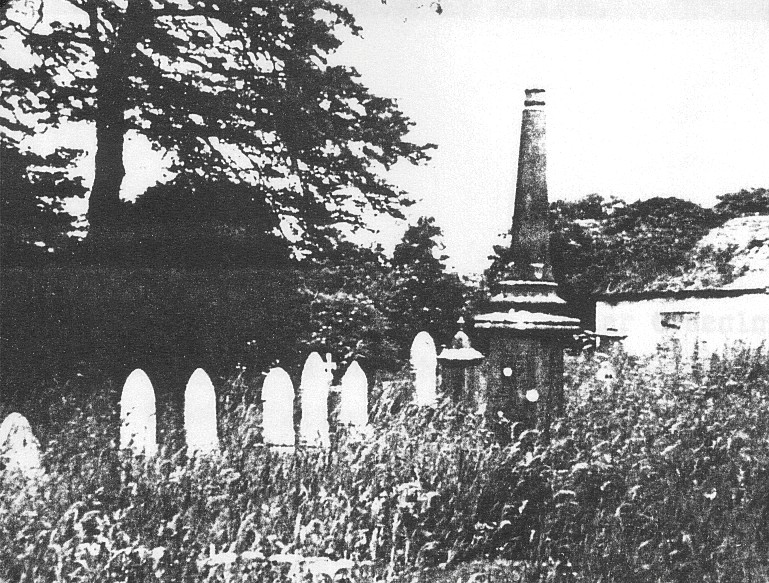
In July of 1985, another Myler researcher, Jessie Thomas of Brazil, IN, went to Ireland in search of any trace of the Myler family, having recently received a copy of The Myler Book by Tom T. Myler. Upon returning she wrote, “The trip to Ireland has proven the information in the Myler book is authentic. The short time I had in the libraries and the areas of the Myler homes has confirmed the information in the book.“
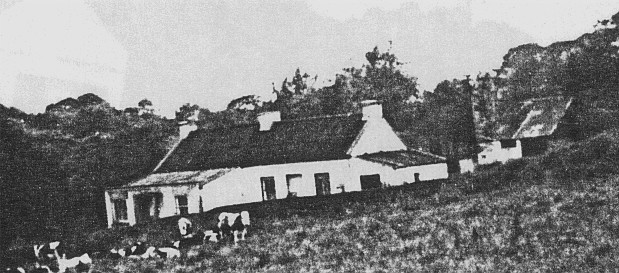 During her travels, she visited the village of Duncormack, which was very small and had only one street. “There were very quaint homes in this area. Some were still thatched roofed. There was an old building on a hill, and an old gentleman told Jessie that that was where a Myler lived years ago. The building had a blacksmith shop and home attached. The old fellow said that Myler had come back to that area every year until about 5 years ago.”
“The town of Old Ross was difficult to find. When I found the area, all that was left of the town was a run down church and cemetery. The weeds were very high in that cemetery, as they had also been in Duncormack. I looked in the cemetery for grave stones of Mylers, but the weeds were so tall I really could not read the head stones.” The pictures that she took of the area are shown above.
For information on the known Myler ancestors beginning in the 1700’s in Old Ross, County Wexford, Ireland, go to my Irish Mylers page.
Visit all my other pages by clicking on this page of links.
This page last updated 21 March, 2001.
The content of these pages was put here by me, but I have no control over the content supplied by Geocities.com.