The Myler History, Ireland to the United States
Our Ancestors in Ireland - 1700's
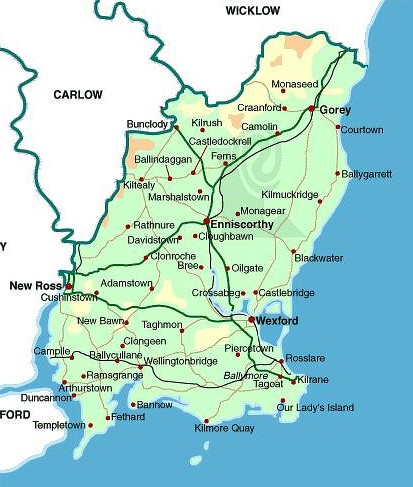
The first Myler ancestor that we have actual knowledge of was Thomas (I) Myler of County Wexford, Ireland. Thomas lived with his wife, Margaret Owen Myler, in the townland of Old Ross. They were born about 1735-1740.
We first hear of Thomas (I) as a married adult. He was a “linen draper”; not only a manufacturer and a merchant of linen, but also a large landed proprietor, according to the record written in The Myler Book, (Vol. 1), compiled by Thomas Trimble Myler, Jr., and printed in Pittsburgh, PA, in 1911. (The information was handed down to Tom T. Myler, Jr., through his Uncle, John Augden Myler, who was in turn told by Thomas (I) and Margaret’s daughter-in-law, Elizabeth Crow Myler, who lived until John Augden was a young man).
 In fact, Elizabeth loved to sit by the fire in the evening and spin yarns of the old times in Ireland and how she and her husband had come to America. It is said that Elizabeth retained her Irish ways until her death. She was a firm believer in witches and spooks and fairies of all kinds. She even told ghost stories to the children until they would become so frightened that they were afraid to go to bed and equally afraid to keep awake when she threatened that the witches would get them if they didn’t get into their “nighties” immediately!
Thomas (II) Myler and Elizabeth Crow
But I am getting ahead of my story. Thomas (I) and Margaret Owen Myler had three sons that I know of: Thomas (II) Myler, born around 1761, William (I) and James (I). More of William (I) and James (I) later.
The family was of the Presbyterian faith. During the 1780’s there was considerable warfare in Ireland between the Protestants and the Catholics. In fact, so fierce was this religious conflict in and around Old Ross and New Ross, that bloody battles, in which many were killed or severely injured, were a common occurrence.
On the land next to the Mylers resided a family named Crow, who were staunch Roman Catholics, and deadly enemies of the Mylers. They had one daughter, Elizabeth, and, of course, the usual thing happened. Young Tom (II) Myler, a Presbyterian, fell desperately in love with the fair Elizabeth, a Roman Catholic. His love was reciprocated, and the war between the two families became even more fierce. Both vowed the union should never take place and went around armed to the teeth.
But Elizabeth had a plan that quickly changed the situation. She decided to become a Presbyterian, and with having made that decision, she won the Mylers over to her side. But, of course, the thought of their daughter becoming a Protestant enraged the Crows even more and they kept her a captive in their house for over a year, forbidding her to see Tom.
But somehow the two lovers communicated, and another plan was formed. Elizabeth would pretend to relent so that her family would relax their guard, and one night she stole away to Tom who was waiting with a horse and a driver with a jaunting car. With the promise of two pennies – a large sum in those days – the driver made all possible speed to the Presbyterian parsonage two miles away. There the parson was awaiting their arrival and in a few moments the words were said that made Thomas (II) and Elizabeth Crow man and wife.

Thomas (II) and Elizabeth Myler set up Housekeeping
Thomas and Elizabeth went to live with Thomas (I) and Margaret, and Elizabeth had no more to do with her family. At the end of two years (1788), Thomas (III) was born, and the feud between the Mylers and the Crows was rekindled. The Crows, of course, considered that Elizabeth was doomed to eternal damnation because she had become a Protestant, and they resolved to save her son, Thomas (III), from that same fate.
When the child was about 8 months old he was abducted by the Crows and hidden in a Nunnery. The Mylers eventually found out where the baby was being kept and devised a plan. They gave out the story that the child had been devoured by a wild boar and the family pretended to go into deep mourning. But what was really happening was that the Mylers were marshalling all the Protestants in Old Ross to come to their aid and were planning to attack the Nunnery and liberate the child.
A Battle Ensues and Thomas (III) is Rescued
When all was in readiness, and under the cover of night, the Myler force, numbering several hundred men and youths, gathered at a point near the Nunnery. However, in some manner the Crows had learned what the Mylers were doing, and they had marshalled their own force and also marched to the Nunnery.
The two small armies met directly in front of St. Peter’s Roman Catholic Church, not far from the Nunnery. Then came a battle that was talked of for many years in Old Ross! It lasted for three hours, and the Mylers won a great victory, and the child, Thomas (III), was recovered and taken to his grandfather’s home.
Many heads were broken and much good Irish blood was spilled during the night time battle, which almost destroyed both the church and the Nunnery. One of the nuns and one member of the Crow family were mortally wounded during the conflict.
Thomas II, Elizabeth and Thomas III Emigrate
For a while after this battle the Crows left the Mylers in peace, but later the Crows again attempted to kidnap the child. At a family council the Mylers decided that the only way that Thomas (II) and his family could ever have peace would be for them to leave the country. So it was decided that they would come to the United States, as they, along with many Irish of the time, thought that life would be easy here and work would be plentiful. But they also knew that there would, best of all, be no religious persecution in the United States.
There were no steam vessels at that time in history (1790). Although they took passage on the swiftest packet ship of those days, it was a long crossing of the Atlantic, taking nearly three months (as the ship probably put in to a number of ports along the way to deliver it’s goods). They left Ireland in the Autumn of 1790, and arrived in Baltimore, MD, at the end of that year or the beginning of 1791. Baltimore was a rather small city at that time, and they decided to settle there.
Life in Baltimore, MD
It is not known exactly how long Thomas (II) and Elizabeth and their family lived in Baltimore, but they were there long enough to have two more sons, William (II) and James (II) and five daughters – whose names I do not know.
It is thought that Thomas (II) received, before leaving Ireland, his share of his inheritance from his father, Thomas (I), and it was with this money that he set up a mercantile business in Baltimore. Life was not as easy as they had been led to believe when they were in Ireland, but by hard work Thomas succeded in making a decent living to support his growing family.
After a few years, Thomas II’s brothers, William (I) and James (I), came and stayed with the family in Baltimore until such time as they were able to move on to other places on their own. It is said that William went to MO, but I, along with other Myler researchers, wonder if he stopped in OH, or IN along the way. James is said to have gone to Canada, married and had a large family. Almost nothing is known about these two branches of the Myler family, as we are still trying to trace the travels of both William and James and establish contact with their descendants.
Thomas II died shortly after the birth of his youngest child, and his widow, Elizabeth, migrated with her children to the Ligonier Valley in PA, where I have found her listed in the 1820 census of Westmoreland County, along with a 19 year old female, probably a daughter.
In wondering why Elizabeth left all she knew in Baltimore and moved to PA, I am drawn more and more to the conclusion that at least one of her sons had gone to PA before Thomas II died, and probably suggested that the family join him after his father’s death.
To learn more about the Myler family's early life in Pennsylvania go to the following story about the Sons of Thomas (II) and Elizabeth Crow Myler on the page entitled "The Thomas Myler Family of Armstrong County, PA". (This page is not yet written but will follow when time allows!)
Click here to visit all my other pages.
This page last updated 4 July, 2001
The content of these pages was put here by me, but I have no control over the content supplied by Geocities.com.