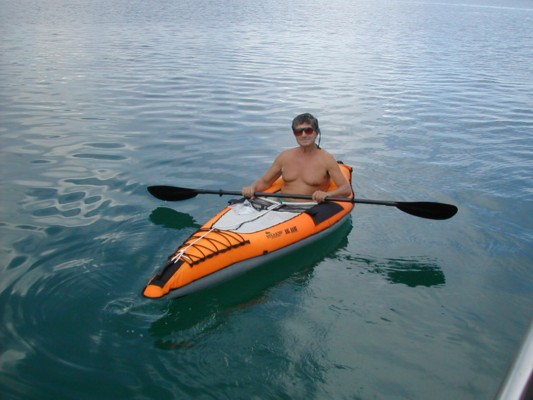
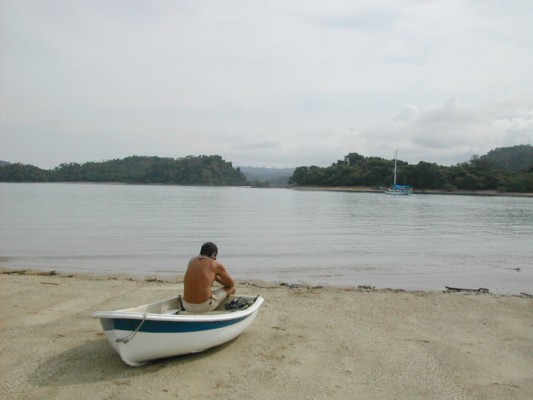
| Around noon, Thursday, August 21, we departed our beautiful anchorage in Bahia Honda and headed to Las Perlas Archipelago in the Gulf of Panama, about 220 miles away. As there weren�t any good anchorages between Bahia Honda and Las Perlas, we decided to do a two-night overnighter instead. Both nights out we had quite a bit of rain. Compared to many cruisers who had traveled this route, though, we felt quite lucky. Often this could be a frustrating sail as weather over Colombia affected at times the Gulf of Panama adversely. For us, most of the time the current and swell were with us, and when there was some wind we were able to sail a reach to a close reach. During our two days transiting we mostly motorsailed, occasionally sailing. Since we often had the current with us, we actually had to slow the boat down our second night out so as not to arrive at Las Perlas Archipelago before sunrise. During these two days we encountered ship traffic at times due to the proximity of the canal, but not as much as we thought we would see. We arrived at Las Perlas Archipelago Saturday, August 23, just as the sun was rising. Countless islets fringed the main islands of the archipelago. With the rising sun, it was a beautiful sight. Our first anchorage was next to the Don Bernardo Islet on the southeastern coast of Isla Pedro Gonzalez. It was a picturesque anchorage with a palm-lined white sand beach and crystal clear waters. Unfortunately, it was here that our dinghy outboard motor decided to quit again - once more losing all compression. For cruising boats, an outboard for one�s dinghy is quite important, especially for exploring. Without an outboard, one is very limited. Thus, there will definitely be a new outboard motor purchased upon our arrival in Panama City. After spending 2 days at Isla Pedro Gonzalez, we moved 5 miles north to the anchorage off Isla Bayoneta. Since the wind had shifted to the northeast, the anchorage at Isla Pedro Gonzalez had become a little sloppy. In contrast, the Isla Bayoneta anchorage was quite protected. Careful navigation was needed as we approached the anchorage as the water was quite shallow and rocks and reefs abounded. Besides using charts and depth sounder, Mary was out on the bow pulpit as lookout while Phil steered, and walkie-talkies were used when needed. Snugly tucked in-between three small islands, this small anchorage was totally secluded. It was a great place for kayaking, especially when the tide was in and we could maneuver amongst all the mangroves, rocks, and islets and quietly observe the many different birds that lived there. Two days later we moved on to the Isla Ampon anchorage, about 5 miles away and located on the eastern side of Las Perlas Islands. This same careful navigation was needed during this passage, both through the narrow channel over to the eastern side and on the approach to the anchorage. While traversing the narrow Gibraleon Channel, we saw our first spotted eagle ray. How beautiful and graceful it was as it moved through the water. The highlight of our stay at the Isla Ampon anchorage was the meeting up with five other cruising boats, none whom we had met before but all whom we had heard at times on the Panama Pacific Cruisers Net. While there, we all became fascinated at observing a group of sharks, 6 to 8 feet long, in the shallow waters off the anchorage. What was most unique about these sharks was that they were non-aggressive and completely oblivious to our watching them from our dinghies. It was like they were doing some form of ritual dance. In fact they were about to give birth. Also, while at this anchorage we had spring tides. The difference between low and high tide was 15 feet. When Mother Nature �drained the bath tub,� it was an amazing sight to see all the rocks and reefs exposed and to realize that we had passed safely through all. After 3 days at the Isla Ampon anchorage, we moved 12 miles south to Espiritu Santo, a small island located along the northeastern side of the largest island in the archipelago, Isla Del Rey. It was here that we spent our 4 last days in Las Perlas. This was a lovely, peaceful anchorage with lots of coves, islets, and beaches to explore - all depending on whether the tide was coming in or going out. When the tide was coming in, it was fun to kayak around all the coves and islets created by the incoming water and observe the many different birds that lived in the area. When it was low tide, it was fun to walk on the beach. Had the outboard to our dinghy still worked, this would have been a great place to use it as there was so much to explore, and many of the beaches were not nearby. |
 |
 |