After 11 days in Las Perlas Archipelago, we pulled up our anchor at 6 a.m., Wednesday, September 3, and headed toward the Balboa Yacht Club, 60 miles away. While traversing northwest along the eastern side of Las Perlas, we spotted a number of large whales, and a few delighted us by breaching. As there was no wind we motored the entire way, and we had a knot or two of current helping us along. We had hoped to arrive in Balboa and Panama City on a blue-sky day, but sadly it was a hazy, overcast day with only 10 miles visibility. When we finally did see the Panama City skyline, we were surprised at all the skyscrapers dotting the horizon. As we approached the outside Panama Canal channel marker, a short-lived squall with gusts to 25 knots came directly down the channel toward us. Luckily, it passed by quickly. In the area surrounding the Panama Canal channel entrance, 24 ships were at anchor - almost all waiting their turn to go through the Panama Canal. What an exhilarating feeling it was to realize that we had finally arrived at the entrance to the Panama Canal, one of the major engineering feats of our time, and that in just over a week we would actually be transiting the canal. We passed all the anchored ships and headed up the Panama Canal channel to the Balboa Yacht Club. We picked up a mooring at the club around 3 p.m.
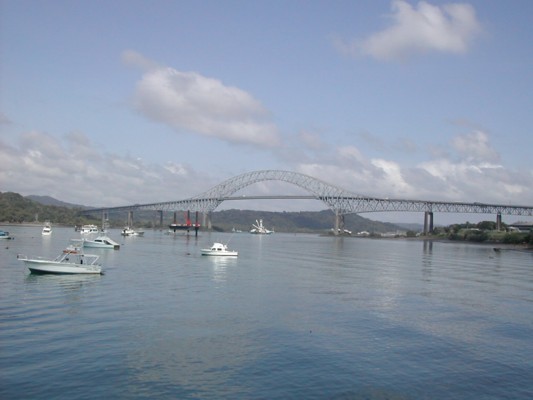
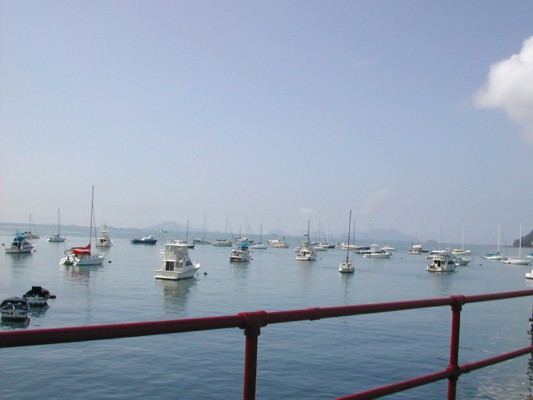
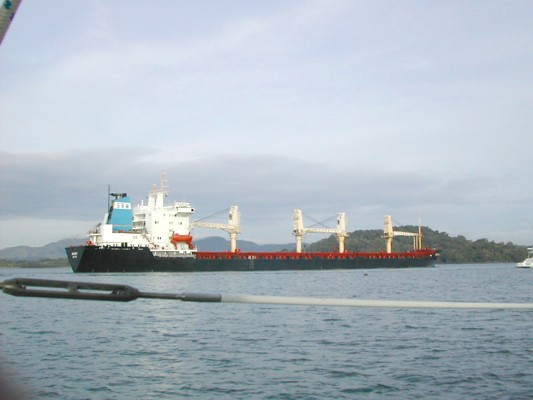
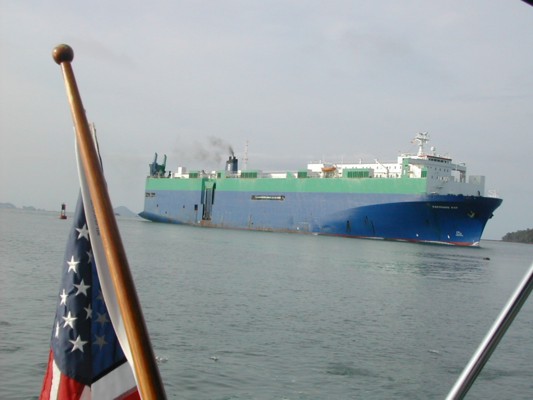
We have thoroughly enjoyed our first couple of days here at the Balboa Yacht Club. It has been fun socializing with other cruisers. The club, being located in the old U.S. Canal Zone, is situated in a lovely park-like setting. And, we couldn�t have asked for a better view. As our mooring at the Balboa Yacht Club is about 100 feet outside the Panama Canal channel markers, ships from all over the world transiting the canal pass just 500 feet away from our boat. From our cockpit, we can also see the Bridge of the Americas � mile away. Watching all the ship traffic pass by has been exciting. Sometimes, the wakes caused by passing boats and ships are annoying, but at least they are short-lived. The pilot boats cause the most wakes with many large ships hardly causing any wakes at all. Before arriving, we had thought that the ship traffic would be continual, but much to our surprise it has been intermittent.
Since arriving in Balboa we have been busy. We �officially� checked into the country and obtained a health clearance, a visa, and a cruising permit. We purchased a new outboard motor. Plus, we completed the entire process necessary to officially schedule our canal transit. This entailed having an admeasurer come to our boat to take �official� measurements and make sure that all the necessary equipment needed was onboard for the canal transit, and then paying for the transit at the bank. Thus, it is now �official.� Barring any unforeseen circumstances, we will be transiting the canal on Sunday, September 14 - exactly one year to the date after we pushed off from Bellingham. For those interested in watching us go through the Miraflores Locks, the canal�s live web cam can be accessed at www.pancanal.com or via a link on our web site.
After transiting the canal, our present plan is to cruise the San Blas Islands before arriving in Cartagena, Colombia, the first part of October. Instead of leaving the boat in Cartagena as originally planned, we have decided to sail the boat back to Florida the first part of November, arriving in St. Petersburg, Florida, no later than the first week in December. As the distance is only about 300 miles more to go through the Yucatan Channel to Florida, we have decided to enjoy our condo during this period before pushing off for the Mediterranean in the spring. |