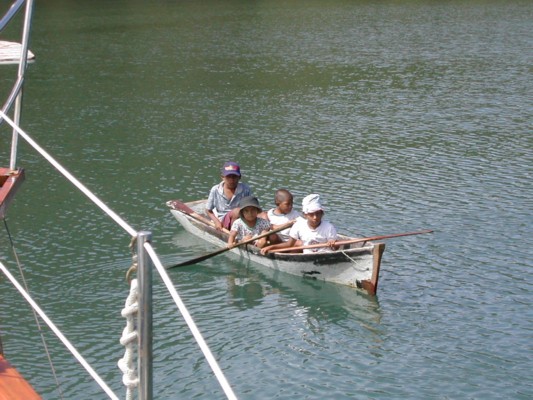
Bahia Honda was a world class anchorage, completely protected, in a beautiful tranquil setting. Mountains surrounded the anchorage and the thick jungle came straight down to the water. In the center of the bay was an island where a small fishing village with very limited supplies was located. The people in this bay were quite isolated as there was no road out to the Pan American Highway, only a horseback trail. Our anchorage was in a secluded cove on the far western part of the bay about 1� miles from the island in the center. Only the sounds of birds, the splash of fish, and the roars of howler monkeys broke the silence.
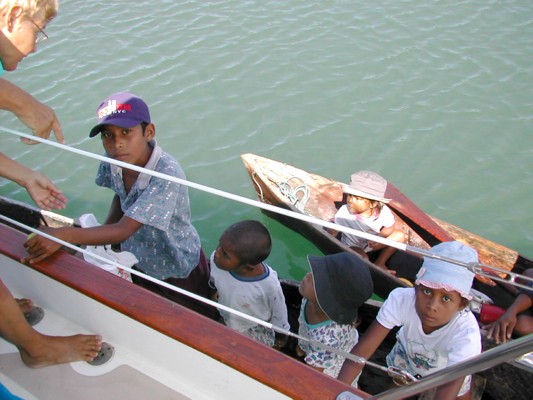
Besides the beautiful surroundings, the people in this bay made this anchorage special. There was Joe Domingo, the bay�s �Welcome Wagon� host, and his son Kennedy. There was Juan, a 68-year-old cruiser who had fallen in love with Domingo�s daughter and so had assimilated into the culture. He was full of so many funny and humorous stories, especially concerning the difficulty of hunting animals in the dense jungle as it was impossible to see anything more than 10 feet ahead. And then, there were the people on the island. Every day one or two dugout canoes came by our boat to visit, some paddled the entire distance and some used small outboards attached to the back of their dugouts. It was amazing that despite my very limited basic Spanish, I was able to carry on a conversation using my Spanish/English dictionary only a few times. Some wanted to trade or sell fruit. One wanted laundry detergent, a school child needed a pen, another needed milk, and a few needed a fishhook. Mostly, though, they all wanted to linger and visit. The last family that came out to our boat gave us a gift of four fresh eggs. These many memories from our days at Bahia Honda will linger with us always.
Around noon, Thursday, August 21, we departed our beautiful anchorage in Bahia Honda and headed to Las Perlas Archipelago in the Gulf of Panama, about 220 miles away. As there weren�t any good anchorages between Bahia Honda and Las Perlas, we decided to do a two-night overnighter instead. Both nights out we had quite a bit of rain. Compared to many cruisers who had traveled this route, though, we felt quite lucky. Often this could be a frustrating sail as weather over Colombia affected at times the Gulf of Panama adversely. For us, most of the time the current and swell were with us, and when there was some wind we were able to sail a reach to a close reach. During our two days transiting we mostly motorsailed, occasionally sailing. Since we often had the current with us, we actually had to slow the boat down our second night out so as not to arrive at Las Perlas Archipelago before sunrise. During these two days we encountered ship traffic at times due to the proximity of the canal, but not as much as we thought we would see. We arrived at Las Perlas Archipelago Saturday, August 23, just as the sun was rising. Countless islets fringed the main islands of the archipelago. With the rising sun, it was a beautiful sight. |