| Before our land trip to Guatemala, we took a walk along a jungle road to see some friendly spider monkeys, and we also visited the Mayan archaeological sites of Joya de Ceren and San Andres. As we traveled along the road to the sites near San Salvador, the damage from both Hurricane Mitch in 1998 and the earthquake in 2001 can still be seen. Joya de Ceren was quite interesting as it had been a small Maya settlement which had been buried under five meters of volcanic ash in 600 AD. The ash from the eruption amazingly preserved the actual structures plus the pottery, tools, and crops of the Mayans at that time. Much excavation work still needs to be done at both sites as research funds in El Salvador are quite limited to almost non-existent. On Friday morning, June 13, we started our land trip to Guatemala and Honduras. We boarded the local bus in Usulutan and headed to San Salvador. Our first bus trip lasted two hours. In San Salvador we transferred to a plush air-conditioned bus for the rest of the trip to Guatemala City, arriving there four hours later. We spent our first night in Guatemala City. All the local buses we experienced during our trip in both El Salvador and Guatemala were quite similar. All had a bus assistant besides the bus driver. He was the most exciting person to watch as he did literally everything except drive the bus. He would lean out the front door of the bus calling the bus� destination to passing people. If someone was interested, he�d quickly jump out, help him or her onto the bus if needed, put any big cargo underneath the bus (in El Salvador) or on top (in Guatemala), and off the bus would go again. Then, when the bus was well on its way, the bus assistant would come down the aisle collecting the fares. Afterwards, each time new people boarded, he�d come down the aisle again but this time jiggling coins in his hand as a way of reminding the new people to pay. At all the bus stops in the different villages and towns along the way, local food vendors from kids to adults would board the bus, call out their products, and then travel down the aisles trying to sell their items. Even now, after our trip, I can still close my eyes and hear all the many, many different sounds we heard along our travels on the local buses. Saturday morning we took the Guatemalan �chicken bus� to the Mayan village, Chichicastenango, in the Guatemalan highlands. As we traveled along the winding roads, it was amazing to see pine trees and experience much cooler temperatures. The change in temperature certainly felt good. On the steep Guatemalan highlands, the Mayas were cultivating almost every bit of usable land. As each individual land plot was rectangular, the total effect was like a patchwork quilt. The ride on the Guatemalan �chicken bus� was definitely quite an experience. These buses were for the most part recycled U.S. school buses and thus smaller than the local buses on which we traveled in El Salvador. Even so, the bus assistant really managed to pack in the people. At the point of our thinking that the bus was full, the bus assistant just kept adding more people. We were packed in like sardines, and believe it or not everyone was seated. No one stood. Seats for two people became seats for three, and because the aisles were so narrow, a grown person could straddle the seats on each side of the aisles. Afterwards, the bus assistant would squeeze by everybody to collect the fares. As people�s cargoes were put on top of the bus, you could hear at times the bus assistant running across the top of the bus when he needed to get something off. 3 � hours later we arrived in Chichicastenango - glad to finally be able to stretch our legs. |
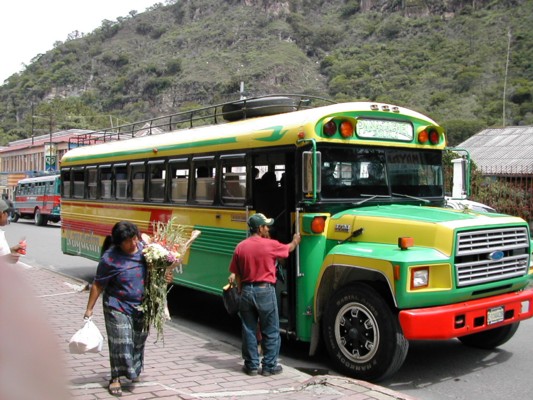 |
| Chicken Bus (Shades of Romancing the Stone) |