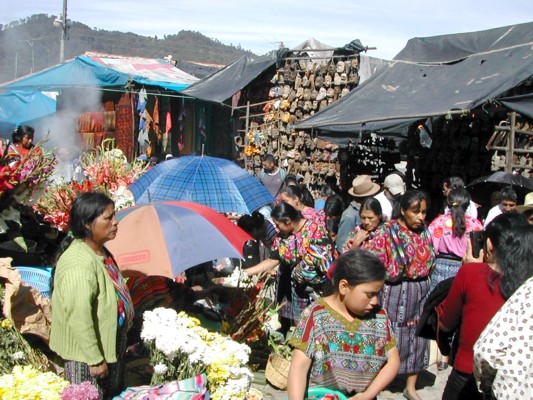
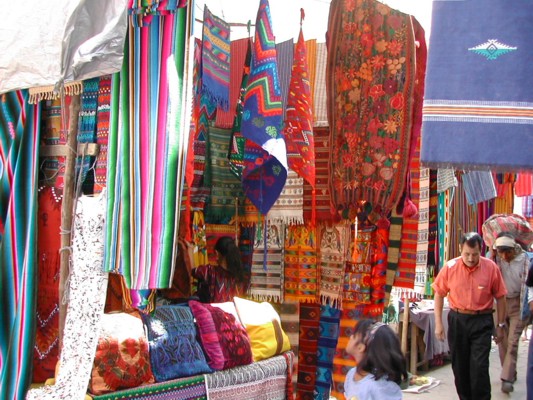
Saturday afternoon in Chichicastenango we hiked up a hill to the Shrine of Pascual Abaj, a Mayan idol that looked like something from Easter Island, although much smaller. In the late afternoon and evening we watched Mayas coming to town carrying their loads and putting up their stalls for the Sunday market. The majority of Mayas in the highlands were shorter than five feet tall. The women carried their loads on their heads, and the men carried their loads on their backs. The embroidered tops (huipiles) that the women wore were just beautiful with their bright and colorful designs. The traditional clothing of each village bore its own unique styles, patterns, and colors. Some villages had such intricate designs that huipiles could take six to nine months to weave. When we went to bed, we thought we had seen everything. On Sunday morning we were stunned to notice the increase in the size of the market. The narrow cobblestone streets directly outside our room, which had been normal streets the day before, were now packed with stalls on both sides - and to think we had heard almost no noise during the entire night.
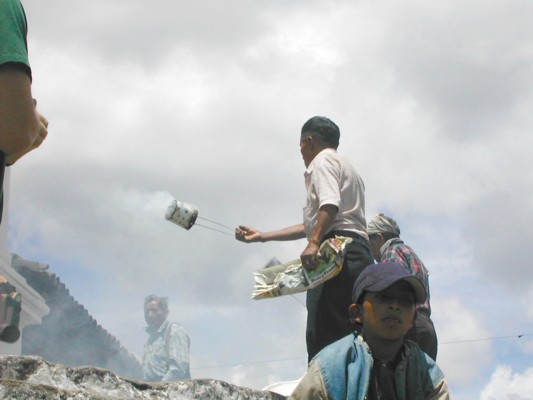
To be in Chichicastenango on a market day and on a Sunday was truly an event that needed to be felt firsthand. So many Mayas were congregated in such a contained area that the multitude of beautiful, colorful clothing worn by the Mayan women was even more awe-inspiring. Besides throngs of people trying to sell their goods around the vicinity of the church, there was also an immense hubbub of religious activity. There were incense burning ceremonies on the lower church steps, and a couple of indigenous prayer leaders were at the top swinging censers (like tin cans poked with holes) containing incense and chanting magic words. Inside the church and along the floor of the center aisle, Mayas were making offerings and lighting and burning candles, the color of the candle representing the nature of the desired request. The church, Iglesia de Santo Tomas, may have once been a Catholic Church during the Spanish days, but it definitely has reverted back to the scene of traditional Mayan religious rituals. |