Saturday morning, September 20, we departed the Chagres River and headed for the San Blas Islands, passing once again Cristobal and the many-anchored ships waiting to transit the Canal. As there was little to no wind, we either motored or motorsailed. It took us 2 days to get to the San Blas Islands. We traveled 35 miles the first day, anchoring Saturday night in Isla Linton just as a rain shower hit. Now that we were anchoring in the Caribbean, a tide variance of only 2 feet had to be taken into account. On Sunday we traveled 50 miles to the Chichime Cays, our first anchorage in the San Blas. Again, the rain showers hit just as we were entering the reef pass into the Chichime Cays and didn�t cease until anchored. So much for timing!
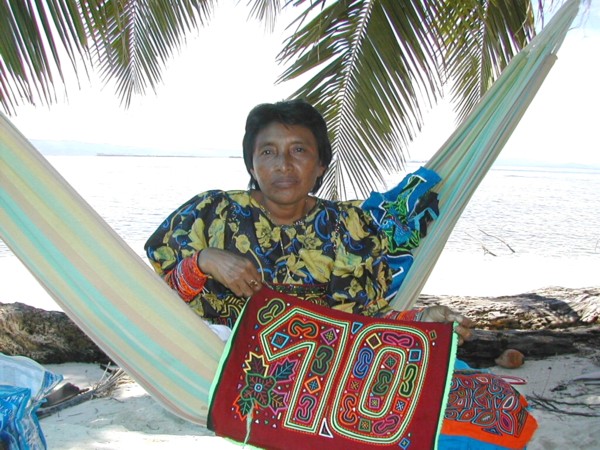
The San Blas Islands where the Chichime Cays are located are the home of the Kunas, one of the indigenous groups of Latin America. Their land encompasses 365 islands and also the mainland mountainous coastal strip that runs the length of the archipelago. Most live either in communities on 48 of the offshore islands or in 9 settlements along the coastal fringe. Since 1938 the Kunas have had almost autonomous rule of their province, Kuna Yala, with only minimal interference from the Panama government. This has enabled them to keep their culture and language intact. The dugout canoe is still the main form of transportation, and the Kunas continue to live in traditional huts, the sides being made from reeds or cane and the thatch roof from palm fronds. The hammock, used as both a chair and a bed, is the main item in most huts. While Kuna men dress western, most Kuna women still wear their traditional dress.
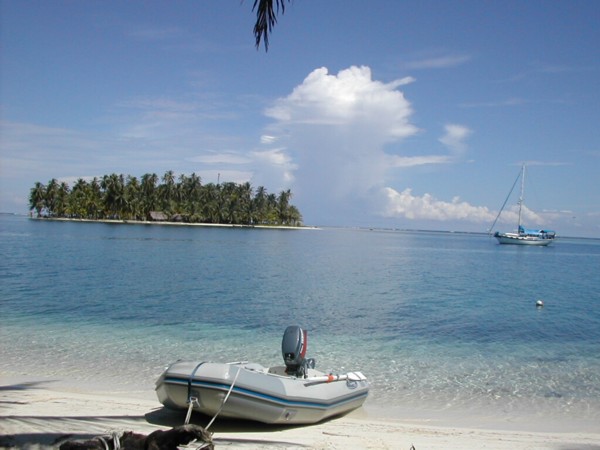
Our first anchorage in the Chichime Cays was idyllic. We anchored in crystal clear water surrounded by two sand cays, each no larger than about the size of a football field, and one very small cay with just a few palm trees. A protective reef mostly encircled these cays, and the sound of the surf against the outer reef could be heard off in the distance. No sooner had we anchored than we were approached by Kuna women paddling out in two dugout canoes wishing to sell their �molas�, the traditional Kuna handicraft. We ended up purchasing a few molas during our stay in Chichime. Also at this anchorage, we were befriended by Eulogio, a Kuna who had gone to college in Walla Walla, Washington. He showed us around and introduced us to some of the Kuna culture and words. He and the other few families at these cays were from the Carti Islands and were staying there to protect and harvest the coconuts. This responsibility was rotated among all the families in the Carti group, with each rotation lasting about 3 months. Once harvested, the coconuts were sold to Colombia. |