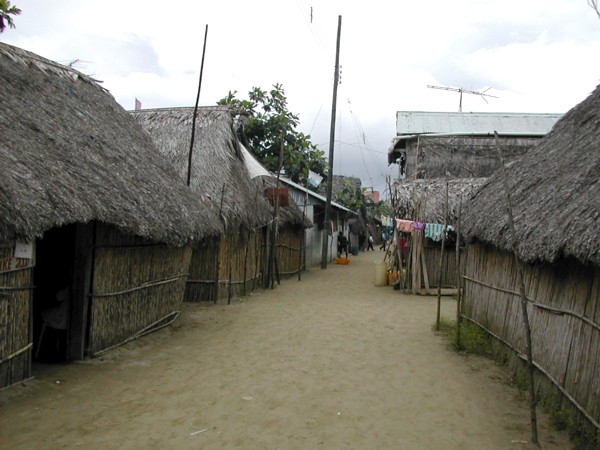
Wednesday morning, September 24, we departed the Chichime Cays and headed to the Carti Islands, about 12 miles away. Eulogio came along as he had invited us to visit his island, Carti Sugtupu. Upon approaching these islands careful navigation was needed as there were quite a few reefs to dodge. All four small islands in this group were so densely populated; each island was totally covered in huts. As the Kuna society was matrilineal, puberty rites for girls were big celebrations. Eulogio had originally invited us to one of these celebrations. Unfortunately, as he was out in Chichime and not in the village, he ended up being told the wrong day. We still had a most delightful afternoon. He showed us around the entire island village. We went inside the large meeting (congreso) hut and the chicha hut where the celebrations took place. The alcoholic drink chicha used in the celebrations was made in the chicha hut from fermented sugar cane juice. We also visited the small Kuna museum and walked by the medical clinic and school. While touring the island, we were especially impressed with its cleanliness. To keep disease down, even an artificial "chicken" island had been created off the islands just for housing the chickens. The Carti islanders through their tribal leaders had voted to purchase a generator with village revenue, and so at 6 p.m. the generator came on, and for six hours the four islands had electricity and the noise from televisions could be heard.
Early Thursday morning while still anchored off of Carti Sugtupu, we watched the men from the islands leave in their canoes, some fishing and others heading to the mainland (about a mile away) to obtain water, gather wood, or farm. Living on the islands and going to the mainland during the day as needed was a way for the Kunas to keep insects and disease at a minimum. After saying goodbye to Eulogio, we departed for the Eastern Holandes Cays, about 20 miles away, once more maneuvering through the reefs. As we had purchased a "Kuna Yala" flag while in Carti Sugtupu, we now flew it alongside the Panama flag.
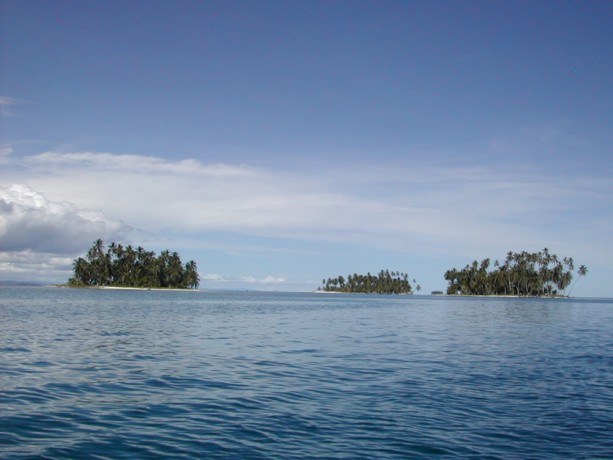
We spent 8 enjoyable days in the Eastern Holandes Cays at an anchorage known as "the swimming pool" because of its clear water and sandy bottom. Unlike the Chichime Cays, these cays were much larger and more numerous. Some were uninhabited; the rest had just a few families living on them. Because of this, only a few dugout canoes came by during our stay trying to sell molas. As mangroves existed on some of the larger cays, "no-see-ums" were a problem when there wasn't any wind, which was the case on a few days. During our travels along the Pacific side of Panama, not many cruising boats had been moving about at this time of year. Once through the canal the increase in the cruising boats was quite noticeable, especially from the eastern United States and Europe. As this anchorage was quite popular, there were already ten other boats anchored when we arrived Thursday afternoon. |