Although we had made a reservation, no one answered on VHF when we called. We circled and circled inside the breakwater, almost 30 minutes, waiting for a space to become available at the reception dock. Then, our engine suddenly quit. This had never happened before, causing us concern as the wind was quickly moving us into some moored boats. We started to drop our anchor when one of the marina boats came alongside to help us. Luckily, we were able to restart our engine. Somehow, the fuel pump had accidentally been turned off. Once alongside the reception dock, we were next startled when a �significant� surge came into the harbor lifting our boat and then smashing our teak caprail in two places against the dock�s permanent fenders. To hear that crunching sound of wood was horrible; all we could do was watch in disbelief. Last, they assigned us a berth between two large powerboats. The heights of our boats were unequal making med-mooring difficult. With the wind blowing 25 knots, it was impossible to fend off one of the powerboats with our size fenders as the wind was pushing us directly into its side. Since his side curved out over our stanchions, a few of our stanchions were bent in the process. By the time we finished mooring, we were physically and mentally exhausted. The next day we purchased four large fenders in case we ever had to come alongside a large powerboat another time while in the Mediterranean.
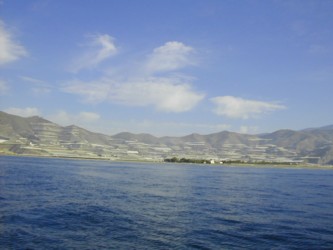
The tourist development at Benalmadena was very impressive. Unfortunately, the winds had now changed back to the east. Surprisingly, west winds were no longer even mentioned in any long term forecast; only easterlies. This meant that the only way to continue our travels was to wait for the winds to become variable and then motor east. Finally on Saturday, May 21, after 4 nights in Benalmadena, we were able to motor 50.2 nautical miles to Motril, anchoring for the night just inside the harbor breakwater. Sunday we motored 37 more nautical miles to Almerimar, arriving just before the winds picked up to 20 knots out of the east. Once leaving Motril, the landscape changed. Now instead of big tourist developments, the coastline was covered with white plastic-covered greenhouses. Most of all northern Europe�s winter crops were grown inside these greenhouses. As this region was covered with miles and miles of white plastic covering, it was referred to often as �Costa de Plastica�. |