We spent 6 nights at Almerimar waiting for weather. Early Saturday morning, May 28, we departed Almerimar. From our weather report the winds were variable, and it looked like we had a window of about 3 days before another NE storm was to hit our area. We felt we could make it to Cartagena, Spain before then.
The most southeastern point of Spain was Cabo de Gata. At times it was difficult to round this cape as two different weather patterns converged here. We motored the 20 nautical miles to Cabo de Gata, but as soon as we rounded the point we were hit with strong northeasterly winds and swell. Even though motoring hard, we couldn�t make any headway and so retreated to the lee of Cabo de Gata and anchored for the night. Late Sunday afternoon we attempted to go around Cabo de Gata a second time. With no wind we made it around the cape, but once on the other side encountered the northeasterly swell. Even though we were able to make headway, it wasn�t much, and so returned to our anchorage in the lee of Cabo de Gata.
With our return to this anchorage, we knew that we were here until after the storm passed. Monday afternoon through Thursday morning gale force winds blew, with one gust maxing out our wind indicator at 60 knots. Lots of sand and salt water blew horizontally across the water onto our boat, and this yellowish sand became embedded everywhere, sticking like cement.
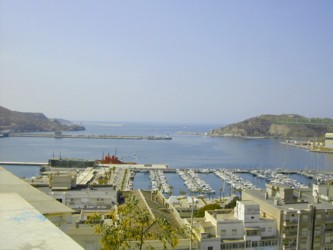
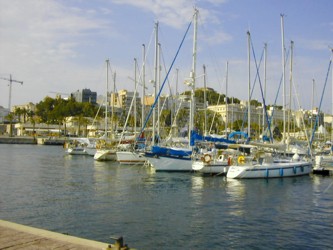
Friday morning, June 3, we finally departed this anchorage and traveled successfully around the cape. With no wind, we motored 55 nautical miles to Aguilas and anchored for the night. Early Saturday morning we motored the rest of the way to Cartagena, 31.5 nautical miles. |