On our way across the Aegean Sea, we wanted to visit the Greek island of Astypalaia, WNW of Rhodes. Our intended route was to sail first north, using the Turkish coastline as a wind buffer, in order to get a better angle on the NW winds before starting westward across the Aegean Sea toward Astypalaia. Although the winds were NW 10 to 15 knots upon leaving Rhodes, the seas were slight. This made for a great morning sail as we tacked our way north. In the shelter of Symi Island, we motored straight north. Making great time, we decided to continue on to the Turkish Datca peninsula, our most northern destination, rather than stop for the night in Symi. Six nautical miles out from our intended anchorage along the peninsula, we were hit by strong 25 knot winds, making those last miles ever so difficult. That evening, we both breathed a huge sigh of relief when we finally dropped the anchor in Kalaboshi, Turkey.
From our weatherman, we found we only had one more good day, if that, before it would be just too difficult to start crossing the Aegean. As we didn�t want to stay at Kalaboshi for possibly four more days, we left early the next morning and started heading westward toward Astypalaia. Luckily, the wind gods cooperated, allowing us to get within 6 nautical miles of the island before hammering us with strong NW winds 25 to 30 knots. Using both sails and engine in order to sail closer into the wind, we forged on, taking quite a bit of water over our decks in the process. A couple of hours later we were anchored in the sheltered harbor at Astypalaia, free of the strong winds. It was an amazing feeling to realize that we had made it to Astypalaia, a distance of 111 nautical miles from Rhodes, in just two days. Before leaving Rhodes a day earlier, we never would have thought that possible. Thank you, wind gods!
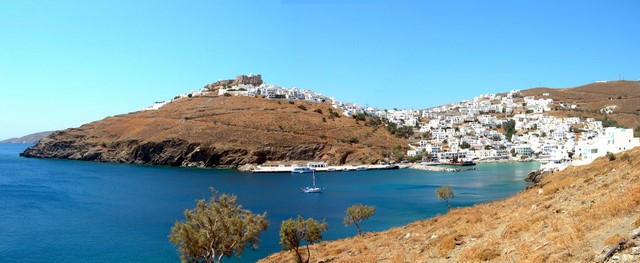
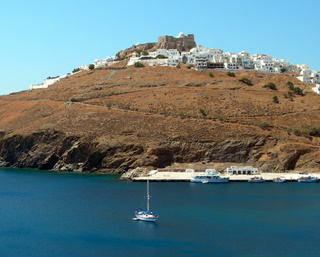
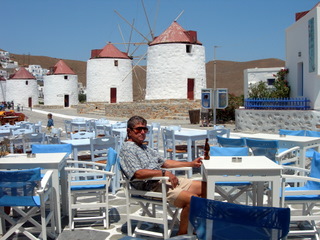
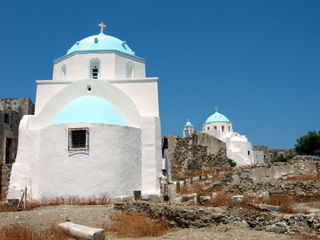
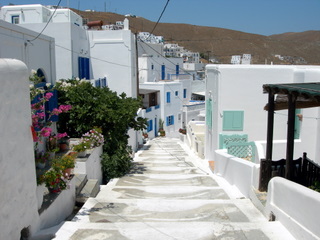
Before leaving the Aegean Greek islands, we wished to enjoy one more typical, picturesque, laid-back Greek island that was off the beaten tourist track. Astypalaia fit that criteria. So for the four days while the wind was blowing strong outside the harbor, we enjoyed the peaceful setting of Astypalaia. We walked up to the Chora (hilltop village) with its windmill square and visited the ruins of the 13th century Venetian castle on top the hill with its two 14th century churches. In the Middle Ages, Astypalaia had flourished when the Venetian Quirini family ruled the island. During that time, most of the population lived within the castle�s walls for protection against piracy, with the houses actually built into the castle�s walls for added protection. |