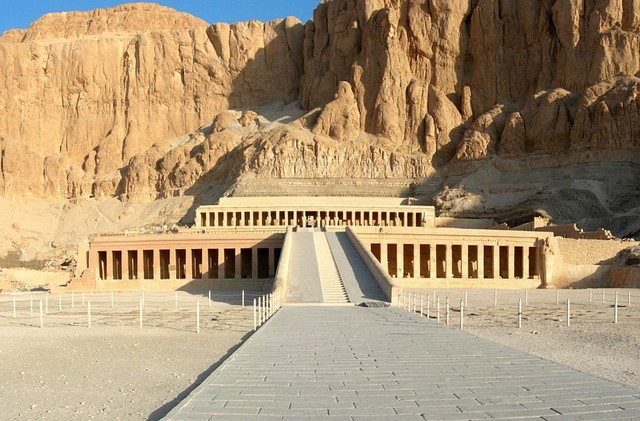
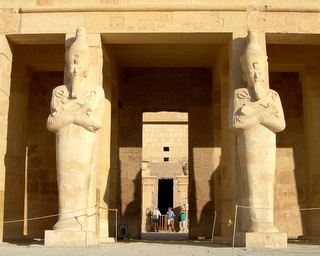
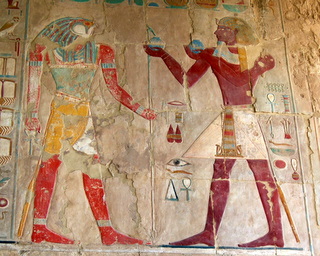
| Afterwards, we visited the restored Mortuary Temple of Queen Hatshepsut with its three grand terraces. Unlike cult temples that were decorated with religious scenes, mortuary temples were decorated with scenes telling about the deceased person�s life. As it was important for each pharaoh to legitimize his claim to be the son of Amun-Ra, Queen Hatshepsut did this by portraying herself in statues as a male king with a false beard and by depicting her divine birth on a wall scene. She also dedicated part of her temple to her father, Tuthmosis I, as a way to legitimize her right to the throne even though she was a woman. In the Chapel of Anubis at her mortuary temple, we captured a scene of Tuthmosis I making offerings to Ra-Harakhty, the god of afterlife, most likely on Hatshepsut�s behalf. |