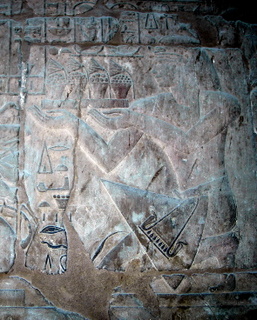
| To ancient Egyptians, the pharaoh was Amun-Ra�s representative on earth. As a result, it was important for each pharaoh to validate his claim to be the son of Amun-Ra. After passing through the hypostyle hall, we entered some smaller rooms, or sanctuaries. One of these sanctuaries had once housed the sacred barge of Amun-Ra. When Alexander the Great became ruler of Egypt in the 4th century BC after driving the Persians out of Egypt, he was recognized by the native Egyptians as a descendent of the pharaohs. To help validate his claim to be the son of Amun-Ra, he rebuilt this sanctuary and redecorated one of its walls with raised reliefs of himself making offerings to Amun-Ra. Thereafter, all subsequent Ptolemaic monarchs used this same tactic of assimilation into the Egyptian culture. Hence, the time during the Ptolemaic Period was generally a peaceful one as the Ptolemies ruled like traditional pharaohs. |